
Technical purpose
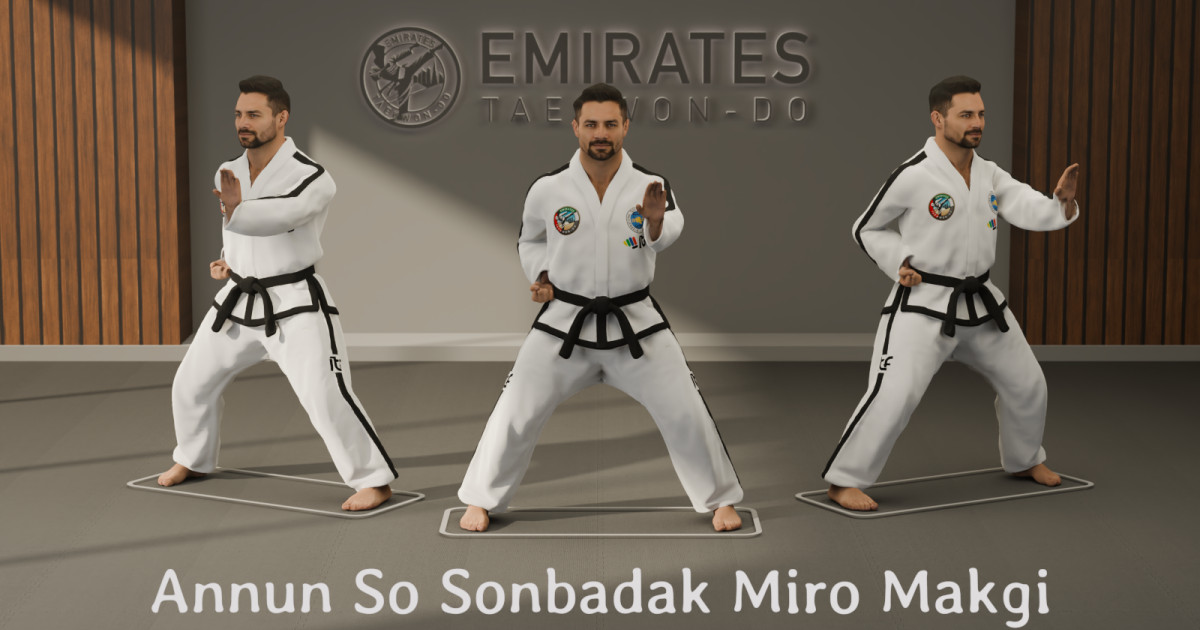
Sitting Stance Palm Pushing Block, called Annun So Sonbadak Miro Makgi in Korean terminology, is an ITF Taekwon-Do defensive technique used to push the opponent off balance. It is performed from Sitting Stance using the palm, or Sonbadak, as the blocking tool.
Pushing Block, or Miro Makgi, is one of the most effective forms for disturbing an opponent's balance. The technique is chiefly performed with the palm, although other tools may occasionally be used in other versions. This article focuses only on the palm version from Sitting Stance.
Key principle
Palm Pushing Block is used to disturb the opponent's balance by pushing against the correct body area, especially the shoulder or bottom area, not by pushing carelessly against the arm.
Technique identity
| Item | Technical reference |
|---|---|
| Technique name | Sitting Stance Palm Pushing Block |
| Korean terminology | Annun So Sonbadak Miro Makgi |
| Short technique name | Sonbadak Miro Makgi |
| Technique family | Blocking technique, or Makgi |
| Block type | Pushing Block, or Miro Makgi |
| Stance | Sitting Stance, or Annun Sogi |
| Blocking tool | Palm, or Sonbadak |
| Main purpose | Put the opponent off balance |
Sitting stance base
| Stance point | Correct standard |
|---|---|
| Width | 1.5 shoulder widths wide |
| Width measuring point | Measured from the inside edges of the big toes |
| Length | No length |
| Foot position | Both feet are even and parallel |
| Foot direction | Both feet point straight forward |
| Weight distribution | 50% on the left leg and 50% on the right leg |
| Knees | Bent outward over the balls of the feet |
Pushing block rules
| Rule | Technical requirement |
|---|---|
| Primary tool | The palm is chiefly used for Pushing Block. |
| Other possible tools | Other versions may occasionally use double forearm, knife-hand, or reverse knife-hand. |
| Main stances | The palm version is mainly executed from Sitting Stance and X-Stance. |
| Occasional stances | Parallel Stance, Close Stance, and Walking Stance may occasionally be used. |
| Correct target area | Execute the block against the shoulder or bottom area. |
| Main tactical effect | Disturb the opponent's balance rather than simply stop the arm. |
How to execute the block
Begin from a correct Sitting Stance. The stance should be wide, stable, and equally weighted. Both feet remain parallel and point straight forward, while both knees are bent outward over the balls of the feet.
Use the palm as the blocking tool. The palm should push into the opponent's structure with enough control to disturb balance. The action should not become a strike, a slap, or a loose arm movement. The purpose is to push the opponent off balance through correct placement and body support.
The block should be executed against the shoulder or bottom area. This point is important. If the block is made against the opponent's arm, it may not be effective because the arm can move without disturbing the opponent's body balance.
Correct target placement
The effectiveness of Miro Makgi depends on where the palm is applied. The encyclopedia reference warns that the block is not effective when it is executed against the arm instead of the shoulder. The shoulder gives a better line for affecting the opponent's body mass and balance.
When the palm pushes the correct area, the opponent's posture can be broken more efficiently. When the palm pushes only the arm, the defender may make contact but fail to disturb the opponent's base. The contact point should therefore be chosen with purpose.
In Sitting Stance, the lower body must remain grounded while the palm pushes. If the stance collapses, narrows, or shifts unevenly, the block loses support and becomes only an arm action.
Reference checklist
| Check | Correct standard |
|---|---|
| Technique | Sitting Stance Palm Pushing Block (Annun So Sonbadak Miro Makgi) |
| Technique family | Blocking technique, or Makgi |
| Block type | Pushing Block, or Miro Makgi |
| Stance | Sitting Stance, or Annun Sogi |
| Blocking tool | Palm, or Sonbadak |
| Purpose | Put the opponent off balance |
| Correct target | Shoulder or bottom area |
| Incorrect target | The arm, when it does not affect the opponent's balance |
| Stance base | Feet parallel, knees bent outward, weight 50% and 50% |
Common technical errors
A common error is pushing against the opponent's arm instead of the shoulder. This may make contact, but it does not reliably put the opponent off balance. The block should be directed to the shoulder or bottom area.
Another error is using the wrong tool. This technique is Sonbadak Miro Makgi, so the palm is the blocking tool. Other tools may be used in other versions of Pushing Block, but they should not replace the palm in this technique.
Students also commonly lose the Sitting Stance while pushing. The stance should remain 1.5 shoulder widths wide, with both feet parallel, both knees bent outward, and weight shared equally between both legs.
Another frequent error is treating the movement like a strike. The objective is not simply impact. The objective is to push the opponent off balance through correct body alignment, correct tool, and correct target placement.