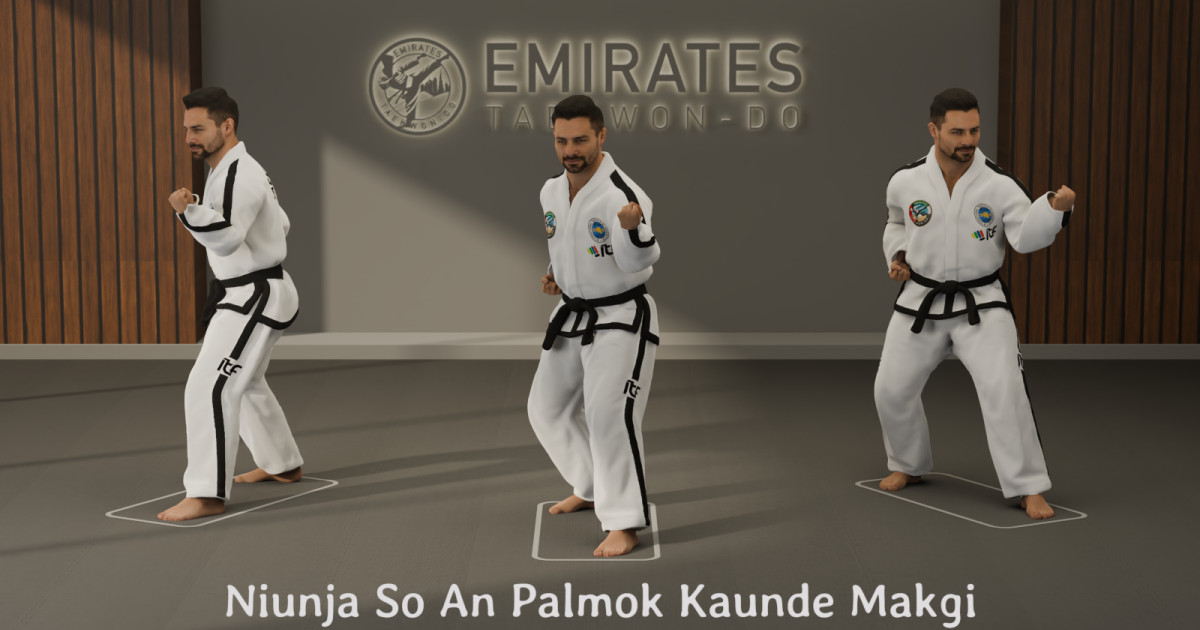

General blocking principles
| Principle | Technical requirement |
|---|---|
| Blocking angle | Keep the blocking arm controlled so the attacking tool is intercepted obliquely. |
| Point of focus | Never extend the blocking tool beyond the point of focus. |
| Shoulder | Lower the shoulder of the blocking arm slightly at the moment of blocking. |
| Withdrawal | With few exceptions, withdraw the blocking tool immediately after contact. |
| Triangle structure | The blocking tool should form a triangle from the contact point upward to the shoulders. |
| Readiness | Maintain a flexible ready posture and remain aware for an immediate counterattack. |
Specific technical points
| Check | Correct standard |
|---|---|
| Blocking tool | Use the inner forearm. |
| Blocking level | Protect the middle section. |
| Shoulders | Keep the shoulders half facing at the moment of the block. |
| Hips | Coordinate the hips with the L-Stance and the half-facing shoulder line. |
| Other fist | Withdraw the opposite fist to the hip in the basic single-arm version. |
| Body posture | Keep the body upright and controlled, without leaning into the block. |
How to execute the block
Begin from a correct L-Stance. The stance should be 1.5 shoulder widths long, measured from the inner foot-sword of the rear foot to the toes of the front foot. The lateral width is minimal, with the heels separated by roughly 1 inch or 2.5 cm. The rear leg carries 70% of the body weight, while the front leg carries 30%.
The block is delivered with the inner forearm. The purpose is to intercept an opponent's attacking tool directed toward the middle section. The blocking tool must not be replaced by the fist, wrist, outer forearm, or upper arm. The name of the technique identifies the required tool: An Palmok, or inner forearm.
At the moment of the block, keep the shoulders in half facing. The body should not finish square to the opponent. The shoulders and hips should coordinate with the stance so the body presents a narrower target while the inner forearm protects the middle line.
The opposite fist is withdrawn to the hip in the basic single-arm version. This withdrawal should be coordinated with the block, not added late. The blocking arm, pulling hand, stance, hips, and shoulders should arrive together at the moment of focus.
Half-facing shoulders in L-stance
The half-facing shoulder position is especially important in L-Stance. Since L-Stance already places most of the body weight on the rear leg and reduces the target area, the shoulders should support that defensive structure. The student should not square the chest fully toward the opponent during the block.
Half-facing shoulders mean the shoulder line is angled while the blocking tool still protects the middle section. This does not mean twisting only the upper body. The hips, stance, and shoulders must work together. If the shoulders turn without the hips, the block becomes disconnected. If the body becomes too square, the stance loses its defensive character.
The correction is simple: keep the L-Stance narrow, keep the weight at 70% on the rear leg and 30% on the front leg, angle the shoulders into half facing, and let the inner forearm protect the middle line without overreaching.
Middle-section protection
The block must protect the middle section. It should not drop into a low-block position or rise into a high-section position. The blocking line should match the level of the attack being intercepted.
The blocking arm must also avoid unnecessary extension. The blocking tool should not pass beyond the point of focus. Overextension weakens the arm, exposes the body, and slows recovery after contact. The block should be compact enough to protect the target and structured enough to intercept the attack obliquely.
After contact, the practitioner should remain ready to withdraw, recover, or counterattack. Defence in Taekwon-Do is not passive. A correct block protects the body and creates the opportunity to respond immediately.
L-stance control
The stance must not change into Walking Stance during the block. L-Stance has a 70% and 30% weight distribution, with most of the body weight on the rear leg. If the student shifts too much weight forward, the stance loses its correct structure and the block becomes less stable.
The feet should keep their correct angles. The rear foot turns 15 degrees inward, and the front foot points 15 degrees inward from the line of attack. If the feet open too much or straighten incorrectly, the knees and hips may lose alignment.
The student should also avoid widening the stance to feel more stable. L-Stance has minimal lateral width. The narrow base, rear-weighted structure, and half-facing shoulders work together to reduce the target area and support the blocking action.
Reference checklist
| Check | Correct standard |
|---|---|
| Technique | L-Stance Inner Forearm Middle Block (Niunja So An Palmok Kaunde Makgi) |
| Technique family | Blocking technique, or Makgi |
| Stance | L-Stance, or Niunja Sogi |
| Blocking tool | Inner forearm |
| Target level | Middle section |
| Weight distribution | 70% rear leg and 30% front leg |
| Facing | Half facing at the moment of the block |
| Shoulders | Shoulder line angled in half facing, not fully square |
| Opposite fist | Withdrawn to the hip in the basic single-arm version |
| Focus | Do not extend the blocking tool beyond the point of focus |
| Posture | Upright, stable, and ready to counterattack |
Common technical errors
A common error is using the wrong blocking surface. This technique requires the inner forearm. If the student makes contact with the fist, wrist, outer forearm, or upper arm, the block no longer matches the required tool.
Another common error is finishing with full-facing shoulders. The shoulders should be half facing at the moment of the block. When the shoulders become too square, the body presents a larger target and the defensive structure of L-Stance is weakened.
Students also often shift too much weight onto the front leg. L-Stance is not a 50% and 50% stance. The rear leg carries 70% of the body weight, and the front leg carries 30%. If the weight becomes equal or forward-heavy, the stance begins to lose its identity.
Another error is allowing the block to drift away from the middle section. A middle block must protect the middle line. If it finishes too low, it no longer covers the intended area. If it finishes too high, it does not match the middle-section reference.
The final error is overextending the blocking arm. The blocking tool should not travel beyond the point of focus. The block should finish with structure, half-facing shoulders, correct L-Stance weight distribution, and readiness for immediate counterattack.
Key principle
The inner forearm middle block must protect the middle section while the body remains in L-Stance, with the shoulders half facing and the weight settled mainly on the rear leg.
Technical purpose
L-Stance Inner Forearm Middle Block, called Niunja So An Palmok Kaunde Makgi in Korean terminology, is an ITF Taekwon-Do defensive technique used to intercept an attack directed toward the middle section. It is performed from L-Stance using the inner forearm as the blocking tool.
The technique must combine three things: a correct L-Stance base, a controlled inner forearm block, and a half-facing body structure. The stance keeps the body narrow and defensive, while the blocking tool protects the middle line. The movement should not be performed as a loose arm action disconnected from the stance.
This article is a technical reference. It focuses on the L-Stance base, inner forearm tool, middle-section protection, half-facing shoulders, opposite-fist withdrawal, and common technical errors.
Technique identity
| Item | Technical reference |
|---|---|
| Technique name | L-Stance Inner Forearm Middle Block |
| Korean terminology | Niunja So An Palmok Kaunde Makgi |
| Technique family | Blocking technique, or Makgi |
| Stance | L-Stance, or Niunja Sogi |
| Blocking tool | Inner forearm, or An Palmok |
| Target area protected | Middle section |
| Body facing | Half facing at the moment of the block |
L-stance base
| Stance point | Requirement |
|---|---|
| Length | 1.5 shoulder widths long |
| Length measuring point | Measured from the inner foot-sword of the rear foot to the toes of the front foot |
| Width | Minimal lateral width, with the heels separated by roughly 1 inch or 2.5 cm |
| Weight distribution | 70% on the rear leg and 30% on the front leg |
| Rear foot | Turns 15 degrees inward |
| Front foot | Points 15 degrees inward from the line of attack |
| Facing | Half facing or reverse half facing as a stance category; this technique uses a half-facing blocking structure |
FAQs for L-Stance Inner Forearm Middle Block
- What is the purpose of the L-Stance Inner Forearm Middle Block?
- How can I improve my L-Stance technique?
- What are the common mistakes when performing Niunja So An Palmok Kaunde Makgi?
Frequently Asked Questions
- What is the purpose of the L-Stance Inner Forearm Middle Block?
- How do I correct common errors in performing this block?
- What are the key principles of L-Stance in Taekwon-Do?