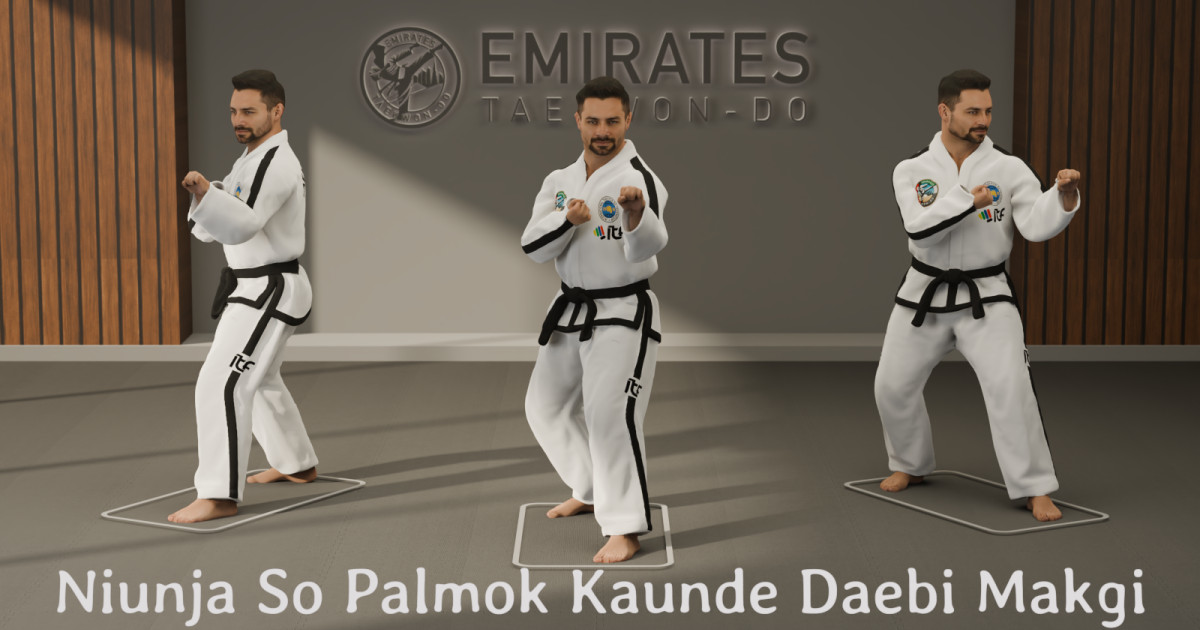

Technical purpose
L-Stance Forearm Guarding Block, called Niunja So Palmok Daebi Makgi in Korean terminology, is an ITF Taekwon-Do defensive technique used to protect the body with a forearm guarding structure while maintaining a half-facing posture. Guarding Block, or Daebi Makgi, is frequently used as a ready posture in free sparring because it allows the practitioner to protect the body with both hands while remaining prepared to move or counterattack.
For forearm guarding blocks, the outer forearm is normally used. The inner forearm may be used in some instances, but all forearm guarding blocks are considered outer forearm guarding blocks unless special directions are given. A critical rule is that the forearm does not perform a low guarding block.
This article is a technical reference for high, middle, and low-section application. High and middle forearm guarding blocks follow the guarding-block rules. Low guarding block is included as an exception because the encyclopedia reference states that the forearm cannot perform a low guarding block.
Key principle
Forearm guarding block protects the body with a half-facing structure, using the outer forearm unless otherwise specified, while the low guarding block is not performed with the forearm.
Technique identity
| Item | Technical reference |
|---|---|
| Technique name | L-Stance Forearm Guarding Block |
| Korean terminology | Niunja So Palmok Daebi Makgi |
| Technique family | Blocking technique, or Makgi |
| Block type | Guarding block, or Daebi Makgi |
| Stance | L-Stance, or Niunja Sogi |
| Normal blocking tool | Outer forearm |
| Special tool option | Inner forearm may be used in some instances when specifically required |
| Body facing | Half facing at all times |
L-stance base
| Stance point | Requirement |
|---|---|
| Length | 1.5 shoulder widths long |
| Length measuring point | Measured from the inner foot-sword of the rear foot to the toes of the front foot |
| Width | Minimal lateral width, with the heels separated by roughly 1 inch or 2.5 cm |
| Weight distribution | 70% on the rear leg and 30% on the front leg |
| Rear foot | Turns 15 degrees inward |
| Front foot | Points 15 degrees inward from the line of attack |
| Facing | Half facing, supporting the guarding structure |
Guarding block rules
| Rule | Technical requirement |
|---|---|
| Blocking tool facing | Keep the blocking tool half facing the target at the moment of blocking. |
| Body facing | Keep the body half facing the target at all times. |
| Opposite guarding hand | Bring the opposite knife-hand or side fist in front of the chest about 3 cm from the body. |
| Guarding quality | The guarding hands should be flexible enough to protect the whole body against an attack. |
| Common stance use | L-Stance and Rear Foot Stance are widely used for guarding blocks, although guarding blocks can be used with other stances. |
High, middle, and low section rules
| Section | Forearm guarding block rule | Main check |
|---|---|---|
| High section | May be used when the required movement is a high forearm guarding block. | Maintain half-facing body posture, keep the guarding hand active, and use the correct forearm tool. |
| Middle section | Standard forearm guarding-block application, normally using the outer forearm unless special directions are given. | The opposite guarding hand remains in front of the chest about 3 cm from the body. |
| Low section | Not performed with the forearm. The reference states that in no case can the forearm perform a low guarding block. | Do not label a low guarding block as a forearm guarding block. |
Forearm tool rules
In a forearm guarding block, the outer forearm is normally used. This means that when the term Palmok Daebi Makgi is used without special direction, the technique should be understood as an outer forearm guarding block.
The inner forearm may be used in some instances, but only when the movement specifically requires it. Students should not freely change the blocking tool from outer forearm to inner forearm unless the pattern, syllabus, or instructor gives that direction.
The most important exception is the low section. A forearm guarding block must not be performed as a low guarding block. This is a clear technical rule. If the movement is a low guarding block, the practitioner should not describe or execute it as a forearm guarding block.
How to execute the technique
Begin from a correct L-Stance. The stance must be narrow, rear-weighted, and stable. The rear leg carries 70% of the body weight, the front leg carries 30%, and the body remains half facing. This stance supports the guarding block by reducing the exposed target area while keeping the practitioner ready to move or counterattack.
Use the forearm as the blocking tool, normally the outer forearm unless special directions state otherwise. The blocking tool must be half facing the target at the moment of blocking. The body must also remain half facing the target at all times.
The opposite guarding hand should be placed in front of the chest about 3 cm from the body. In a forearm guarding block, this will usually be the opposite side fist when that hand shape is required, or the hand form specified by the movement. The guarding hand must remain close enough to protect the center line but flexible enough to respond to the attack.
Do not make the technique stiff. A guarding block is a defensive posture that protects the body and prepares for immediate action. The hands should be organized, the shoulders should remain controlled, and the stance should stay connected to the blocking movement.
Half-facing body line
Half facing is one of the central requirements of Daebi Makgi. The body should remain half facing the target at all times. This reduces the target area and allows both hands to protect the body more effectively.
The blocking tool itself should also be half facing the target at the moment of blocking. This means the forearm is not simply placed in front of the body without structure. The forearm, shoulder line, hips, and stance must work together. The practitioner should not finish full facing, because that presents a larger target and weakens the defensive posture.
The correct feeling is compact and guarded. L-Stance supplies the defensive base, the forearm protects the line of attack, and the opposite guarding hand protects the chest and center line.
High section reference
A high forearm guarding block may be used when the required movement calls for high-section protection. The general guarding-block rules still apply: the body remains half facing, the blocking tool is half facing the target at the moment of blocking, and the opposite guarding hand remains active in front of the body.
The student should not lift the whole posture or lose the L-Stance base when guarding high. The stance remains 70% on the rear leg and 30% on the front leg. The arms adjust to the high-section requirement, but the body should still remain narrow, controlled, and ready for the next action.
Middle section reference
Middle forearm guarding block is the standard reference point for this article. The outer forearm is normally used unless special directions indicate the inner forearm. The opposite guarding hand stays in front of the chest about 3 cm from the body.
The hands should be flexible enough to protect the whole body. If the guarding hand is too far from the chest, the center line becomes exposed. If it is pressed too close or held too rigidly, the guard becomes slow and less useful. The correct position should feel structured but responsive.
Low section exception
The low section is the critical exception in this reference. A forearm guarding block is not used as a low guarding block. The encyclopedia statement is direct: in no case can the forearm perform a low guarding block.
For this reason, a student should not describe a low guarding block as Palmok Daebi Makgi. If a low guarding block is required, the correct blocking tool must be the tool specified for that movement, not the forearm. This distinction protects the technical meaning of both the forearm guarding block and the low guarding block.
Reference checklist
| Check | Correct standard |
|---|---|
| Technique | L-Stance Forearm Guarding Block (Niunja So Palmok Daebi Makgi) |
| Technique family | Blocking technique, or Makgi |
| Block type | Guarding block, or Daebi Makgi |
| Stance | L-Stance, or Niunja Sogi |
| Normal tool | Outer forearm |
| Special tool | Inner forearm only in some instances when specified |
| Low guarding block | Not performed with the forearm |
| Body facing | Half facing at all times |
| Blocking tool facing | Half facing the target at the moment of blocking |
| Opposite guarding hand | In front of the chest about 3 cm from the body |
| Guarding quality | Flexible enough to protect the whole body |
Common technical errors
A common error is using the inner forearm when the movement has not specified it. Forearm guarding blocks are normally considered outer forearm guarding blocks unless special directions are given. The student should not change the tool casually.
Another error is trying to perform a low guarding block with the forearm. This is not correct in this reference. The forearm cannot perform a low guarding block. Low-section guarding must use the correct tool required by that movement, not the forearm.
Students also commonly lose the half-facing posture. The body should remain half facing the target at all times, and the blocking tool should be half facing the target at the moment of blocking. Becoming full facing presents more target area and weakens the guarding structure.
Another frequent error is moving the opposite guarding hand too far from the body. The opposite knife-hand or side fist should be in front of the chest about 3 cm from the body. If it drifts away, the center line opens. If it presses too tightly, the hands become rigid and slow.
The final error is allowing the L-Stance to collapse into another stance. The stance must remain rear-weighted, narrow, and measured. The 70% rear-leg and 30% front-leg weight distribution supports the defensive structure of the block.