
Technical purpose
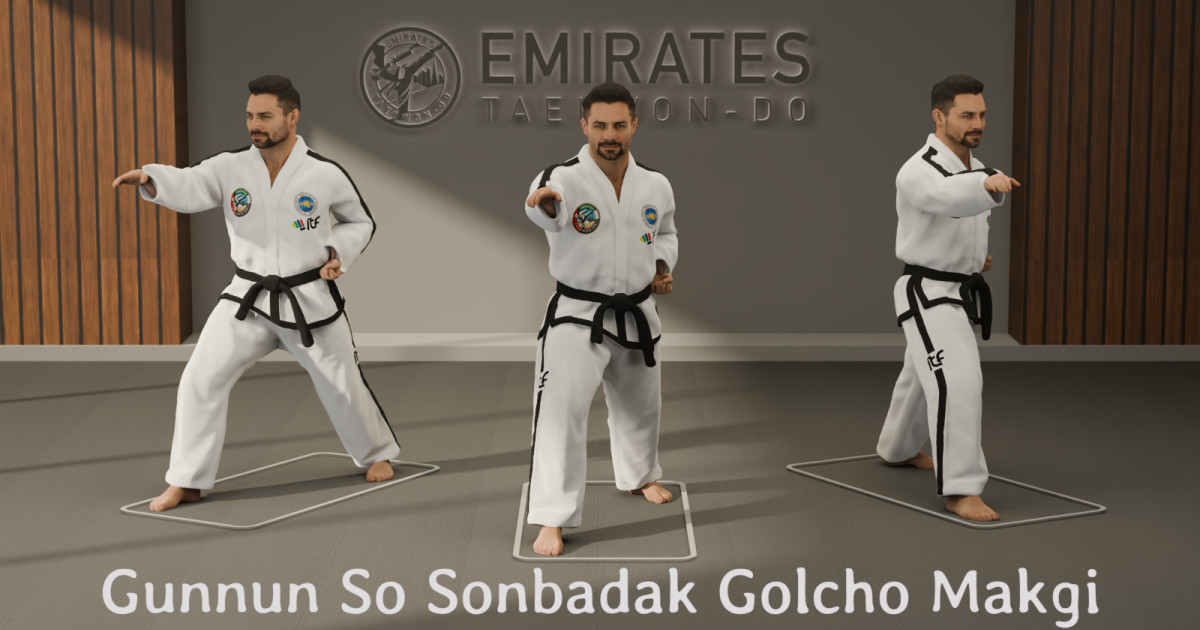
Walking Stance Palm Hooking Block, called Gunnun So Sonbadak Golcho Makgi in Korean terminology, is an ITF Taekwon-Do defensive technique performed from Walking Stance using the palm as the blocking tool. It belongs to the hooking block family, called Golcho Makgi.
Unlike many other blocking methods, Hooking Block requires a minimum amount of effort from the defender when performed correctly. It allows the opposite hand or the foot to respond immediately with a counterattack. The technique is not simply a stopping block; it places the blocking tool in a position where the opponent's attacking limb can be controlled, redirected, or followed by a grab.
This article is a technical reference. It focuses on the Walking Stance base, palm blocking tool, arc motion, outside and inside application, elbow angle, wrist position, target placement, counterattack readiness, and common technical errors.
Key principle
The palm hooking block reaches the target in an arc, places the palm on the opponent's attacking limb, and leaves the opposite hand or foot ready for immediate counterattack.
Technique identity
| Item | Technical reference |
|---|---|
| Technique name | Walking Stance Palm Hooking Block |
| Korean terminology | Gunnun So Sonbadak Golcho Makgi |
| Short technique name | Sonbadak Golcho Makgi |
| Technique family | Blocking technique, or Makgi |
| Block type | Hooking Block, or Golcho Makgi |
| Stance | Walking Stance, or Gunnun Sogi |
| Blocking tool | Palm, or Sonbadak |
| Main tactical value | Controls or redirects the attack while allowing immediate counterattack |
Walking stance base
| Stance point | Requirement |
|---|---|
| Length | 1.5 shoulder widths, measured from big toe to big toe |
| Width | 1 shoulder width, measured from the centers of the insteps |
| Weight distribution | 50% on the front leg and 50% on the rear leg |
| Front foot | Points straight forward |
| Rear foot | Turns 25 degrees outward |
| Front knee | Bent so the kneecap drops in a vertical line with the heel |
Main technical rules
| Rule | Technical requirement |
|---|---|
| Tool preference | The palm is usually the most effective tool for Hooking Block. |
| Other possible tools | Hooking Block may occasionally be performed with the outer forearm, knife-hand, or back hand. |
| Common stance | Walking Stance is commonly used, although the technique can be used in nearly all stances. |
| Tool path | The blocking tool must reach the target in an arc. |
| Contact placement | The tool should be properly placed on the opponent's back forearm or outer tibia. |
| Elbow position | Keep the elbow bent about 25 degrees outward at the moment of the block. |
| Wrist position | Keep the wrist slightly inward at the moment of the block. |
| Counterattack readiness | The opposite hand or the foot should be ready for an immediate response. |
How to execute the block
Begin from a correct Walking Stance. The stance should be stable, measured, and equally weighted. The front knee is bent, the rear foot is grounded, and the body remains ready to respond immediately after the block.
The palm travels toward the attacking limb in an arc. This arc is essential. The purpose is not to smash directly into the attack with excessive force. The palm should arrive in a position where it can hook, control, or redirect the opponent's attacking tool.
At the moment of the block, the elbow is bent about 25 degrees outward, and the wrist is kept slightly inward. This shape helps the palm make useful contact and increases the chance of a successful grab or control action.
The palm should be placed on the opponent's back forearm or outer tibia, depending on whether the attack is made with the hand or the foot. The block should not be performed as a loose slap or a flat push. It must reach the target with a controlled hooking shape.
Palm as the blocking tool
The palm, or Sonbadak, is usually the most effective tool for Hooking Block because it increases the chances of making a successful grab. This is one of the practical reasons the palm is preferred over harder or narrower tools in many hooking-block applications.
The palm should not be tense or rigid before contact. It must be organized enough to block, but flexible enough to control the opponent's limb after contact. The movement should allow the practitioner to hook, catch, redirect, or prepare a counterattack.
Although Hooking Block may occasionally be performed with the outer forearm, knife-hand, or back hand, this article focuses only on the palm version. The name Sonbadak Golcho Makgi identifies the palm as the required tool.
Inside and outside hooking
Hooking Block may be performed as an inside block or an outside block. The inside version can be used, but the outside version can better ensure the blocking of the opponent's other free hand. This makes the outside application tactically important when the defender must manage both the attacking limb and the opponent's ability to continue attacking.
The student should not think only about stopping the first attack. The value of Hooking Block is that it can reduce the effort needed for defence while creating an immediate chance to counterattack. The opposite hand or foot should remain available.
In Walking Stance, the body must stay stable enough to support this follow-up action. If the stance collapses, the block may still touch the opponent's limb, but the defender will not be ready to counter effectively.
Target placement
| Opponent's attacking tool | Hooking block placement |
|---|---|
| Hand or arm attack | Place the palm on the opponent's back forearm. |
| Foot or leg attack | Place the palm on the opponent's outer tibia. |
| Follow-up option | Use the opposite hand or the foot for immediate counterattack. |
| Control objective | Redirect, hook, or prepare to grab rather than collide with unnecessary force. |
Arc motion and counterattack
The blocking tool must reach the target in an arc. A straight push does not express the correct hooking action. The arc allows the palm to arrive in a position where it can be placed on the opponent's limb and used for control.
Because the block requires relatively little effort when performed correctly, the defender should not overcommit the whole body into the block. The opposite hand or the foot should remain ready for an immediate counterattack. This is one of the defining advantages of Golcho Makgi.
The technique can also lead naturally into twisting or controlling actions after the block. However, the first requirement is correct placement. Without correct palm placement, the follow-up grab or control action becomes unreliable.
Reference checklist
| Check | Correct standard |
|---|---|
| Technique | Walking Stance Palm Hooking Block (Gunnun So Sonbadak Golcho Makgi) |
| Technique family | Blocking technique, or Makgi |
| Block type | Hooking Block, or Golcho Makgi |
| Stance | Walking Stance, or Gunnun Sogi |
| Blocking tool | Palm, or Sonbadak |
| Tool path | Arc motion to the target |
| Hand attack placement | Opponent's back forearm |
| Foot attack placement | Opponent's outer tibia |
| Elbow | Bent about 25 degrees outward |
| Wrist | Slightly inward at the moment of the block |
| Main tactical advantage | Allows immediate response with the opposite hand or foot |
Common technical errors
A common error is pushing straight into the attack instead of reaching the target in an arc. Hooking Block must travel in an arc so the palm can be placed properly on the opponent's back forearm or outer tibia.
Another error is using excessive force. The encyclopedia reference explains that Hooking Block requires a minimum amount of effort compared with other blocking methods. If the defender overpowers the movement, the block can become slow and may prevent a fast counterattack.
Students also commonly use the wrong tool. This article is for Sonbadak Golcho Makgi, so the palm is the blocking tool. The outer forearm, knife-hand, or back hand may be used occasionally in other versions, but they should not replace the palm in this technique.
Another frequent error is losing the elbow and wrist shape. The elbow should be bent about 25 degrees outward, and the wrist should be slightly inward at the moment of the block. If the elbow is too straight or the wrist is flat and inactive, the palm may fail to hook or prepare a grab.
The final error is forgetting the counterattack. Hooking Block is useful because it allows the opposite hand or the foot to respond immediately. A correct block should leave the body balanced, the stance stable, and the defender ready to continue without delay.