
High block reference
| High block point | Technical requirement |
|---|---|
| Purpose | Intercept an opponent's attacking tool directed toward the neck or points above. |
| Common targets protected | Philtrum, temple, neck artery, face, and other high-line targets. |
| High-block level | When the fist or fingertip reaches the same level as the defender's eyes at the moment of block, the block is called high block. |
| Philtrum reference | If the philtrum is attacked, the fist or fingertip reaches exactly the same level as the eyes. |
| Triangle principle | The blocking tool forms a triangle with the shoulders at the moment of the block. |
| Tool options in high block | High block may be performed with several tools, including forearm, knife-hand, reverse knife-hand, palm, side fist, back hand, and double forearm. |
Side block reference
| Side block point | Technical requirement |
|---|---|
| Definition | When the body is half facing or side facing the opponent at the moment of the block, the technique is called a side block. |
| This Walking Stance version | Use half facing shoulders and body at the moment of the block. |
| Tool focus | The blocking tool is focused toward the center of the defender's shoulders. |
| Short focus error | If the block is focused too short of the target, it becomes weak and can be deflected by a strong punch or kick. |
| Over-focus error | If the block is focused beyond the defender's body, it creates exposure. |
| Direction | Side block may be executed toward different directions as required by the movement. |
How to execute the block
Begin from a correct Walking Stance. The stance should be 1.5 shoulder widths long and 1 shoulder width wide. The front knee is bent, the rear foot is stable, and the body weight is shared equally between the front and rear legs.
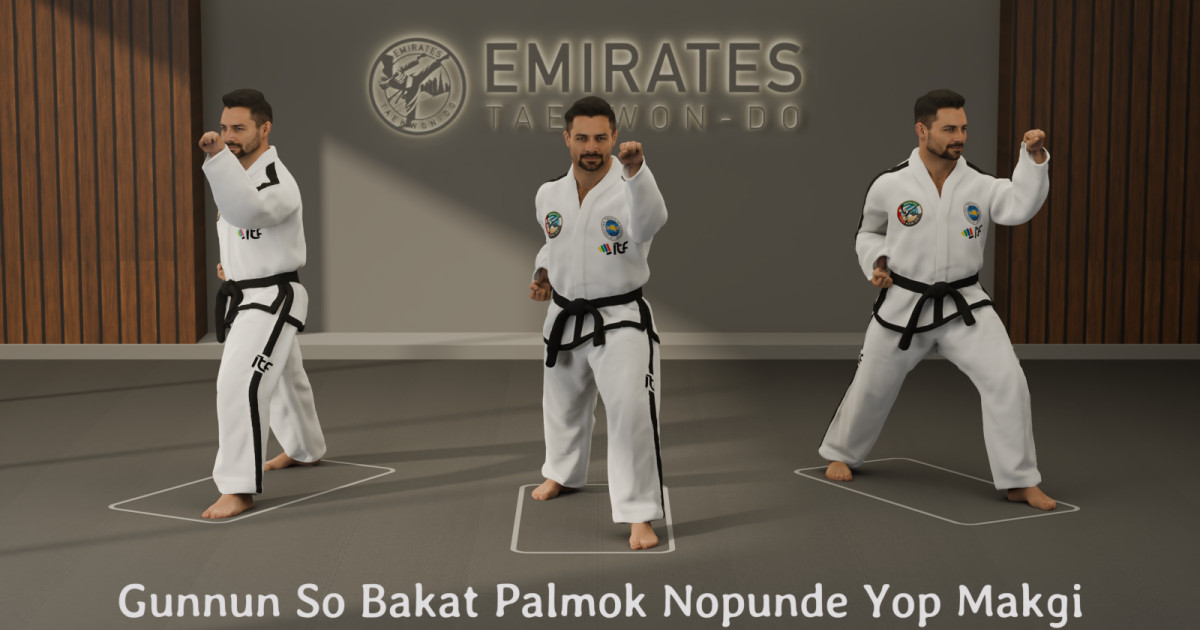
The block is delivered with the outer forearm, called Bakat Palmok. The purpose is to intercept an attack directed to the high section. Depending on the application, the block may protect against an attack toward the philtrum, temple, neck artery, or another high-line target.
At the moment of the block, the shoulders should be half facing. This half-facing line is what gives the movement its side-block character in Walking Stance. The body should not become full facing, because the technique is not a front block. The body should also not turn away so far that the target cannot be seen or controlled.
The blocking tool must be focused correctly. It should not stop short of the target, and it should not pass beyond the defender's body. The tool should connect to the shoulder line so that the block forms a clear triangle with the shoulders at the moment of impact.
Half-facing shoulders
Half-facing shoulders are a key requirement in this Walking Stance side block. The shoulders should be angled at the moment of the block, not squared fully toward the opponent. This reduces the target area and supports the side-block structure.
The half-facing shoulder line must be connected to the stance and hips. The student should not twist only the upper body while the lower body remains disconnected. Walking Stance provides the base, the hips organize the facing, and the shoulders align the block with the target.
The correction is simple: keep the Walking Stance measured, keep the body upright, turn into half facing, and place the outer forearm on the correct high-side blocking line without overreaching.
High-section protection
The block protects the high section. In high block terminology, the fist or fingertip reference reaches the same level as the defender's eyes at the moment of the block. This is especially clear when the attack is directed toward the philtrum.
The outer forearm must protect the line of the attack without drifting too low. If the blocking tool drops below the high line, the face, temple, or neck area may remain exposed. If the blocking tool lifts too high or travels too far outward, the block may lose its connection to the center of the shoulders.
The block should intercept the attacking tool at the useful line of contact. It should not be a decorative high arm position. The final shape should show a practical defence against a high-line attack, with the outer forearm structured, the shoulders half facing, and the stance stable.
Focus and exposure
The side block must be focused toward the center of the defender's shoulders. This is an important technical point because it defines how far the block should travel. A block that stops too short can be weak and easily deflected. A block that passes too far beyond the defender's body creates an opening.
The student should not chase the attack with the arm. The body, shoulder line, and blocking tool should arrive together. The outer forearm should meet the attack with structure, not with an uncontrolled swing.
The triangle principle should also be visible. The blocking tool forms a triangle with the shoulders at the moment of the block. This same principle applies to middle and low blocks, but in this article the block is specifically high section and side oriented.
Reference checklist
| Check | Correct standard |
|---|---|
| Technique | Walking Stance Outer Forearm High Side Block (Gunnun So Bakat Palmok Nopunde Yop Makgi) |
| Technique family | Blocking technique, or Makgi |
| Block type | High Side Block, or Nopunde Yop Makgi |
| Stance | Walking Stance, or Gunnun Sogi |
| Blocking tool | Outer forearm, or Bakat Palmok |
| Target level | High section, or Nopunde |
| Targets protected | Neck, philtrum, temple, face, and points above |
| Facing | Half facing at the moment of the block |
| Shoulders | Half facing, not full facing |
| Tool focus | Focused toward the center of the defender's shoulders |
| Structure | Blocking tool forms a triangle with the shoulders |
| Error to avoid | Do not stop short and do not pass beyond the defender's body |
Common technical errors
A common error is finishing full facing. In this Walking Stance side block, the shoulders should be half facing at the moment of the block. If the body becomes full facing, the technique loses its side-block character and exposes more of the body.
Another error is focusing the block too short of the target. A block that stops short becomes weak and can be deflected by a strong punch or kick. The block must reach the correct line of contact.
The opposite error is allowing the blocking tool to pass beyond the defender's body. This creates exposure and leaves a vital target open. The block should be focused toward the center of the defender's shoulders, not beyond the body.
Students also commonly let the blocking tool drift away from the high line. Since this is a high block, the defence must protect the neck, face, temple, philtrum, or points above. If the arm finishes too low, the high target remains open.
The final error is disconnecting the arm from the stance. The outer forearm, shoulders, hips, and Walking Stance must finish together. A correct block should be measured, half facing, focused, and ready for immediate counterattack.
Key principle
The outer forearm high side block protects the high line while the body stays half facing and the blocking tool is focused toward the center of the defender's shoulders.
Technical purpose
Walking Stance Outer Forearm High Side Block, called Gunnun So Bakat Palmok Nopunde Yop Makgi in Korean terminology, is an ITF Taekwon-Do defensive technique used to intercept an attack directed toward the neck, face, temple, philtrum, or another high-line target.
The technique combines three specific references: Walking Stance, outer forearm, and high side block. The stance gives the base, the outer forearm is the blocking tool, and the side-block structure requires the body to be half facing or side facing at the moment of the block. In this Walking Stance version, the shoulders should be half facing at the moment of the block.
This article is a technical reference. It focuses on the Walking Stance base, outer forearm tool, high-section blocking line, half-facing shoulders, side-block focus, point of contact, and common technical errors.
Technique identity
| Item | Technical reference |
|---|---|
| Technique name | Walking Stance Outer Forearm High Side Block |
| Korean terminology | Gunnun So Bakat Palmok Nopunde Yop Makgi |
| Short technique name | Bakat Palmok Nopunde Yop Makgi |
| Technique family | Blocking technique, or Makgi |
| Block type | High Side Block, or Nopunde Yop Makgi |
| Stance | Walking Stance, or Gunnun Sogi |
| Blocking tool | Outer forearm, or Bakat Palmok |
| Target level | High section, or Nopunde |
| Body facing | Half facing at the moment of the block |
Walking stance base
| Stance point | Requirement |
|---|---|
| Length | 1.5 shoulder widths, measured from big toe to big toe |
| Width | 1 shoulder width, measured from the centers of the insteps |
| Weight distribution | 50% on the front leg and 50% on the rear leg |
| Front foot | Points straight forward |
| Rear foot | Turns 25 degrees outward |
| Front knee | Bent so the kneecap drops in a vertical line with the heel |
| Facing for this technique | Half facing shoulders and body at the moment of the side block |