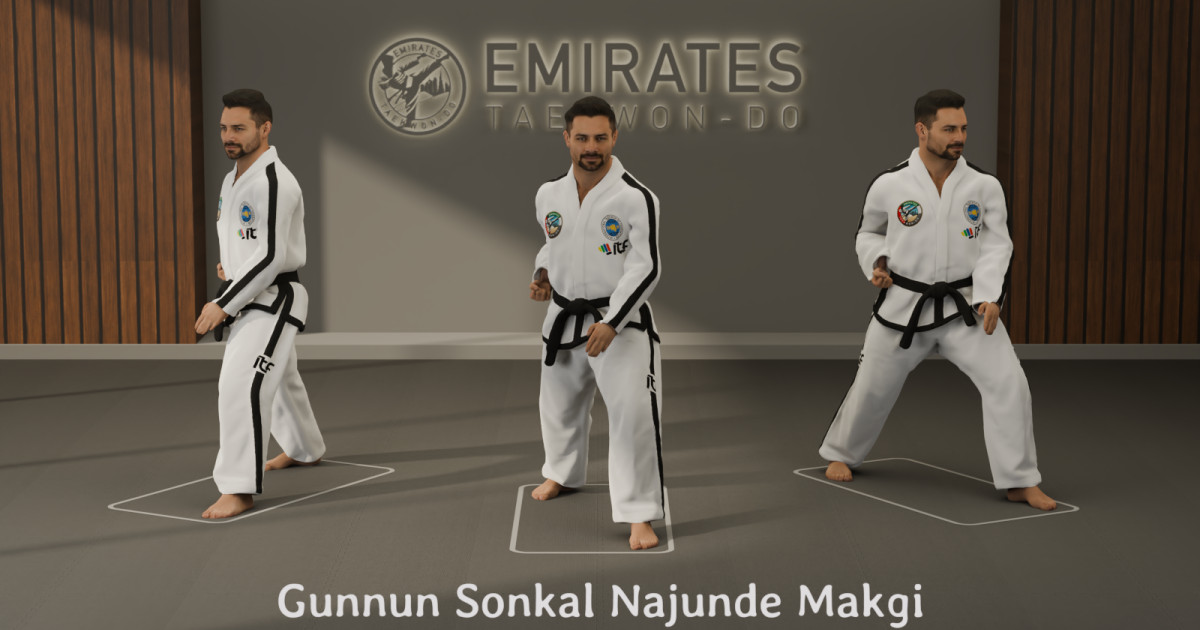

Low block purpose
| Point | Technical requirement |
|---|---|
| Purpose | Intercept an opponent's attacking foot or hand directed toward the lower abdomen or below. |
| Level of contact | The blocking tool should make impact at the same level as the target area. |
| Recognized low-block tools | Low block may be performed with tools including the outer forearm, knife-hand, reverse knife-hand, palm, and side sole. |
| This technique | Uses the knife-hand as the blocking tool. |
| Main protection | The lower abdomen and low line of the body must remain covered. |
General blocking principles
| Principle | Technical requirement |
|---|---|
| Arm angle | Keep the arm bent between 15 and 45 degrees so the attacking tool is intercepted obliquely. |
| Point of focus | Never extend the blocking tool beyond the point of focus. |
| Shoulder | Lower the shoulder of the blocking arm slightly at the moment of blocking. |
| Withdrawal | With few exceptions, withdraw the blocking tool immediately after contact. |
| Triangle shape | The blocking tool should form a triangle from the contact point upward to the shoulders. |
| Readiness | Maintain a flexible ready posture and remain aware for an immediate counterattack. |
How to execute the block
Begin from a correct Walking Stance. The stance must be stable before the block is judged. The front knee is bent, the rear foot is grounded, the stance keeps its correct width and length, and the body weight remains equally distributed between the front and rear legs.
The block is delivered with the knife-hand. The purpose is to intercept an opponent's attacking hand or foot directed toward the lower abdomen or points below. The blocking tool should meet the attack at the same level as the target area. The block should not chase the attack too far outward or extend beyond the point of focus.
At the moment of blocking, the arm should remain bent enough to intercept the attack obliquely. The shoulder of the blocking arm lowers slightly, and the body should remain organized for immediate recovery or counterattack. The movement should protect the lower line without becoming stiff, exaggerated, or disconnected from the stance.
Knife-hand tool
The defining feature of this technique is the use of the knife-hand as the blocking tool. The student should not replace it with the outer forearm, side fist, upper arm, or any other surface. The name of the technique identifies the tool: Sonkal, or knife-hand.
The knife-hand must be directed into the low block with a clear defensive purpose. It is not simply an arm swing. The tool must protect the lower abdomen or points below by meeting the attacking tool at the proper level. If the hand position is careless, the low line can remain exposed even when the movement appears large.
The arm should not be overextended. A low block must keep enough bend to intercept the attack obliquely and maintain structural protection. Extending beyond the focus point weakens the block and can expose the body.
Facing and body posture
Defensive movement in ITF Taekwon-Do normally emphasizes half-facing posture during movement toward and away from an opponent, with a few exceptions. For Walking Stance Knife-Hand Low Block, the body should be organized so the lower abdomen remains protected and the blocking line is clear.
The practitioner should not turn so fully square that the body becomes unnecessarily exposed. The stance, hips, shoulders, and knife-hand must work together. The student should also avoid turning away so far that it becomes difficult to see the target or control the attack.
The back should remain upright and controlled. The block should not be produced by leaning forward, collapsing the shoulder, or throwing the arm away from the body. Correct posture allows the block to protect the low line while keeping the practitioner ready to move or counterattack.
Reference checklist
| Check | Correct standard |
|---|---|
| Technique | Walking Stance Knife-Hand Low Block (Gunnun So Sonkal Najunde Makgi) |
| Technique family | Blocking technique, or Makgi |
| Stance | Walking Stance |
| Blocking tool | Knife-hand |
| Purpose | Intercept an attack toward the lower abdomen or below |
| Contact level | Same level as the target area |
| Arm principle | Arm bent 15 to 45 degrees to intercept obliquely |
| Focus | Do not extend the blocking tool beyond the point of focus |
| Shoulder | Lower the blocking-side shoulder slightly at impact |
| Recovery | Withdraw the blocking tool immediately after contact, with few exceptions |
Common technical errors
A common error is using the wrong blocking surface. This technique is a knife-hand low block, so the blocking tool must be the knife-hand. If the student makes contact with the forearm, side fist, or upper arm, the technique no longer matches its required tool.
Another common error is allowing the lower abdomen to become exposed. A low block must protect the low line. If the movement opens the body, travels in the wrong direction, or fails to meet the attacking tool at the target level, the block is not fulfilling its purpose.
Students should also avoid overextending the arm. The blocking tool must not go beyond the point of focus. Overextension can weaken the shoulder, expose the body, and make immediate recovery difficult. The arm should remain bent enough to intercept the attack obliquely.
Another error is becoming too square or too turned away. If the body becomes unnecessarily full facing, the lower abdomen can be exposed. If the body turns too far away, the student may lose sight of the target or expose the armpit. The body should remain controlled, defensive, and ready to counterattack.
The final error is treating the stance as secondary. Walking Stance must remain measured, stable, and equally weighted. A correct knife-hand low block depends on both the blocking tool and the stance that supports it.
Key principle
The knife-hand low block must protect the lower line with the correct blocking tool, without overextending beyond the point of focus or exposing the lower abdomen.
Technical purpose
Walking Stance Knife-Hand Low Block, called Gunnun So Sonkal Najunde Makgi in Korean terminology, is an ITF Taekwon-Do defensive technique used to intercept an attack directed toward the lower abdomen or points below. It is a low block performed from Walking Stance using the knife-hand as the blocking tool.
Low Block, or Najunde Makgi, is used against an opponent's attacking foot or hand when the attack is directed low. The blocking tool should make impact at the same level as the target area. In this technique, the correct blocking tool is not the forearm or fist; it is the knife-hand.
This article is a technical reference. It focuses on the Walking Stance base, low-block purpose, knife-hand tool, half-facing defensive posture, blocking principles, and common technical errors.
Technique identity
| Item | Technical reference |
|---|---|
| Technique name | Walking Stance Knife-Hand Low Block |
| Korean terminology | Gunnun So Sonkal Najunde Makgi |
| Technique family | Blocking technique, or Makgi |
| Stance | Walking Stance |
| Blocking tool | Knife-hand |
| Target area protected | Lower abdomen or points below |
| Attack intercepted | An opponent's attacking foot or hand directed low |
Walking stance base
| Stance point | Requirement |
|---|---|
| Length | 1.5 shoulder widths, measured from big toe to big toe |
| Width | 1 shoulder width, measured from the centers of the insteps |
| Weight distribution | 50% on the front leg and 50% on the rear leg |
| Front foot | Points straight forward |
| Rear foot | Turns 25 degrees outward |
| Front knee | Bent so the kneecap drops in a vertical line with the heel |