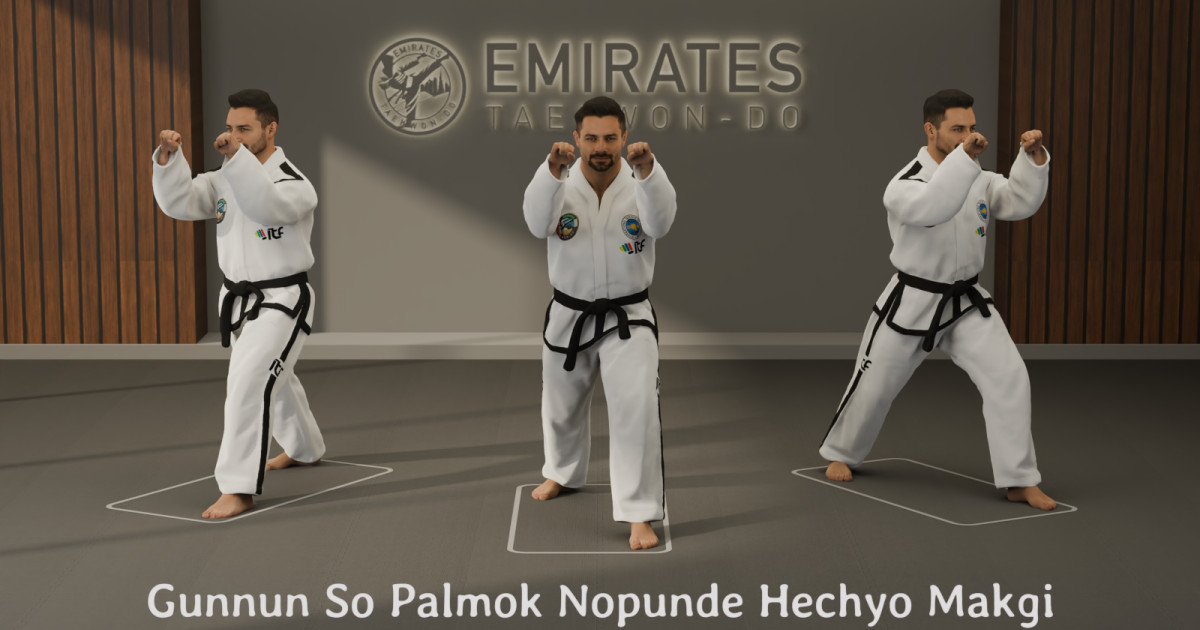

Technique identity
| Item | Technical reference |
|---|---|
| Technique name | Walking Stance Forearm Wedging Block |
| Korean terminology | Gunnun So Palmok Hechyo Makgi |
| Short technique name | Palmok Hechyo Makgi |
| Technique family | Blocking technique, or Makgi |
| Block type | Wedging Block, or Hechyo Makgi |
| Stance | Walking Stance, or Gunnun Sogi |
| Blocking tools | Forearms, or Palmok |
| Main purpose | Block a twin attack while preventing the neck, head, or lapel from being grabbed |
Walking stance base
| Stance point | Requirement |
|---|---|
| Length | 1.5 shoulder widths, measured from big toe to big toe |
| Width | 1 shoulder width, measured from the centers of the insteps |
| Weight distribution | 50% on the front leg and 50% on the rear leg |
| Front foot | Points straight forward |
| Rear foot | Turns 25 degrees outward |
| Front knee | Bent so the kneecap drops in a vertical line with the heel |
Purpose and target attacks
| Attack or threat | Use of the block |
|---|---|
| Twin fist vertical punch | The wedging action opens and intercepts the simultaneous punch line. |
| Twin fore-knuckle fist punch | The forearms wedge outward to prevent the twin attack from reaching the body. |
| Twin knife-hand inward strike | The block opens against the inward striking line before it closes on the target. |
| Neck, head, or lapel grab | The outward wedging action prevents the opponent from securing the grab. |
Main technical rules
| Rule | Technical requirement |
|---|---|
| Blocking tools | Wedging Block may be performed with outer forearm, inner forearm, knife-hand, or reverse knife-hand. This article covers the forearm version. |
| Distance between tools | The distance between the blocking tools is equal to one shoulder width of the defender. |
| Elbow angle | Keep the elbows bent about 35 degrees outward at the moment of the block. |
| Point of focus | Do not allow the blocking tools to pass the point of focus. |
| Common stances | The outer forearm version is mainly executed from Walking Stance, Sitting Stance, or X-Stance. |
| Occasional stances | Parallel Stance, Close Stance, or One-Leg Stance may be used occasionally when required. |
How to execute the block
Begin from a correct Walking Stance. The stance must be stable before the block is judged. The front knee is bent, the rear foot is firm, the stance keeps its correct width and length, and the body weight remains equally distributed between the front and rear legs.
The forearms move outward in a wedging action. The purpose is to intercept or split a double-line attack before it reaches the body. The action must be direct and controlled. It should not become a wide arm swing or an exaggerated opening of the chest.
At the moment of the block, the distance between the two blocking tools should be equal to one shoulder width of the defender. This measurement is important. If the hands finish too close, the block may not open the attack effectively. If they finish too wide, the body can become exposed.
The elbows should be bent about 35 degrees outward at the moment of blocking. This gives the block structure while avoiding excessive extension. The forearms must not pass the point of focus. Once the blocking tools go beyond the proper focus point, the whole body can become exposed.
Forearm tool use
The forearm version of Wedging Block uses Palmok, or forearm, as the blocking tool. The encyclopedia reference explains that Wedging Block may be performed with both the outer and inner forearm, as well as with knife-hand and reverse knife-hand. In this article, the focus is the forearm version from Walking Stance.
The blocking surface must be deliberate. The student should not allow the wrists, fists, or upper arms to replace the forearm action. The name of the technique identifies the tool: Palmok. The forearms must wedge outward with enough structure to intercept the attack, but not with so much extension that the body becomes open.
For the outer forearm wedging action, Walking Stance is one of the main stances used. This makes the technique practical for forward movement, fundamental practice, and pattern application.
Distance and focus
The distance between the blocking tools is equal to one shoulder width of the defender. This creates a measured opening that is wide enough to wedge against the attack but not so wide that the center of the body becomes unprotected.
The point of focus must be respected. The blocking tools should not pass beyond it. Passing the point of focus is a major technical error because it exposes the entire body. This same principle applies to the other wedging-block tools, including knife-hand and reverse knife-hand versions.
The correct finish should feel strong, compact, and controlled. The practitioner should be able to stop the incoming line, prevent the grab or twin attack, and remain ready for immediate follow-up movement.
Reference checklist
| Check | Correct standard |
|---|---|
| Technique | Walking Stance Forearm Wedging Block (Gunnun So Palmok Hechyo Makgi) |
| Technique family | Blocking technique, or Makgi |
| Block type | Wedging Block, or Hechyo Makgi |
| Stance | Walking Stance, or Gunnun Sogi |
| Blocking tools | Forearms, or Palmok |
| Main attacks | Twin fist vertical punch, twin fore-knuckle fist punch, or twin knife-hand inward strike |
| Grab prevention | Protects against the neck, head, or lapel being grabbed |
| Tool spacing | One shoulder width of the defender |
| Elbows | Bent about 35 degrees outward at the moment of the block |
| Focus | Blocking tools must not pass the point of focus |
Common technical errors
A common error is allowing the blocking tools to pass the point of focus. When this happens, the arms move too far outward and the entire body becomes exposed. The wedging action must open the attack, but it must not over-open the defender.
Another error is finishing with the forearms too close together. The distance between the blocking tools should be one shoulder width of the defender. If the forearms finish too close, the block may fail to split or intercept the twin attack correctly.
Students also commonly open the arms too wide. A wide finish may look strong, but it exposes the center line and weakens the defensive purpose of the block. The correct width is measured, not guessed.
Another frequent error is losing the elbow angle. The elbows should be bent about 35 degrees outward at the moment of the block. If the elbows are too straight, the block becomes overextended. If they are too bent, the wedging action may not open the attack enough.
The final error is disconnecting the block from Walking Stance. The stance must remain measured, stable, and equally weighted. A correct Forearm Wedging Block depends on the stance, body line, elbow structure, and forearm tools arriving together at the moment of focus.
Key principle
Forearm Wedging Block opens the attacking line with both forearms while keeping the blocking tools within the point of focus and spaced one shoulder width apart.
Technical purpose
Walking Stance Forearm Wedging Block, called Gunnun So Palmok Hechyo Makgi in Korean terminology, is an ITF Taekwon-Do defensive technique used to open or wedge outward against a double-line attack. It is a blocking technique, or Makgi, performed from Walking Stance using the forearms as the blocking tools.
Wedging Block, or Hechyo Makgi, is used to block attacks such as a twin fist vertical punch, a twin fore-knuckle fist punch, or a twin knife-hand inward strike. It also helps prevent the neck, head, or lapel from being grabbed. The technique is not a random outward arm spread; it is a measured defensive action with specific distance, tool use, and elbow structure.
This article is a technical reference. It focuses on the Walking Stance base, forearm wedging action, distance between the blocking tools, elbow angle, point of focus, and common technical errors.