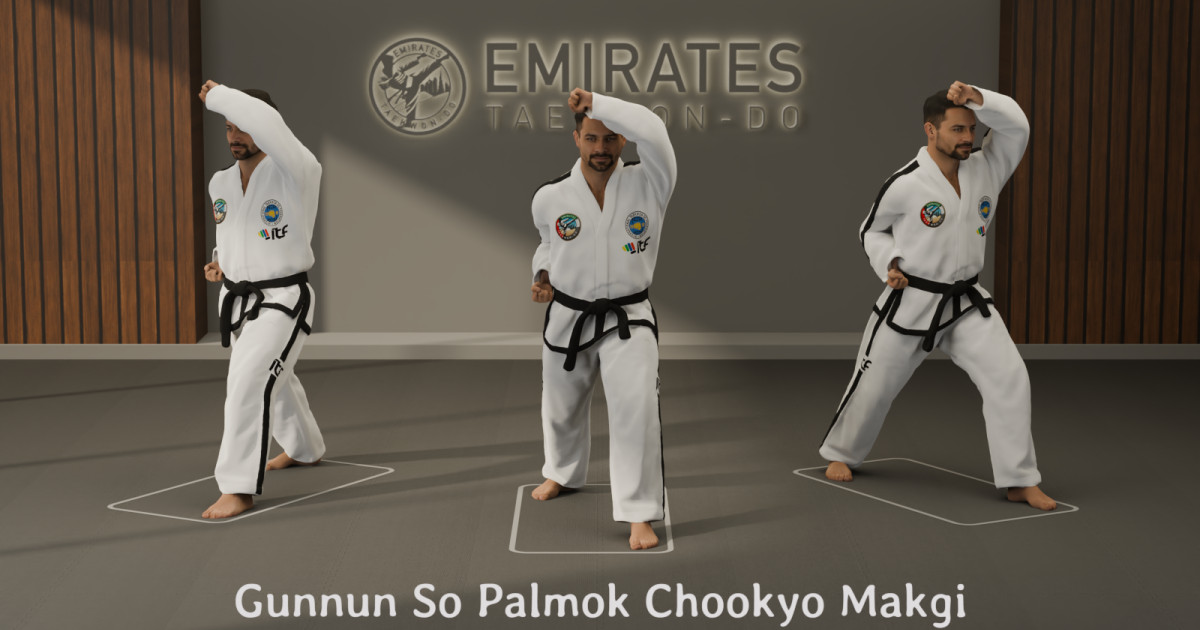

Purpose and target attacks
| Attack or threat | Use of the block |
|---|---|
| Hand attack to the head | Intercepts an attack directed toward the forehead, face, or head line. |
| Foot attack to the face | Can be used against a kick directed toward the bridge of the nose or above. |
| Weapon attack | May be used against a downward strike toward the forehead or skull with a club, pole, or similar weapon. |
| Downward hand strike | The forearm version is chiefly used against a downward strike toward the forehead or skull. |
Main technical rules
| Rule | Technical requirement |
|---|---|
| Blocking tool | Only the outer forearm is used for the forearm rising block. |
| Facing | Maintain a full-facing posture toward the opponent at the moment of the block when using Walking Stance. |
| Shoulders | Keep the shoulders full facing at the moment of the block, not half facing. |
| Center line | The blocking tool must stay at the center of the defender's forehead or face at the moment of the block. |
| Fist and elbow | The fist should be slightly higher than the elbow. |
| Forearm distance | The distance between the inner forearm and the forehead is about 7 centimeters. |
| Elbow angle | The elbow is bent at about a 45-degree angle. |
| Final level | The inner forearm reaches the same level as the forehead. |
How to execute the block
Begin from a correct Walking Stance. The stance must be stable before the block is judged. The front knee is bent, the rear foot is firm, the stance keeps its correct width and length, and the body weight remains equally distributed between the front and rear legs.
The block rises to protect the head line. The blocking tool must stay at the center of the defender's forehead or face at the moment of the block. It should not drift to the side, finish outside the body line, or move away from the area being protected.
The forearm version uses the outer forearm as the blocking tool. The movement is especially relevant against a downward strike toward the forehead or skull, whether the attack comes from a hand, club, pole, or similar weapon. The forearm must be positioned with enough structure to intercept the attack without exposing the face.
At the moment of the block, the body and shoulders should be full facing toward the opponent. The shoulder line should not finish half facing. The stance, hips, shoulders, and blocking arm should arrive together at the moment of focus.
Full-facing shoulders
In Walking Stance Forearm Rising Block, the shoulders should remain full facing at the moment of the block. This means the shoulders and hips are squared toward the opponent. The block protects the center of the forehead or face, so the upper body must not rotate away into a half-facing structure.
Full-facing shoulders help keep the blocking tool centered. If the shoulders turn away, the forearm can drift off the center line and leave part of the head exposed. If the shoulders over-rotate or become uneven, the block may lose both direction and structure.
The correction is simple: keep the Walking Stance measured, keep the body upright, square the shoulders toward the opponent, and place the blocking tool at the center of the forehead or face at the moment of the block.
Final forearm position
The fist should finish slightly higher than the elbow. This keeps the rising block angled and structurally useful. If the elbow rises too high, the block can lose its protective shape. If the fist drops below the elbow, the block may no longer cover the head correctly.
The distance between the inner forearm and the forehead is about 7 centimeters. This keeps the block close enough to protect the head while still allowing room to intercept the attack. If the forearm is too close, the impact can collapse into the head. If it is too far away, the block may expose the face or become disconnected from the body.
The elbow is bent at about a 45-degree angle, and the inner forearm reaches the same level as the forehead. These details help define the final shape of the technique and should be checked every time the block is practiced.
Stance use and direction
Forearm Rising Block can be executed from nearly all stances, but Walking Stance, Sitting Stance, and X-Stance are among the most commonly employed. This article focuses only on the Walking Stance version.
When using Walking Stance, full-facing posture is required at the moment of the block. The block should not be performed with the body angled as if it were an L-Stance or Rear Foot Stance technique. Walking Stance gives the block a direct front-facing structure.
The practitioner should also avoid leaning backward while raising the arm. The block must protect the head from a position of balance, not from a collapsed or exaggerated posture. The stance gives the base, the shoulders provide the full-facing alignment, and the outer forearm protects the upper line.
Reference checklist
| Check | Correct standard |
|---|---|
| Technique | Walking Stance Forearm Rising Block (Gunnun So Palmok Chookyo Makgi) |
| Technique family | Blocking technique, or Makgi |
| Block type | Rising Block, or Chookyo Makgi |
| Stance | Walking Stance, or Gunnun Sogi |
| Blocking tool | Outer forearm |
| Protected area | Head, forehead, bridge of the nose, and area above |
| Facing | Full facing toward the opponent at the moment of the block |
| Shoulders | Full facing, squared toward the opponent |
| Tool position | At the center of the defender's forehead or face |
| Fist position | Slightly higher than the elbow |
| Forearm distance | Inner forearm about 7 centimeters from the forehead |
| Elbow angle | About 45 degrees |
| Final level | Inner forearm reaches the same level as the forehead |
Common technical errors
A common error is finishing with the shoulders half facing. In Walking Stance Forearm Rising Block, the shoulders should be full facing toward the opponent at the moment of the block. If the shoulders turn away, the blocking tool may leave the center line and the head may become exposed.
Another error is placing the blocking tool away from the center of the forehead or face. The rising block must protect the center line. If the forearm finishes too far to one side, the block no longer covers the intended target area.
Students also commonly use the wrong blocking surface. For the forearm rising block, only the outer forearm is used for blocking. The wrist, fist, or inner surface should not replace the required tool.
Another frequent error is using the wrong final angle. The fist should be slightly higher than the elbow, the elbow should be bent about 45 degrees, and the inner forearm should be about 7 centimeters from the forehead. If the arm is too straight, too close, too far, or incorrectly angled, the block becomes weaker and less protective.
The final error is disconnecting the block from Walking Stance. The stance must remain measured, stable, and equally weighted. The block should rise from a strong base, with the body upright, the shoulders full facing, and the outer forearm protecting the upper line.
Key principle
Forearm Rising Block protects the head by keeping the blocking tool at the center of the defender's forehead or face while the body and shoulders remain full facing at the moment of the block.
Technical purpose
Walking Stance Forearm Rising Block, called Gunnun So Palmok Chookyo Makgi in Korean terminology, is an ITF Taekwon-Do defensive technique used to block an opponent's hand, foot, or weapon directed toward the head. It is frequently used against a punch or side-piercing kick aimed at the bridge of the nose or the area above.
Rising Block, or Chookyo Makgi, may be performed with several tools, including the forearm, knife-hand, X-fist, X-knife-hand, arc-hand, and twin palm. This article focuses on the forearm version from Walking Stance. For the forearm rising block, the encyclopedia reference states that only the outer forearm is used for blocking.
This article is a technical reference. It focuses on the Walking Stance base, outer forearm tool, full-facing shoulder line, final position of the blocking tool, elbow angle, distance from the forehead, and common technical errors.
Technique identity
| Item | Technical reference |
|---|---|
| Technique name | Walking Stance Forearm Rising Block |
| Korean terminology | Gunnun So Palmok Chookyo Makgi |
| Short technique name | Palmok Chookyo Makgi |
| Technique family | Blocking technique, or Makgi |
| Block type | Rising Block, or Chookyo Makgi |
| Stance | Walking Stance, or Gunnun Sogi |
| Blocking tool | Outer forearm |
| Main protected area | Head, forehead, bridge of the nose, and area above |
Walking stance base
| Stance point | Requirement |
|---|---|
| Length | 1.5 shoulder widths, measured from big toe to big toe |
| Width | 1 shoulder width, measured from the centers of the insteps |
| Weight distribution | 50% on the front leg and 50% on the rear leg |
| Front foot | Points straight forward |
| Rear foot | Turns 25 degrees outward |
| Front knee | Bent so the kneecap drops in a vertical line with the heel |