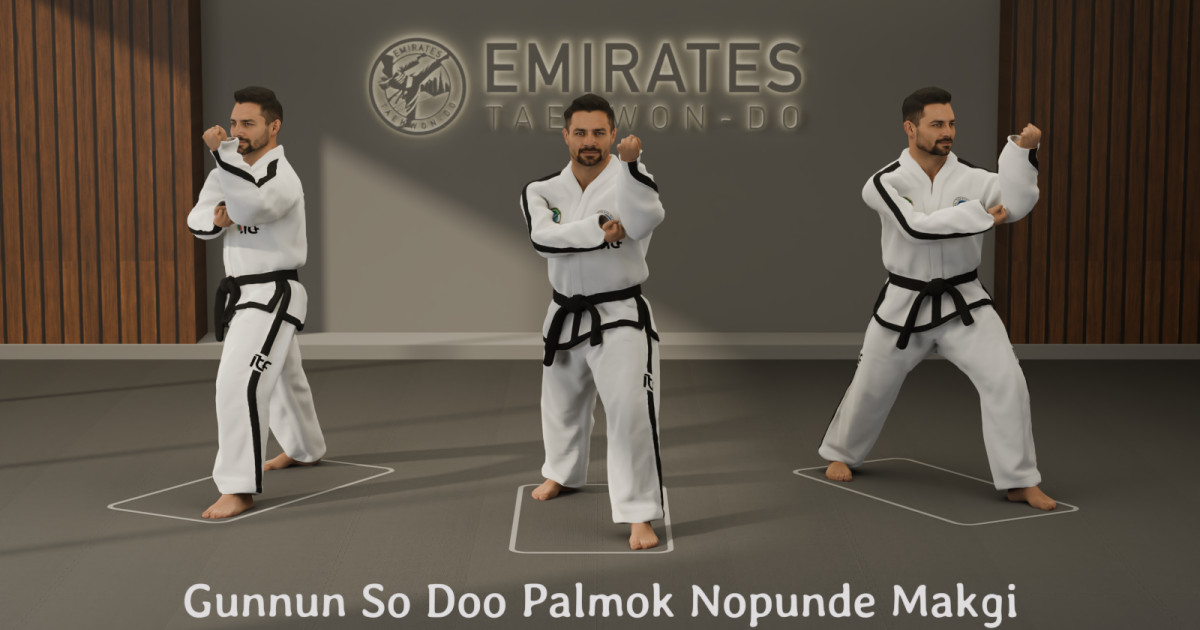

Technique identity
| Item | Technical reference |
|---|---|
| Technique name | Walking Stance Double Forearm High Block |
| Korean terminology | Gunnun So Doo Palmok Nopunde Makgi |
| Short technique name | Doo Palmok Nopunde Makgi |
| Technique family | Blocking technique, or Makgi |
| Block type | Double Forearm Block, or Doo Palmok Makgi |
| Stance | Walking Stance, or Gunnun Sogi |
| Target level | High section, or Nopunde |
| Working surface | Inner forearm |
| Body facing | Half facing at the moment of the block |
Walking stance base
| Stance point | Requirement |
|---|---|
| Length | 1.5 shoulder widths, measured from big toe to big toe |
| Width | 1 shoulder width, measured from the centers of the insteps |
| Weight distribution | 50% on the front leg and 50% on the rear leg |
| Front foot | Points straight forward |
| Rear foot | Turns 25 degrees outward |
| Front knee | Bent so the kneecap drops in a vertical line with the heel |
| Facing for this technique | Half facing body and shoulders at the moment of the block |
Main technical rules
| Rule | Technical requirement |
|---|---|
| Strength of block | Double Forearm Block is one of the strongest forms of blocking. |
| Tactical advantage | One forearm can quickly shift into another block while the other forearm continues blocking. |
| Common stances | Mainly performed in Walking Stance or X-Stance. |
| Occasional stances | May occasionally be performed in L-Stance or Rear Foot Stance. |
| Forearm surface | Only the inner forearm is used. |
| Body facing | Keep the body half facing the target. |
| Hand relationship | Bring the second knuckle of the little finger to the elbow at the moment of the block. |
| Triangle structure | The blocking hand forms a triangle with the shoulders. |
High-section purpose
The target level is high section, or Nopunde. The block is used to protect against attacks directed toward the upper line, including targets such as the philtrum, chin, face, neck, or points above, depending on the specific application.
Because this is a double forearm block, the technique is not judged only by the front hand. The supporting forearm and the blocking forearm must work together. The final structure should show strong high-line protection while still keeping the body half facing.
The block should not become a simple upward motion. The encyclopedia warning shows that if the block is performed upward instead of with the correct side-blocking action, the target can be missed. The direction and focus must match the intended high-section defence.
Obverse and reverse versions
| Version | Walking Stance reference |
|---|---|
| Obverse block | The blocking side corresponds with the same side as the fully bent front leg. |
| Reverse block | The blocking side corresponds with the opposite side of the fully bent front leg. |
| Walking Stance rule | Both obverse and reverse double forearm blocks can be performed in Walking Stance. |
| Shared standard | Both versions keep the body half facing, use the inner forearm, and maintain the triangle structure with the shoulders. |
How to execute the block
Begin from a correct Walking Stance. The stance should be 1.5 shoulder widths long and 1 shoulder width wide. The front knee is bent, the rear foot is firm, and the weight is shared equally between the front and rear legs.
The double forearm structure is formed by bringing both forearms into the high-section blocking position. Only the inner forearm is used as the working blocking surface. The technique must not be performed with careless wrist, fist, or outer-arm contact if the required tool is the inner forearm.
At the moment of the block, the body should be half facing the target. The shoulders should also support this half-facing line. The body should not become full facing, because that exposes the lower abdomen and weakens the structure of the technique.
The second knuckle of the little finger is brought to the elbow at the moment of the block. This relationship helps define the double forearm structure. From the top view, the blocking hand forms a triangle with the shoulders, showing that the block is connected to the body rather than isolated in the arms.
Half-facing body and shoulders
Half facing is one of the most important checks in this technique. The body should remain half facing the target at the moment of the block. If the body becomes full facing, the lower abdomen can become exposed and the defensive structure becomes weaker.
The shoulders must coordinate with the hips and stance. The student should not twist only the upper body while the lower body remains disconnected. Walking Stance provides the base, the hips set the facing, and the shoulders organize the double forearm block.
The correction is simple: keep the Walking Stance measured, keep the body upright, keep the shoulders half facing, and bring the forearms into a structured high-section block without allowing the body to square fully toward the opponent.
Direction and focus
The block must reach the correct high-section line. It should not be delivered in an uncontrolled upward motion. The encyclopedia reference warns that an upward motion can miss the target, especially when the intended contact is toward points such as the chin or philtrum.
The block also requires correct use of the hip and abdomen. If the muscles of the hip and abdomen are not used, the body may become full facing and expose the lower abdomen. The block should be supported by coordinated body mechanics, not just by the arms.
The double forearm structure should remain compact and practical. The forearms protect the high line while the body stays half facing. The final position should show both defence and readiness to shift one forearm into another block if needed.
Reference checklist
| Check | Correct standard |
|---|---|
| Technique | Walking Stance Double Forearm High Block (Gunnun So Doo Palmok Nopunde Makgi) |
| Technique family | Blocking technique, or Makgi |
| Block type | Double Forearm Block, or Doo Palmok Makgi |
| Stance | Walking Stance, or Gunnun Sogi |
| Target level | High section, or Nopunde |
| Working surface | Inner forearm only |
| Facing | Half facing at the moment of the block |
| Shoulders | Half facing, not full facing |
| Hand relationship | Second knuckle of the little finger brought to the elbow |
| Structure | Blocking hand forms a triangle with the shoulders |
| Walking Stance options | Obverse and reverse blocks can both be performed |
| Body mechanics | Use the hip and abdomen so the body does not collapse into full facing |
Common technical errors
A common error is performing the block in an upward motion instead of the required side-blocking action. When this happens, the block can miss the target because both fists are drawn from the hip and the technique does not reach the correct line.
Another error is missing the high-section target. The encyclopedia examples warn that the fist may fail to reach the point of the chin or that the back fist may miss the philtrum. The blocking structure must protect the intended high-line target, not pass beside it or stop short of it.
Students also commonly become full facing. This is incorrect for this technique. If the hip and abdomen are not used properly, the body may square up and expose the lower abdomen. The correct finish is half facing.
Another error is using the wrong forearm surface. The reference states that only the inner forearm is used. The student should not replace it with the outer forearm, fist, wrist, or upper arm.
The final error is failing to form the correct double forearm relationship. The second knuckle of the little finger should come to the elbow at the moment of the block, and the blocking hand should form a triangle with the shoulders. Without this structure, the technique loses the strength that makes Doo Palmok Makgi one of the strongest forms of blocking.
Key principle
Double Forearm High Block uses both forearms in a strong half-facing structure, with the blocking hand forming a triangle with the shoulders and the body ready to shift one forearm into another block.
Technical purpose
Walking Stance Double Forearm High Block, called Gunnun So Doo Palmok Nopunde Makgi in Korean terminology, is an ITF Taekwon-Do defensive technique performed from Walking Stance using both forearms. It belongs to the double forearm block family, called Doo Palmok Makgi.
Double Forearm Block is described as one of the strongest forms of blocking. Its main advantage is that one forearm can quickly shift into another block while the other forearm continues to protect the body. This makes the technique structurally strong and tactically useful when the defender must cover more than one line.
This article is a technical reference. It focuses on the Walking Stance base, high-section purpose, inner forearm use, half-facing body position, relationship between the hands, obverse and reverse use, triangle structure, and common technical errors.