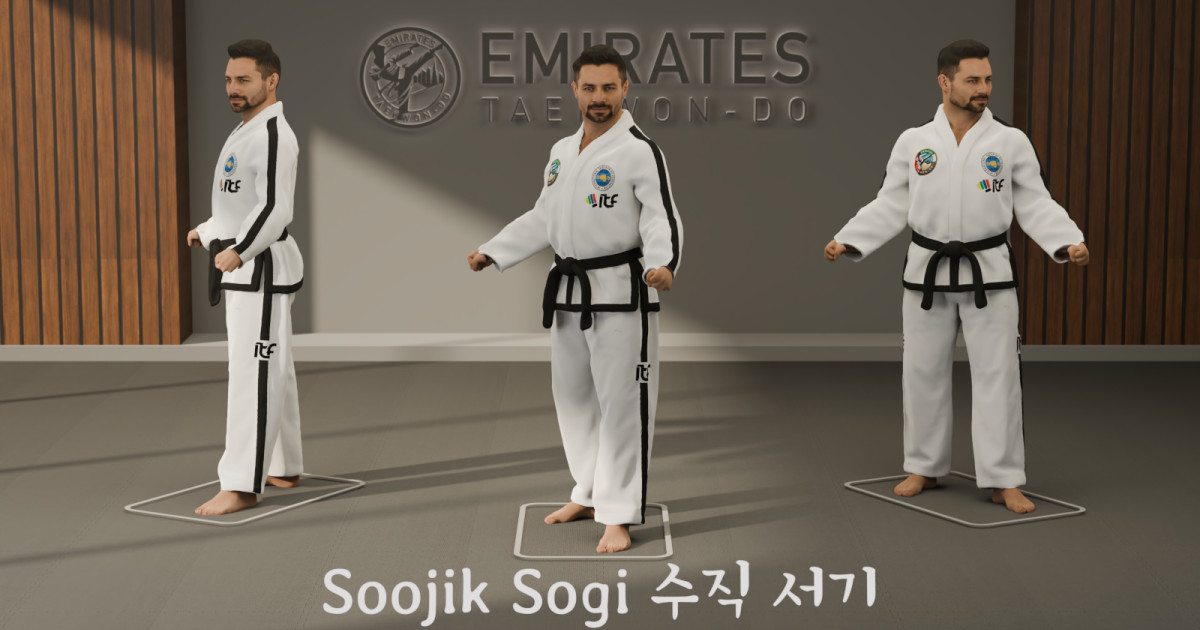
Vertical stance (Soojik Sogi) technical reference

May 22, 2026 Stance 1 views
Ricardo Scheidegger profile picture

Created by

Ricardo Scheidegger

AI assisted Created with AI assistance

May 22, 2026 New

Click to load the interactive view.

Main stance dimensions

Reference pointMeasurement
WidthMinimal width
Width detailThe heels are almost entirely on a straight line
Length1 shoulder width long
Length measuring pointMeasured from the big toe of the rear foot to the big toe of the front foot
Weight distribution60% on the rear leg and 40% on the front leg

Foot and leg structure

Body partTechnical requirement
Rear footTurns 15 degrees inward
Front footTurns 15 degrees inward
Rear legStraight and carrying 60% of the body weight
Front legStraight and carrying 40% of the body weight
Body weightSlightly biased toward the rear leg, without leaning backward

How to measure the stance

The length of Vertical Stance is 1 shoulder width. It is measured from the big toe of the rear foot to the big toe of the front foot. This shorter length separates it from longer stances such as Walking Stance, L-Stance, Fixed Stance, and Low Stance.

The width is minimal. The heels are almost entirely on a straight line, which keeps the stance narrow and compact. This does not mean that the feet should be forced into an uncomfortable line. The structure should remain precise, but the student must still be able to stand with control and balance.

Because the stance is narrow, students should not widen it to feel safer. A wider base changes the character of Soojik Sogi and makes it less accurate. The stance should remain compact, measured, and organized, with the body placed cleanly over the feet.

Weight distribution and posture

Vertical Stance uses a 60% and 40% weight distribution. The rear leg carries 60% of the body weight, while the front leg carries 40%. The weight is therefore not equal, but the difference is moderate compared with stances such as L-Stance or Rear Foot Stance.

Both legs are held straight. The student should not bend the knees as in Sitting Stance, Walking Stance, or Low Stance. The straight-leg structure is one of the defining features of this stance. At the same time, the knees should not be locked aggressively. The body should remain upright, balanced, and able to move.

The rear-weighted structure gives the stance a controlled defensive quality. It can help the practitioner absorb force or prepare for a quick shift. However, the body should not lean backward. The 60% rear-leg weight should come from correct placement of the stance, not from collapsing the posture away from the front foot.

Facing options

FacingUse in Vertical Stance
Full facingNot used for Vertical Stance in this reference
Half facingStrictly used for Vertical Stance
Reverse half facingNot used for Vertical Stance in this reference
Side facingNot used for Vertical Stance in this reference

Half facing in Vertical Stance

Vertical Stance is performed strictly in Half Facing. In half facing, the shoulders and hips are angled so that the body presents a narrower target. This facing supports the compact nature of the stance and keeps the practitioner ready for controlled defensive or shifting movement.

The facing should not disturb the stance measurements. The length remains 1 shoulder width, the width remains minimal, both feet remain turned 15 degrees inward, and the weight distribution remains 60% on the rear leg and 40% on the front leg.

A common issue is turning the upper body without organizing the hips and feet. In Vertical Stance, the whole structure must work together. The feet set the base, the legs remain straight, the body weight sits slightly toward the rear, and the shoulders and hips maintain half facing.

Reference checklist

CheckCorrect standard
Stance nameVertical Stance (Soojik Sogi)
WidthMinimal width
Width detailHeels almost entirely on a straight line
Length1 shoulder width
Measuring pointFrom the big toe of the rear foot to the big toe of the front foot
Weight60% rear leg and 40% front leg
Foot anglesBoth feet turn 15 degrees inward
LegsBoth legs straight
FacingStrictly half facing

Common technical errors

The most common error in Vertical Stance is making the stance too wide. Because the stance feels narrow, students may separate the feet too much for comfort. This changes the stance and weakens the technical accuracy. The heels should remain almost entirely on a straight line.

Another common error is placing the body weight equally on both legs. Vertical Stance is not a 50% and 50% stance. The rear leg carries 60% of the body weight, and the front leg carries 40%. The difference should be visible in the structure but should not create a backward lean.

Students should also check that both legs remain straight and both feet turn 15 degrees inward. If the knees bend, the stance begins to lose its defining shape. If the feet open outward or point straight ahead, the stance no longer follows the correct foot angle. The final check is the facing: Vertical Stance is strictly half facing.

Key principle

Vertical Stance keeps both legs straight, places more weight on the rear leg, and uses half facing to keep the body compact and controlled.

Technical purpose

Vertical Stance, called Soojik Sogi in Korean terminology, is an ITF Taekwon-Do stance with a narrow base, straight legs, and a clear rear-to-front weight distribution. It is used when the practitioner needs a compact stance that can absorb force or prepare the body for quick shifting movements.

This article is a technical reference. It focuses on the specific structure of the stance: length, minimal width, measuring point, weight distribution, foot angles, leg position, and facing. Students should use it to check the position accurately, and instructors may use it as a simple correction guide in the Dojang.

Share this article

Spread the word on your favorite platform.
Link copied!

Frequently Asked Questions

Vertical Stance is called Soojik Sogi.

Vertical Stance is 1 shoulder width long, measured from the big toe of the rear foot to the big toe of the front foot.

Vertical Stance has minimal width, with the heels almost entirely on a straight line.

The weight distribution is 60% on the rear leg and 40% on the front leg.

Vertical Stance is executed strictly in half facing.

Share your thoughts

Be the first to comment.

Please log in to leave a comment.
Cookie preferences

We use essential cookies to keep the site working. Enable optional cookies to improve your experience.