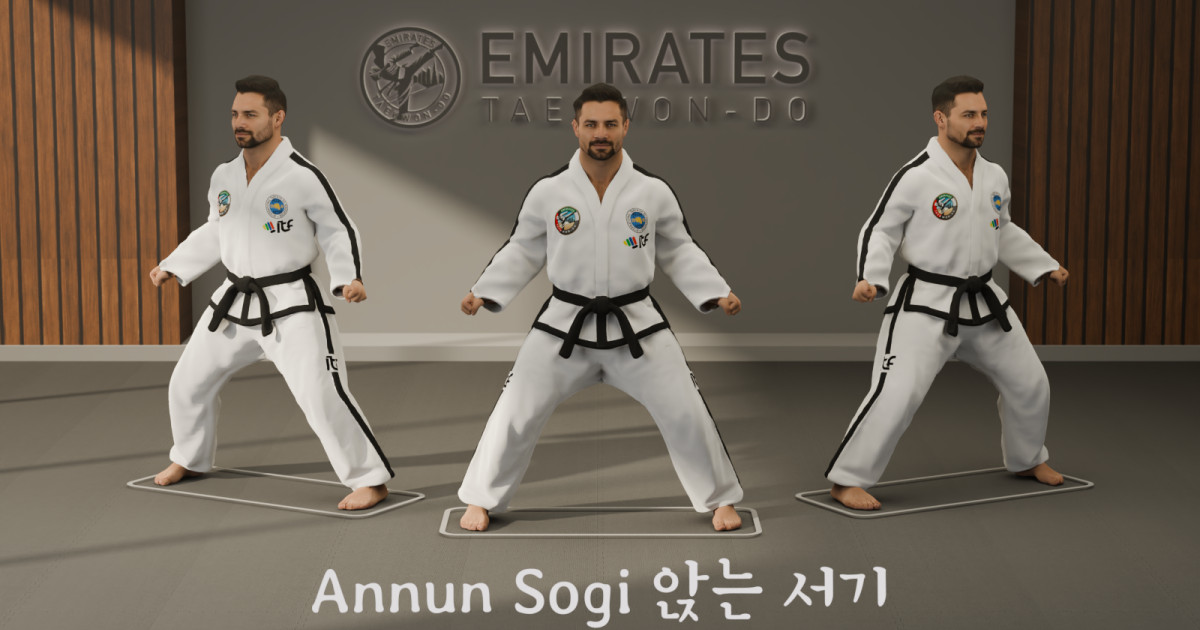

Main stance dimensions
| Reference point | Measurement |
|---|---|
| Width | 1.5 shoulder widths wide |
| Width measuring point | Measured from the inside edges of the big toes |
| Length | 0 shoulder widths |
| Length detail | The feet are even, with no front foot and no rear foot |
| Weight distribution | 50% on the left leg and 50% on the right leg |
Foot and leg structure
| Body part | Technical requirement |
|---|---|
| Left foot | Points straight forward |
| Right foot | Points straight forward |
| Feet | Perfectly parallel and placed evenly on the same line |
| Knees | Bent outward over the balls of the feet |
| Body weight | Balanced equally through both legs |
How to measure the stance
The width of Sitting Stance is 1.5 shoulder widths. It is measured from the inside edges of the big toes. This measuring point is important because Sitting Stance is not measured from the outside edges of the feet, the heels, or the centers of the insteps. Using the wrong measuring point can change the stance and make it technically inaccurate.
The stance has no length. This means there is no front foot and no rear foot. Both feet are placed evenly on the same horizontal line. The body should not shift forward or backward as if one leg were leading the stance.
The student should check width and alignment together. The stance must be wide enough to create a strong base, but not so wide that the knees lose their correct position. If the stance is too narrow, it becomes weak and loses the correct sitting shape. If it is too wide, the legs may become strained and the knees may no longer sit correctly over the balls of the feet.
Weight distribution and knee line
Sitting Stance uses a 50% and 50% weight distribution. The body weight is shared equally between the left leg and the right leg. The student should not lean to one side, push more weight into one foot, or allow one knee to bend more than the other.
Both knees are bent outward over the balls of the feet. This is one of the most important visual checks for Annun Sogi. The knees should not collapse inward, and they should not move randomly outside the structure of the stance. The knee line must match the parallel foot position and the equal weight distribution.
The stance should feel stable and symmetrical. The body remains centered between both legs, with the feet flat on the floor and the toes pointing straight forward. The posture should be strong, but not forced. A correct Sitting Stance gives the practitioner a clear base for technical movement while keeping the body balanced and controlled.
Full facing in Sitting Stance
Sitting Stance may be performed in Full Facing. In full facing, the shoulders and hips are squared toward the front. The feet remain parallel, the knees bend outward over the balls of the feet, and the weight remains equally distributed between both legs.
Full facing should not cause the student to lift the body, straighten the knees, or shift the weight unevenly. The stance must stay wide, low, and symmetrical. The chest and hips should face the same direction without disturbing the lower-body structure.
Side facing in Sitting Stance
Sitting Stance may also be performed in Side Facing. In this facing, the stance keeps the same lower-body structure, but the body is oriented sideways according to the required movement. The feet remain parallel, the stance remains 1.5 shoulder widths wide, and the weight remains 50% on each leg.
The facing changes the orientation of the body, not the measurements of the stance. The student should not narrow the stance, turn the feet outward, or change the knee line when using side facing. Annun Sogi remains defined by parallel feet, equal weight, bent knees, and a wide symmetrical base.
Reference checklist
| Check | Correct standard |
|---|---|
| Stance name | Sitting Stance (Annun Sogi) |
| Width | 1.5 shoulder widths |
| Width measuring point | From the inside edges of the big toes |
| Length | No Length |
| Foot position | Feet even and parallel |
| Weight | 50% left leg and 50% right leg |
| Foot angles | Both feet point straight forward at 0 degrees |
| Knees | Bent outward over the balls of the feet |
| Facing options | Full facing or side facing |
Common technical errors
The most common error in Sitting Stance is turning the toes outward. The feet should point straight forward at 0 degrees. If the toes open outward, the stance loses its correct parallel structure and the knees may no longer track properly over the balls of the feet.
Another common error is using the wrong width. Sitting Stance should be 1.5 shoulder widths wide, measured from the inside edges of the big toes. If the stance is too narrow, it becomes weak. If it is too wide, the student may lose control of the knee position and create unnecessary strain.
Students should also check that the weight is equal. The stance should not lean toward one leg. Both knees should bend evenly, and both feet should remain flat and parallel. The final check is the facing: Sitting Stance may be full facing or side facing, but the lower-body structure must stay the same.
Key principle
Sitting Stance creates a strong symmetrical base by placing both feet parallel, bending both knees outward, and distributing the weight equally between both legs.
Technical purpose
Sitting Stance, called Annun Sogi in Korean terminology, is a wide and stable ITF Taekwon-Do stance. It is used to develop strong posture, clear lower-body control, and a balanced base for fundamental movements. The stance is simple to recognize, but it must be measured accurately to avoid becoming too narrow, too wide, or incorrectly angled.
This article is a technical reference. It focuses on the specific structure of the stance: width, length, measuring point, weight distribution, knee position, foot angles, and facing options. Students should use it to check the position accurately, while instructors may use it as a simple correction guide in the Dojang.