
Exam overview
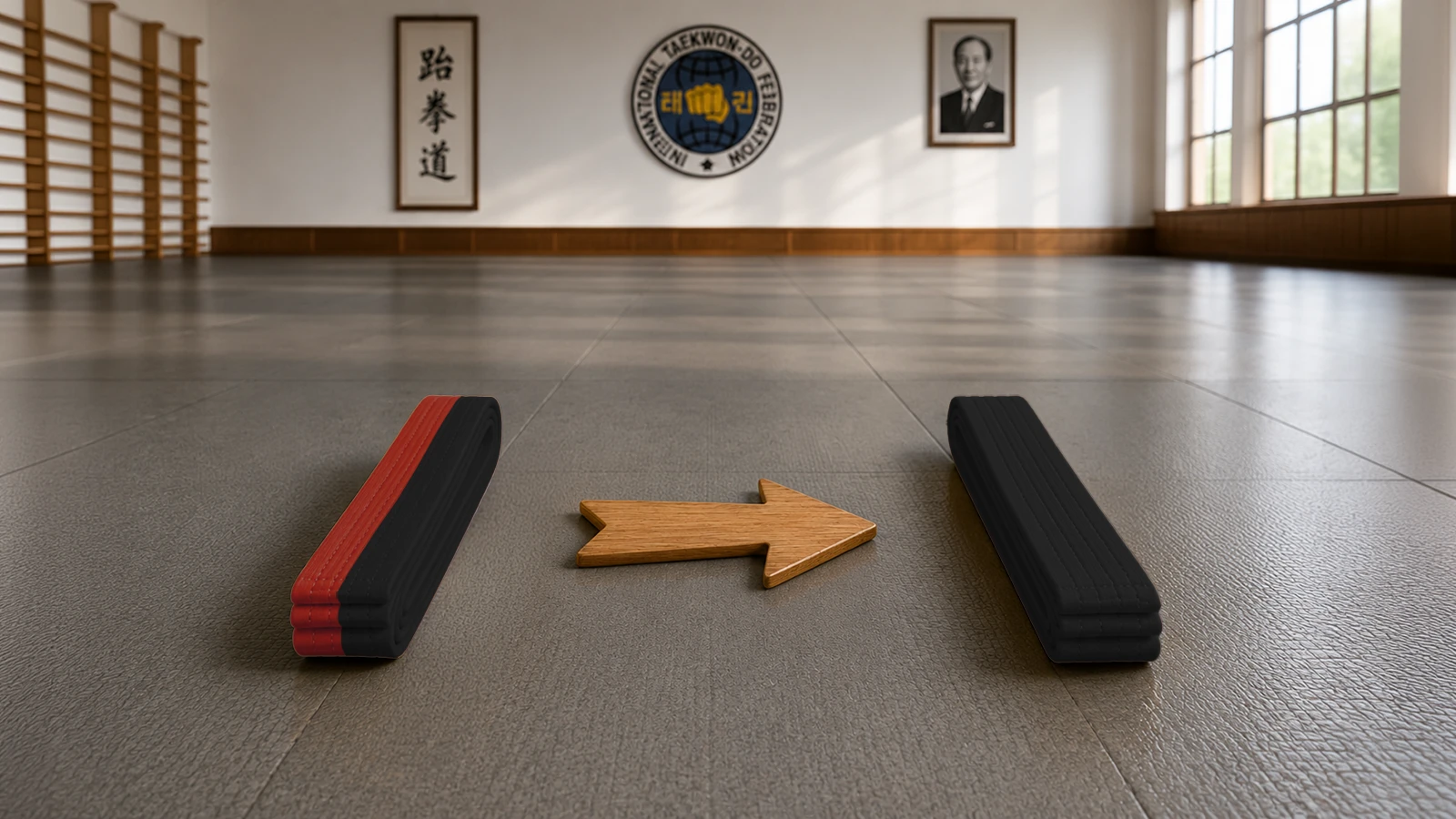
This syllabus is for Red-Black Belt, also called Black Stripe, students preparing for promotion to Black Belt. This is the final colour belt stage before 1st Dan, so the standard is cumulative. Students are not only expected to know the new material for this grade; they must also retain the theory, kicks, movements, and patterns from all previous colour belts.
The exam areas for this level are fundamental movements, all kicks, pattern, all previous patterns, and theory review. The required new pattern is Choong-Moo Tul, with 30 movements. Students must also review Hwa-Rang Tul, with 29 movements, and all earlier colour belt patterns. Promotion to black belt should show technical maturity, strong discipline, accurate terminology, and readiness to represent Taekwon-Do with responsibility.
Knowledge warning
For the black belt exam, students should know theory, kicks, and movements from all colour belts. This is an important part of the requirement. A candidate may be asked about earlier patterns, previous kicks, previous terminology, belt colour meanings, tenets, student behaviour, Theory of Power, history, and other theory studied during the colour belt journey.
Students should not prepare only the newest page of material. Black belt grading tests long-term understanding. Review from white belt through red-black belt: fundamental movements, kicks, Tul, sparring concepts, self-defence areas, Korean terminology, pattern meanings, and exam theory. The examiner should see that the student has built a complete foundation, not only memorised the most recent techniques. If an earlier grade requirement is weak, it should be corrected before attempting promotion.
Red-Black-syllabus.pdf
Open PDFFundamental movements
The fundamental movements for this exam are three specific techniques. Students must practise each movement with correct stance, correct tool, height, direction, preparation, breath control, and a clean final position.
- Walking Stance Knife-hand High Front Strike — Gunnun So Sonkal Nopunde Ap Taerigi
- L-Stance Forearm Low Block — Niunja So Palmok Najunde Makgi
- Walking Stance Reverse Knife-hand High Strike — Gunnun So Sonkal Dung Nopunde Ap Taerigi
At this grade, students should be able to explain the names as well as perform the movements. The stance, tool, height, specification, and technique type should be clear. Each movement should show control, not only memory.
Technique details
In Gunnun So Sonkal Nopunde Ap Taerigi, the stance is walking stance, the tool is knife-hand, the height is high, the specification is front, and the technique type is strike. The strike must finish with sharp focus and a stable stance. Do not let the shoulder rise or the stance shorten at the moment of completion.
In Niunja So Palmok Najunde Makgi, the stance is L-stance, the tool is forearm, the height is low, and the technique type is block. The block must finish with strong balance and correct body facing. In Gunnun So Sonkal Dung Nopunde Ap Taerigi, the tool changes to reverse knife-hand. Students should clearly understand the difference between Sonkal, knife-hand, and Sonkal Dung, reverse knife-hand.
All the kicks
The kicking requirement for this level includes all the kicks. Students must review every kick studied during the colour belt syllabus, not only the newest kicking techniques. The page for this grade highlights several important kicks that should be performed with confidence and correct terminology.
- Reverse Side Kick — Mondora Yop Chagi
- Reverse Turning Kick — Bandae Dollyo Chagi
- Reverse Hooking Kick — Bandae Dollyo Goro Chagi
- Twisting Kick — Bituro Chagi
- Side Turning Kick — Yop Dollyo Chagi
Students should also review the earlier kicks from previous ranks, including front snapping kick, turning kick, side piercing kick, downward kick, hooking kick, back piercing kick, reverse side kick, and other kicking requirements. Every kick should show chamber, balance, direction, recovery, and safe landing.
Pattern requirement
The required new pattern for this exam is Choong-Moo Tul. Choong-Moo has 30 movements. Students must know the pattern name, number of movements, starting position, sequence, diagram, direction changes, rhythm, breathing, and correct finishing point.
Students must also review all previous patterns. This includes Chon-Ji, Dan-Gun, Do-San, Won-Hyo, Yul-Gok, Joong-Gun, Toi-Gye, and Hwa-Rang. Hwa-Rang has 29 movements. At this level, the examiner may check any earlier Tul to confirm that the student has retained the full colour belt pattern foundation. Choong-Moo should be practised carefully, but it must not replace the review of previous patterns.
Meaning of Choong-Moo
Students must memorise the meaning of Choong-Moo exactly as follows:
CHOONG-MOO: Was the name given to the great Admiral Yi Soon-Sin of the Yi Dynasty. He was reputed to have invented the first armored battleship (Kobukson) in 1592, which is said to be the precursor of the present day submarine. The reason why this pattern ends with a left hand attack is to symbolize his regrettable death, having no chance to show his unrestrained potentiality checked by the forced reservation of his loyalty to the king.
This meaning should be learned word by word. During the theory section of the exam, students should be able to say it clearly without changing the names, dates, historical reference, or explanation of the left hand attack.
Theory review
The theory requirement for black belt preparation includes all theory studied during the colour belt syllabus. Students should review the tenets of Taekwon-Do, the Student Oath, meaning of Taekwon-Do, Korean numbers, instructor titles, terminology for stances, tools, heights, blocks, strikes, thrusts, punches, kicks, sparring, self-defence, and class commands.
Students should also review all pattern meanings, belt colour meanings, history of Taekwon-Do, student behaviour, rules of the Dojang, purpose of patterns, purpose of board breaking, composition of Taekwon-Do, differences between Taekwon-Do and other martial arts, origins of martial arts, and the Theory of Power. A black belt candidate should be able to answer theory questions clearly, respectfully, and with confidence. Theory is not separate from training; it explains the system the student is now preparing to represent.
Exam checklist
Before the exam, students should confirm that they can demonstrate every area from this syllabus. Practise Gunnun So Sonkal Nopunde Ap Taerigi, Niunja So Palmok Najunde Makgi, Gunnun So Sonkal Dung Nopunde Ap Taerigi, Mondora Yop Chagi, Bandae Dollyo Chagi, Bandae Dollyo Goro Chagi, Bituro Chagi, Yop Dollyo Chagi, and all previous kicks.
Students should also practise Choong-Moo Tul with 30 movements and review all previous patterns, especially Hwa-Rang Tul with 29 movements. Recite the meaning of Choong-Moo exactly. Review all theory, kicks, and movements from the colour belt syllabus. On exam day, wear a clean Dobok, tie the belt correctly, bow properly, listen carefully, and show the discipline, control, and maturity expected from a future black belt.