
Exam overview
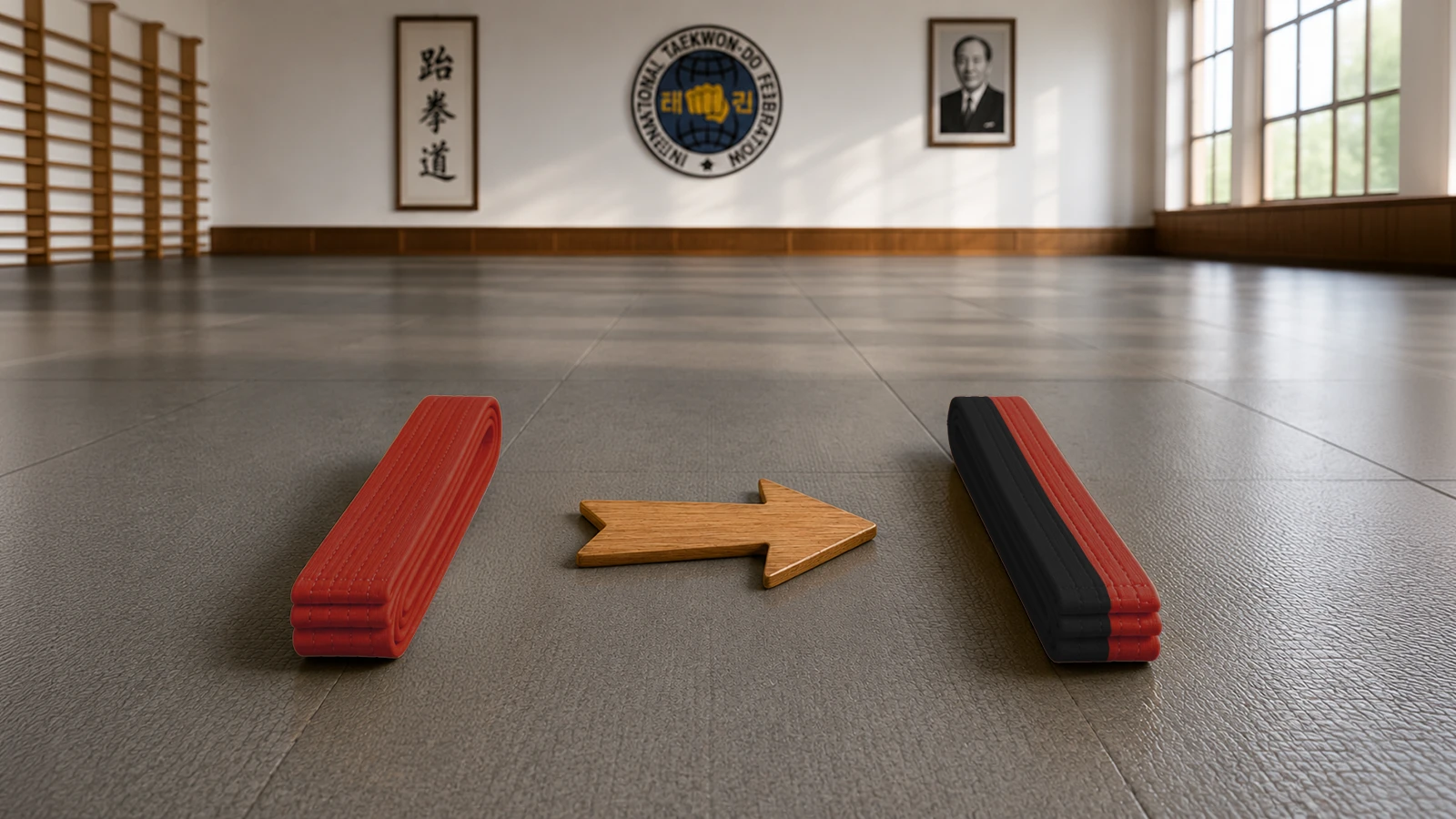
This syllabus is for Red Belt, 2nd Gup students preparing for promotion to Red-Black Belt, 1st Gup. It gives students one clear online reference for the exam areas they must practise and study before grading.
The exam areas for this level are fundamental movements, the kick, pattern, and theory. Students should be able to demonstrate mature control in vertical stance, L-stance, knife-hand downward strike, obverse punch, upward punch, and side turning kick. Students must also know Hwa-Rang Tul, including its 29 movements and exact meaning. The theory for this level is Moral Culture, including humanity, righteousness, propriety, wisdom, and trust.
Red-syllabus.pdf
Open PDFFundamental movements
The first exam area is fundamental movements. These are the required movements that red belt students must practise before promotion to red-black belt. Each movement should be performed with correct stance, tool, direction, technique type, breathing, balance, and final position.
- Vertical Stance Knife-hand Downward Strike — Soojik So Sonkal Naeryo Taerigi
- L-Stance Obverse Punch — Niunja So Baro Jirugi
- L-Stance Upward Punch — Niunja So Ollyo Jirugi
At this grade, the examiner should see technical confidence rather than beginner hesitation. Practise each movement slowly first, then with stronger rhythm and timing. The movement should be sharp, but not tense or rushed.
Technique details
In Soojik So Sonkal Naeryo Taerigi, the stance is vertical stance, the tool is knife-hand, the direction is downward, and the technique type is strike. The body should remain tall and stable while the strike finishes clearly on the correct line.
In Niunja So Baro Jirugi, the student performs an obverse punch from L-stance. Baro means that the attacking hand is on the same side as the stance. The punch should finish with balance and a clear line of power. In Niunja So Ollyo Jirugi, the student performs an upward punch from L-stance. The punch must rise with control, without lifting the shoulders or weakening the stance. Each technique should show accurate terminology through accurate movement.
The kick
The required kick for this exam is Side Turning Kick, called Yop Dollyo Chagi. Students should use the correct ITF name and avoid confusing it with side piercing kick or ordinary turning kick. The name identifies both the side direction and the turning action of the technique.
When practising Yop Dollyo Chagi, begin from balance. Prepare the knee, rotate the hip correctly, deliver the kick on the proper side-turning line, retract the leg, and land under control. The examiner should see chamber, direction, target awareness, recovery, and safe foot placement. Height is not the main standard. A medium-height kick with correct body alignment is better than a high kick that loses balance, posture, or technical shape.
Pattern requirement
The required pattern is Hwa-Rang Tul. Hwa-Rang has 29 movements. Students must know the pattern name, number of movements, starting position, sequence, direction changes, diagram, and correct finishing point.
Hwa-Rang is an important pattern because it brings together stronger stance transitions, higher technical demand, and clearer rhythm. Students should connect the pattern to the fundamental movements for this grade, especially vertical stance knife-hand downward strike, L-stance obverse punch, and L-stance upward punch. The pattern should not be performed as a memory race. Each movement should show correct stance, tool, height, direction, breathing, rhythm, and technical control from beginning to end. Practise slowly until the sequence is reliable, then increase confidence without sacrificing accuracy.
Meaning of Hwa-Rang
Students must memorise the meaning of Hwa-Rang exactly as follows:
HWA-RANG: Named after the Hwa-Rang youth group which originated in the Silla Dynasty in the early 7th century. The 29 movements refer to the 29th Infantry Division, where Taekwon-Do developed into maturity.
This meaning should be learned word by word. During the theory section of the exam, students should be able to say it clearly, without changing the name, historical reference, dynasty, century, movement count, or reference to the 29th Infantry Division. A short and accurate answer is better than a long answer with mistakes. Students should remember that each Tul has a name, meaning, movement count, diagram, and purpose within the student’s progression.
Moral culture
The theory for this grade is Moral Culture. Moral culture is the endeavour and process of becoming an exemplary person. To become such a person, one must first understand oneself and build a moral character that is respected by others. This can only be achieved through constant practice of mental discipline.
Taekwon-Do places heavy emphasis on moral culture because the art should develop more than a healthy body and strong technique. It should also develop a keen mind, good sportsmanship, and moral behaviour. A mentally disciplined person can contribute to a free and peaceful society through wise action, proper conduct, and lasting example. The more disciplined and cultivated the mind is, the more disciplined and cultivated the student’s use of Taekwon-Do should become.
Humanity and righteousness
The first quality is Humanity, or In. Humanity is the ability to feel sorrow for the misfortunes of fellow people and to love them equally, as parents love their children equally. To practise humanity, a student should use prudence, modesty, and discretion in everyday life. The student should also devote sincere effort to assigned work, whether the task is large or small.
The second quality is Righteousness, or Ui. Righteousness is the ability to feel ashamed of unjust acts and to do one’s duty to others. For a red belt student, this means understanding that strength and rank must be guided by conscience. The student should not only know what is technically correct, but also what is morally correct.
Propriety wisdom trust
The third quality is Propriety, or Ye. Propriety means respectful and courteous behaviour. The theory gives the example that, unlike animals fighting over food, a courteous person would offer another person a piece of bread even if both were starving, out of respect and good manners.
The fourth quality is Wisdom, or Ji. Wisdom is the ability to judge right from wrong, especially in matters concerning oneself. The fifth quality is Trust, or Shin. Trust is the ability to keep one’s words and promises, not only to friends but to everyone in general. Without trust, a person loses principles and dignity. These qualities should be shown through behaviour, not only recited for theory.
Exam checklist
Before the exam, students should check that they can demonstrate every area from this syllabus. They should practise Soojik So Sonkal Naeryo Taerigi, Niunja So Baro Jirugi, Niunja So Ollyo Jirugi, Yop Dollyo Chagi, and Hwa-Rang Tul with 29 movements.
Students should also be able to recite the meaning of Hwa-Rang exactly and explain Moral Culture, including Humanity, Righteousness, Propriety, Wisdom, and Trust. On exam day, wear a clean Dobok, tie the belt correctly, bow properly, listen carefully, and correct mistakes without frustration. Promotion to Red-Black Belt, 1st Gup should show mature technique, accurate terminology, disciplined pattern performance, and responsible character.