
Technical purpose
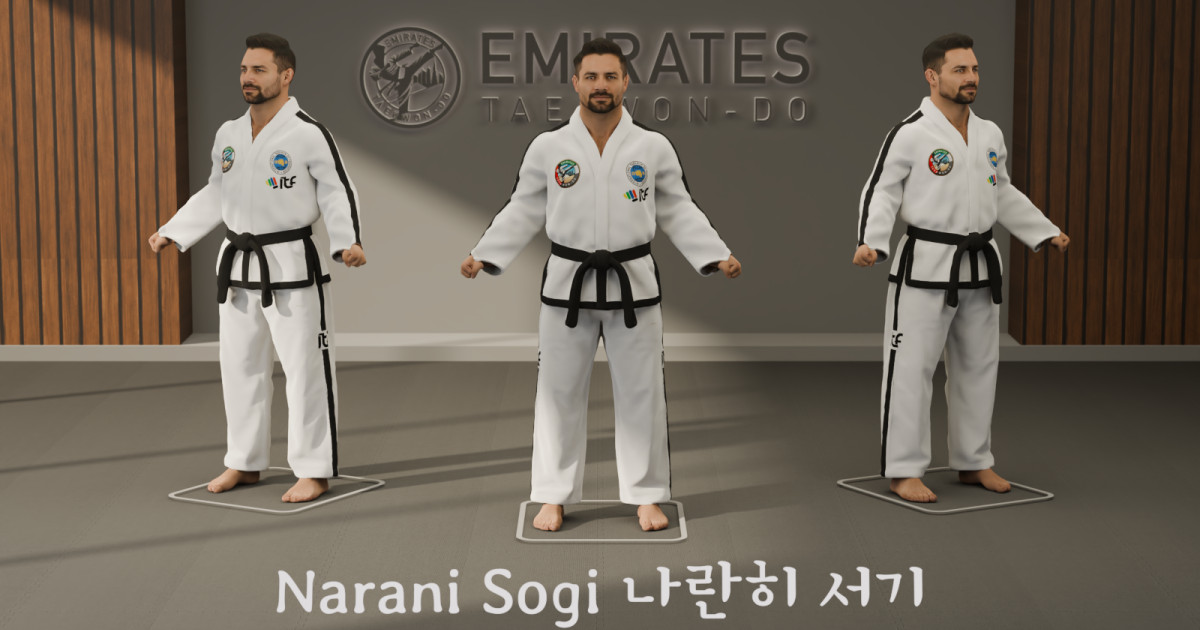
Parallel Stance, called Narani Sogi in Korean terminology, is a basic ITF Taekwon-Do stance chiefly used for ready positions and fundamental exercises. It may also be used occasionally in attack and defense.
The stance is simple, but it must be measured accurately. Both feet are kept parallel, the body weight is shared equally, and the stance is measured by one shoulder width between the footswords. It should not be treated as casual standing.
Stance structure
| Reference point | Technical requirement |
|---|---|
| Stance name | Parallel Stance (Narani Sogi) |
| Width | 1 shoulder width |
| Width measuring point | Measured from footsword to footsword |
| Length | No length |
| Foot position | Both feet are even and parallel |
| Foot direction | Both feet point straight forward |
| Weight distribution | 50% on the left leg and 50% on the right leg |
| Leg position | Both legs are straight |
Measurement and alignment
The width of Parallel Stance is 1 shoulder width. The measurement is taken from footsword to footsword, meaning from the outer edge of one foot to the outer edge of the other foot.
The stance has no length because neither foot is advanced. Both feet are placed evenly on the same line. The toes point straight forward, and both feet remain parallel to each other.
The weight is distributed equally between both legs. The student should stand centered, with the body upright and the legs straight. The stance should feel neutral, balanced, and ready for the next movement.
Facing and use
| Point | Technical reference |
|---|---|
| Main use | Chiefly used for ready positions and exercises |
| Other use | Occasionally used in attack and defense |
| Facing | Full facing or side facing |
| Full facing | The shoulders and hips are squared toward the front |
| Side facing | The body is oriented sideways while the feet remain parallel and evenly placed |
Reference checklist
| Check | Correct standard |
|---|---|
| Width | 1 shoulder width |
| Measurement | Footsword to footsword |
| Length | No length |
| Feet | Even, parallel, and pointing forward |
| Weight | 50% left leg and 50% right leg |
| Legs | Straight |
| Facing | Full facing or side facing |
| Primary use | Ready position and exercise stance |
Common technical errors
A common error is measuring from the wrong point. Parallel Stance is measured from footsword to footsword. If the student measures from the big toes, heels, or centers of the feet, the stance may become too narrow or too wide.
Another error is turning the toes outward. The feet should remain parallel and point straight forward. If the toes open outward, the stance becomes a relaxed standing position rather than a technical Taekwon-Do stance.
Students also commonly shift the weight to one side. The weight should be equal, with 50% on each leg. The legs should remain straight, and the body should stay centered.
The final error is creating length by advancing one foot. Parallel Stance has no length. Both feet must stay even on the same line.