
Technical purpose
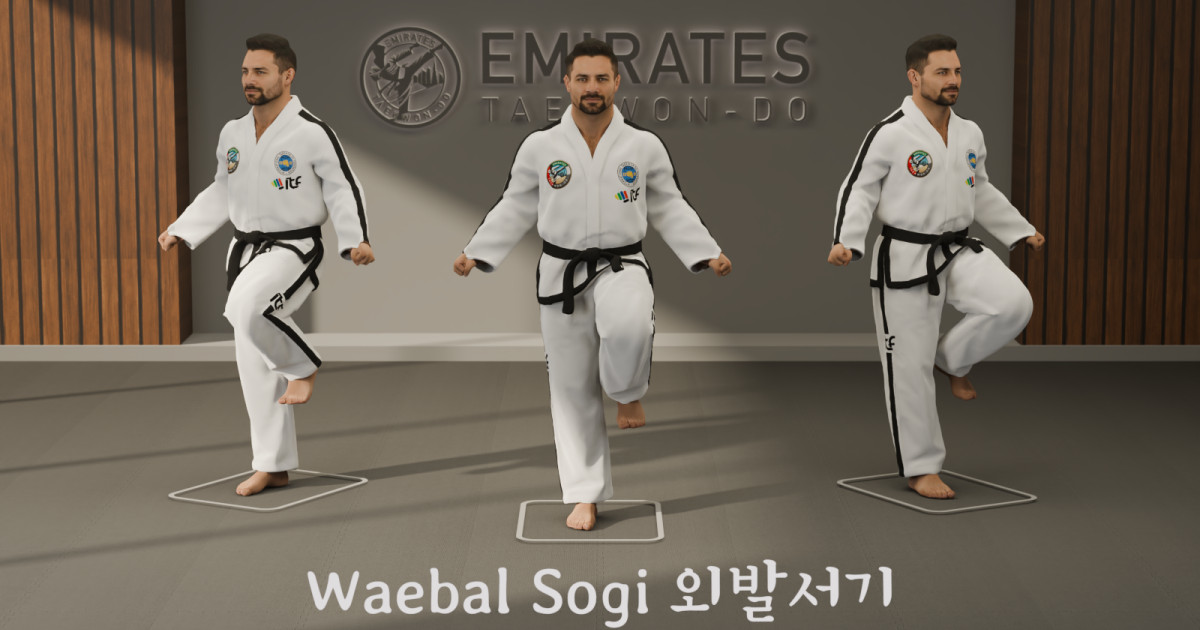
One-Leg Stance, called Waebal Sogi in Korean terminology, is an ITF Taekwon-Do stance primarily used for balance exercise. It trains the student to control the whole body over one supporting leg while keeping the lifted leg organized and ready. Although balance training is its main purpose, it may also be used occasionally in attack and defense techniques.
The stance is simple in appearance, but it requires precision. The stationary leg is stretched, the body weight is fully supported by one foot, and the lifted foot is placed correctly near the knee area. The stance must look deliberate and controlled, not like casual standing on one leg.
This article is a technical reference. It focuses on the no-width and no-length structure of the stance, the standing-foot naming rule, the lifted-foot placement, balance control, and the facing specification used for Waebal Sogi.
Key principle
One-Leg Stance places the entire body weight on one stretched supporting leg while the opposite foot is lifted and positioned carefully near the knee area.
Stance identity
| Item | Technical reference |
|---|---|
| Stance name | One-Leg Stance |
| Korean terminology | Waebal Sogi |
| Stance family | Taekwon-Do stance, or Sogi |
| Main use | Balance exercise |
| Occasional use | Attack and defense techniques |
| Naming rule | Named by the standing foot |
| Facing specification | Full facing or side facing, both in attack and defense |
Main stance structure
| Reference point | Technical requirement |
|---|---|
| Width | No width |
| Length | No length |
| Measuring point | The standing foot is the only point of contact with the floor |
| Weight distribution | 100% on the standing leg |
| Standing leg | Stretched and supporting the full body weight |
| Lifted foot | Placed near the knee area according to the required form |
Standing-foot naming rule
One-Leg Stance is named by the foot that remains on the floor. When the practitioner is standing with the right foot, it is called a right One-Leg Stance. When the practitioner is standing with the left foot, it is called a left One-Leg Stance.
This naming rule is important because students may be tempted to name the stance by the lifted leg. In Waebal Sogi, the supporting foot defines the stance. The lifted leg is part of the shape, but it does not name the stance.
For example, if the right foot is the supporting foot and the left leg is lifted, the stance is right Waebal Sogi. If the left foot is the supporting foot and the right leg is lifted, the stance is left Waebal Sogi.
Lifted-foot placement
The stationary leg is stretched while the other leg is lifted and placed carefully near the knee area. The encyclopedia reference describes bringing the other reverse footsword to the knee joint, or bringing the instep to the knee hollow.
This means the lifted foot is not loose, hanging, or accidental. It must be positioned with control according to the required version of the stance. The supporting leg remains straight and stable, while the lifted leg stays organized close to the body.
The exact placement must preserve balance. If the lifted foot pulls the body out of line, the stance loses its purpose. The student should keep the body upright, avoid leaning to one side, and keep the supporting foot stable on the floor.
Facing specification
| Facing | Use in One-Leg Stance |
|---|---|
| Full facing | Used when the shoulders and hips are squared toward the direction of the technique |
| Side facing | Used when the body is oriented sideways while maintaining balance on the standing foot |
Full facing and side facing
Waebal Sogi can be performed in full facing or side facing, both in attack and defense. In full facing, the shoulders and hips are squared toward the direction of the technique. In side facing, the body is oriented sideways while the stance remains balanced on one supporting foot.
The facing should not disturb the stance structure. The stance still has no width and no length, because only one foot supports the body. The standing leg remains stretched, the lifted foot stays controlled near the knee area, and the body weight remains fully on the standing foot.
The student should change the facing through the body as a whole, not by twisting only the shoulders. A correct Waebal Sogi should remain stable whether the body is full facing or side facing.
Balance and control
The main training value of One-Leg Stance is balance. The practitioner must control the body over one supporting foot without leaning, dropping the lifted leg, or softening the stance into a casual posture. The standing leg should be stretched and stable.
The upper body should remain upright. The shoulders should not lift, the hips should not collapse, and the arms should not be used to compensate for poor balance. The stance should look calm, centered, and deliberate.
When used in attack or defense, the balance requirement becomes more important. The stance must be stable enough to support the next technique. If the student cannot control the body in Waebal Sogi, the following movement will usually become rushed, unstable, or technically inaccurate.
Reference checklist
| Check | Correct standard |
|---|---|
| Stance | One-Leg Stance (Waebal Sogi) |
| Width | No width |
| Length | No length |
| Weight | 100% on the standing leg |
| Standing leg | Stretched |
| Lifted foot | Reverse footsword to the knee joint, or instep to the knee hollow, according to the required form |
| Naming rule | Named by the standing foot |
| Facing | Full facing or side facing |
| Main use | Balance exercise |
| Occasional use | Attack and defense techniques |
Common technical errors
A common error is naming the stance by the lifted leg instead of the standing foot. Waebal Sogi is named by the foot on the floor. If the practitioner stands on the right foot, it is a right One-Leg Stance. If the practitioner stands on the left foot, it is a left One-Leg Stance.
Another error is bending or relaxing the stationary leg too much. The encyclopedia reference describes stretching the stationary leg. If the supporting leg collapses, the stance loses its clean one-leg structure and becomes unstable.
Students also commonly allow the lifted foot to hang loosely. The lifted foot must be placed with control near the knee area, using the reverse footsword on the knee joint or the instep to the knee hollow according to the required form.
Another frequent error is leaning the upper body to maintain balance. The body should remain upright and controlled over the supporting foot. Excessive leaning may help the student stay up temporarily, but it weakens the technical shape of the stance.
The final error is changing the facing while losing the stance. Waebal Sogi may be full facing or side facing, but in both cases the stance still has no width, no length, full body weight on the standing leg, and a controlled lifted-foot position.