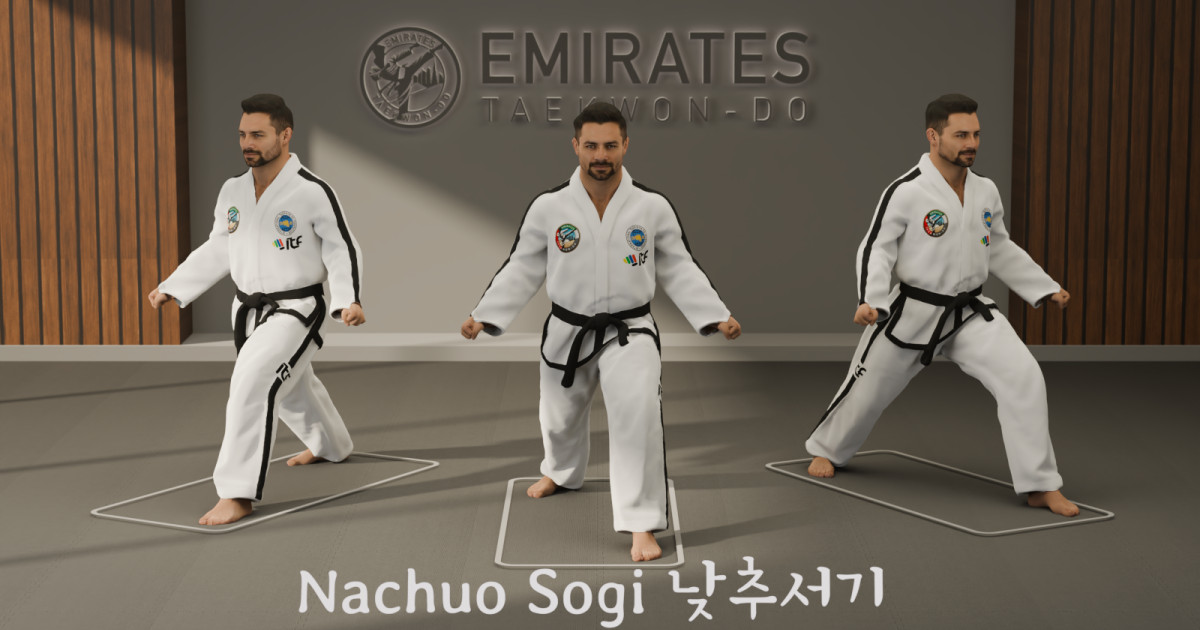

Main stance dimensions
| Reference point | Measurement |
|---|---|
| Width | 1 shoulder width wide |
| Width measuring point | Measured from the centers of the insteps |
| Length | 1.5 shoulder widths plus one additional foot length |
| Length measuring point | Measured from the big toe of the rear foot to the big toe of the front foot |
| Weight distribution | 50% on the front leg and 50% on the rear leg |
Foot and leg structure
| Body part | Technical requirement |
|---|---|
| Front foot | Points straight forward at 0 degrees |
| Rear foot | Turns 25 degrees outward |
| Front leg | Supports 50% of the body weight |
| Rear leg | Supports 50% of the body weight |
| Body position | Lowered into a deep, stable base without changing the required measurements |
How to measure the stance
The width of Low Stance is 1 shoulder width. It is measured from the centers of the insteps. This measuring point is important because Low Stance is not measured from the outside edges of the feet or from the heels. Measuring from the wrong point can make the stance wider or narrower than intended.
The length of Low Stance is 1.5 shoulder widths plus one additional foot length. It is measured from the big toe of the rear foot to the big toe of the front foot. The added foot length is the detail that makes the stance longer than a standard Walking Stance.
Students should measure both width and length carefully. The width gives side-to-side stability, while the extended length gives greater reach. If the stance is too short, it loses the purpose of Nachuo Sogi. If it is too long, the body may become difficult to control and the movement may lose practical structure.
Weight distribution and low base
Low Stance uses a 50% and 50% weight distribution. The body weight is shared equally between the front leg and the rear leg. The student should not lean heavily onto the front leg or sit backward onto the rear leg. Equal weight is one of the main checks for correct structure.
The stance creates a low center of gravity through its extended length and deep base. This gives the practitioner stability while increasing reach. The purpose is not simply to make the stance look long. The stance should remain controlled, balanced, and usable for the required Taekwon-Do technique.
Because the stance is longer than Walking Stance, students may be tempted to overreach. Overreaching usually causes the body to lean, the feet to lose correct angle, or the weight to shift away from the required 50% and 50% distribution. The correct position should feel low and stable, not stretched and weak.
Facing options
| Facing | Use in Low Stance |
|---|---|
| Full facing | Used when the shoulders and hips are squared toward the direction of the technique |
| Half facing | Used when the torso is angled while the stance remains long, low, and stable |
| Reverse half facing | Used when the torso is angled to the opposite side while the stance remains long, low, and stable |
Full facing in Low Stance
Low Stance may be performed in Full Facing. In this facing, the shoulders and hips are squared toward the opponent or toward the direction of the technique. This facing supports direct forward application while the stance provides extra reach and a low base.
The body should remain organized over both legs. Full facing should not cause the practitioner to lift the posture, shorten the stance, or shift the body weight forward. The length remains 1.5 shoulder widths plus one foot length, the width remains 1 shoulder width, and the weight remains equally distributed.
Half facing in Low Stance
Low Stance may also be performed in Half Facing. In half facing, the torso is angled rather than squared fully forward. This can help present a narrower target while preserving the longer, lower base of the stance.
The facing changes the orientation of the hips and shoulders, but it does not change the stance measurements. The feet keep their required position, the front foot points straight forward, the rear foot turns 25 degrees outward, and the weight remains 50% on each leg.
Students should avoid twisting only the shoulders while leaving the lower body disconnected. The stance must remain a single organized structure. The feet, legs, hips, shoulders, and direction of the technique should support the same movement.
Reference checklist
| Check | Correct standard |
|---|---|
| Stance name | Low Stance (Nachuo Sogi) |
| Width | 1 shoulder width |
| Width measuring point | From the centers of the insteps |
| Length | 1.5 shoulder widths plus one additional foot length |
| Length measuring point | From the big toe of the rear foot to the big toe of the front foot |
| Weight | 50% front leg and 50% rear leg |
| Front foot | Straight forward at 0 degrees |
| Rear foot | 25 degrees outward |
| Facing options | Full facing, half facing and reverse half facing |
Common technical errors
The most common error in Low Stance is making it only slightly longer than Walking Stance. Low Stance must be measured as 1.5 shoulder widths plus one additional foot length. Without the extra foot length, the stance loses its specific identity and purpose.
Another common error is overextending the stance. A stance that is too long may look dramatic, but it can weaken balance, reduce control, and make the next movement difficult. The correct length should extend reach while still allowing the practitioner to remain stable and organized.
Students should also check the width. The stance is 1 shoulder width wide, measured from the centers of the insteps. If the stance becomes too narrow, side-to-side stability is reduced. If it becomes too wide, the hips may feel restricted and the stance may become heavy.
The final checks are weight distribution and foot angle. The weight remains 50% on each leg. The front foot points straight forward, and the rear foot turns 25 degrees outward. If these details are lost, the stance may no longer function as a clean Low Stance in ITF Taekwon-Do.
Key principle
Low Stance extends the reach of the body by adding one extra foot length to the stance while keeping equal weight distribution and a low, stable base.
Technical purpose
Low Stance, called Nachuo Sogi in Korean terminology, is an ITF Taekwon-Do stance used to create a longer and lower base than a standard Walking Stance. It extends the reach of the technique while keeping the center of gravity low and stable.
This article is a technical reference. It focuses on the specific structure of the stance: width, length, measuring points, weight distribution, foot angles, and facing options. Students should use it to check the position accurately, while instructors may use it as a simple correction guide in the Dojang.