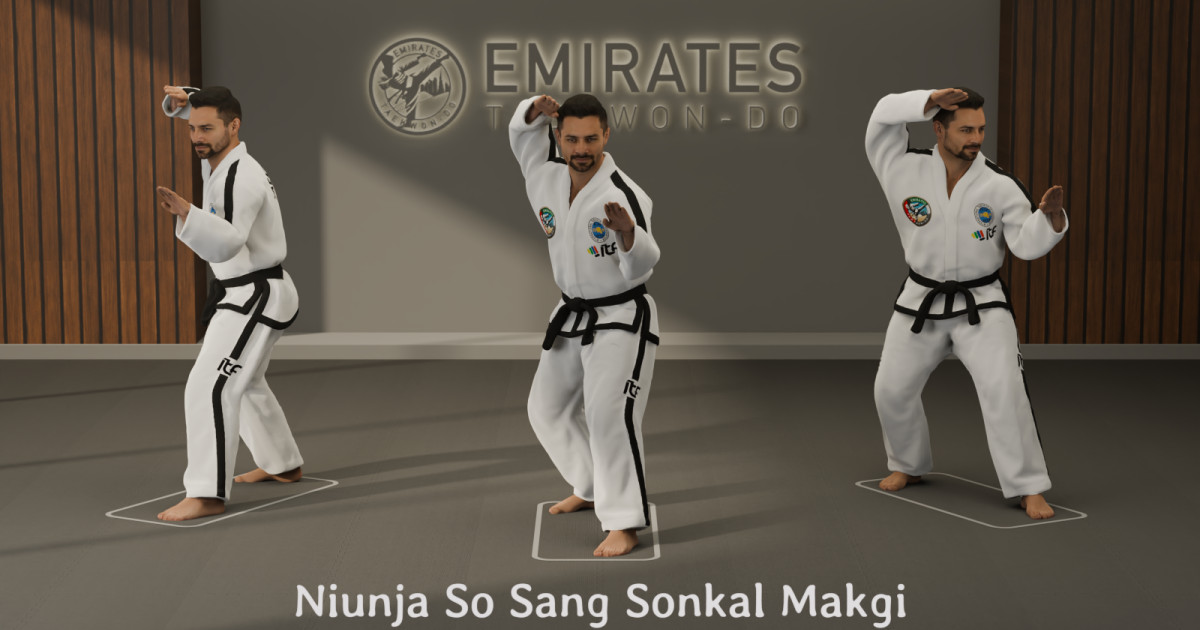

Main technical rules
| Rule | Technical requirement |
|---|---|
| Method and purpose | The method and purpose are the same as Twin Forearm Block, but the blocking tools are knife-hands. |
| Simultaneous defence | The technique protects against attacks coming from the front and the side at the same time. |
| Primary defence | The side block is the primary defence. |
| Side-hand route | The side-blocking knife-hand must move in the side-blocking route. |
| Upper-hand route | The upper knife-hand must move in the upward or rising route when defending the upper line. |
| Revolving action | The knife-hands must revolve correctly as they reach their targets to produce necessary force. |
How to execute the technique
Begin from a correct L-Stance. The stance should remain narrow, rear-weighted, and stable. The rear leg carries 70% of the body weight, the front leg carries 30%, and the body should be organized to defend the side line while still covering the front or upper line.
The two knife-hands move into their blocking positions together. One knife-hand performs the side defence, which is the primary block. The other knife-hand protects the front or upper line according to the required movement. The technique must not look like two unrelated arm movements. Both knife-hands should finish as one coordinated defensive structure.
The knife-hands must revolve correctly as they reach their targets. If the tools reach the target without revolving, the blocks lack the necessary force. This revolving action is not decorative; it is part of how the blocking tools are organized and powered.
The practitioner must also avoid exposing the armpit at the start of the block. If the preparation opens the armpit to the opponent, the technique creates a weakness before the block has even reached its final position.
Side block priority
The side block is the primary defence in Twin Knife-Hand Block, following the same principle used in Twin Forearm Block. This is important because students often focus on the upper hand and allow the side hand to become weak or secondary. The side-blocking knife-hand must be placed with clear defensive purpose.
The side block should not be made as a loose extension of the arm. It should reach the target with the correct route, correct tool, and correct revolving action. The L-Stance supports this by keeping the body compact and rear-weighted.
The upper knife-hand must perform the correct upward or rising route when protecting the upper line. The two hands have different jobs. If the side hand moves upward while the upper hand moves sideways, the blocks are not being performed effectively.
Correct hand routes
| Hand role | Correct route | Common incorrect route |
|---|---|---|
| Side-blocking knife-hand | Moves in a side-blocking motion to protect the side line. | Moves upward instead of sideways. |
| Upper-line knife-hand | Moves in an upward or rising motion to protect the upper line. | Moves sideways instead of upward. |
| Both knife-hands | Revolve correctly as they reach their targets. | Reach the target without revolving, reducing force. |
Armpit protection
One of the specific warnings in the encyclopedia reference is that the armpit may be attacked if it is exposed. This applies to Twin Knife-Hand Block in the same way it applies to Twin Forearm Block. The preparation and delivery of the block must not open the armpit unnecessarily.
The student should keep the arms organized during the movement. The hands must travel through useful defensive lines, not through large open paths that create targets for the opponent. A correct preparation should allow the knife-hands to reach their final positions without exposing the body.
This is especially important because Twin Knife-Hand Block is designed for simultaneous threats. If one line is protected while another line is exposed, the technique has failed in its purpose.
Body and stance control
L-Stance is a chiefly used stance for twin blocking structures because it gives the practitioner a compact defensive base. The stance should not drift into Walking Stance. The rear leg must keep most of the body weight, and the front leg must remain light enough to support movement and recovery.
The shoulders should remain controlled. Excessive tension makes the block heavy and slow, while loose arms make the block weak. The correct structure should feel firm at the moment of focus and flexible enough to continue into the next movement.
The stance, hips, shoulders, and knife-hands must finish together. If the hands arrive before the body, the block lacks support. If the body turns without the hands, the target line may remain open. A correct Twin Knife-Hand Block should look compact, coordinated, and ready for immediate counterattack.
Reference checklist
| Check | Correct standard |
|---|---|
| Technique | L-Stance Twin Knife-Hand Block (Niunja So Sang Sonkal Makgi) |
| Technique family | Blocking technique, or Makgi |
| Blocking tools | Both knife-hands |
| Stance | L-Stance, or Niunja Sogi |
| Method and purpose | Same as Twin Forearm Block |
| Primary defence | Side block |
| Side-hand route | Side motion |
| Upper-hand route | Upward or rising motion |
| Tool action | Knife-hands revolve as they reach the targets |
| Main protection warning | Do not expose the armpit at the start of blocking |
Common technical errors
A common error is exposing the armpit at the start of blocking. This creates a target for the opponent before the block is complete. The preparation must protect the body as the hands travel to their final positions.
Another error is letting the blocking tools reach their targets without revolving. The knife-hands must revolve correctly to create the necessary force. Without this action, the blocks may arrive in position but lack power and structure.
Students also commonly interchange the hand routes. The side-blocking knife-hand must use the side motion, while the upper-line knife-hand must use the upward or rising motion. If the right knife-hand reaches in an upward motion when it should move to the side, or the left knife-hand moves sideways when it should rise, the blocks are not being performed effectively. The same principle applies in the opposite direction when the stance is reversed.
Another mistake is allowing the L-Stance to collapse. The stance must remain rear-weighted, narrow, and stable, with 70% of the weight on the rear leg and 30% on the front leg. If the stance becomes too square, too wide, or too forward-heavy, the block loses its correct base.
The final error is treating the technique as a pose. Twin Knife-Hand Block must protect two lines at the same time and prepare the practitioner to continue immediately. The block should be coordinated, guarded, and technically precise.
Key principle
Twin Knife-Hand Block uses both knife-hands to defend two lines at once, but the side block is the primary defence and the tools must revolve correctly to generate force.
Technical purpose
L-Stance Twin Knife-Hand Block, called Niunja So Sang Sonkal Makgi in Korean terminology, is an ITF Taekwon-Do defensive technique performed with both knife-hands at the same time. The encyclopedia reference explains that the method and purpose are the same as those of Twin Forearm Block, but the blocking tools are changed to knife-hands.
The technique is used to defend against simultaneous attacks from the front and the side. Although both hands are active, the side block remains the primary defence. The other hand protects the upper or front line according to the required movement.
This article is a technical reference. It focuses on the L-Stance base, twin knife-hand structure, side-block priority, correct hand routes, revolving action, armpit protection, and common technical errors.
Technique identity
| Item | Technical reference |
|---|---|
| Technique name | L-Stance Twin Knife-Hand Block |
| Korean terminology | Niunja So Sang Sonkal Makgi |
| Short technique name | Sang Sonkal Makgi |
| Technique family | Blocking technique, or Makgi |
| Stance | L-Stance, or Niunja Sogi |
| Blocking tools | Both knife-hands, or Sonkal |
| Main purpose | Defend against simultaneous attacks from the front and side |
| Primary defence | The side block |
L-stance base
| Stance point | Requirement |
|---|---|
| Length | 1.5 shoulder widths long |
| Length measuring point | Measured from the inner foot-sword of the rear foot to the toes of the front foot |
| Width | Minimal lateral width, with the heels separated by roughly 1 inch or 2.5 cm |
| Weight distribution | 70% on the rear leg and 30% on the front leg |
| Rear foot | Turns 15 degrees inward |
| Front foot | Points 15 degrees inward from the line of attack |
| Body structure | Compact, rear-weighted, and suitable for side defence |