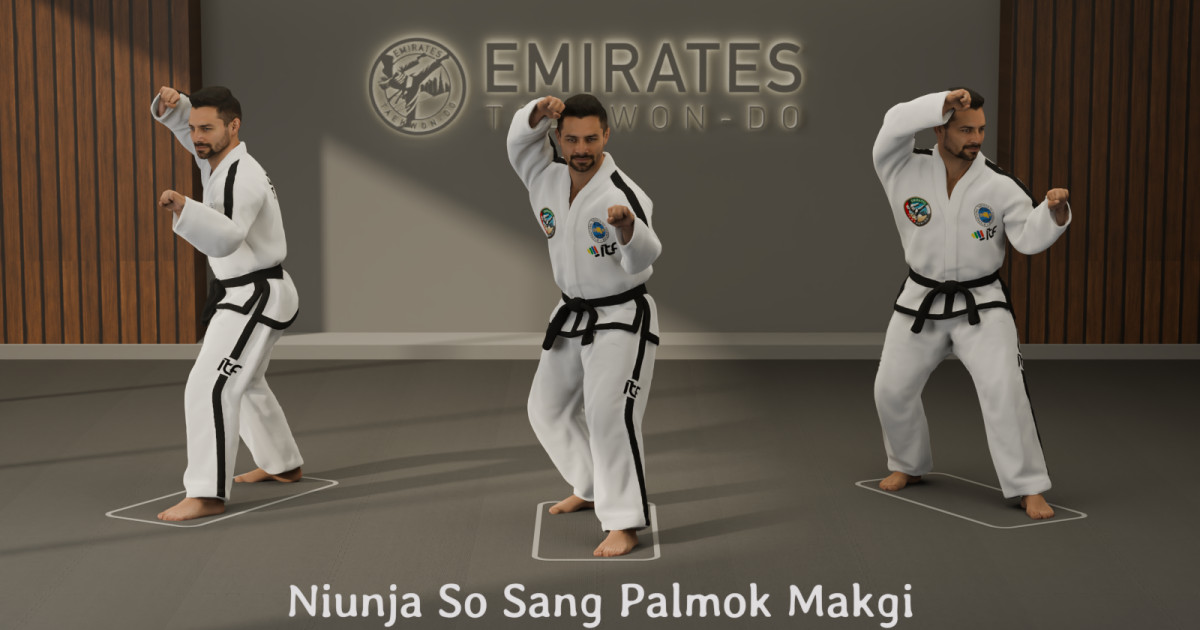

L-stance base
| Stance point | Requirement |
|---|---|
| Length | 1.5 shoulder widths long |
| Length measuring point | Measured from the inner foot-sword of the rear foot to the toes of the front foot |
| Width | Minimal lateral width, with the heels separated by roughly 1 inch or 2.5 cm |
| Weight distribution | 70% on the rear leg and 30% on the front leg |
| Rear foot | Turns 15 degrees inward |
| Front foot | Points 15 degrees inward from the line of attack |
| Body structure | Compact, stable, and suitable for side defence |
Main technical rules
| Rule | Technical requirement |
|---|---|
| Simultaneous defence | The technique can block attacks coming at the same time from the front and the side. |
| Primary defence | The side block is the primary defence. |
| Side forearm level | The side blocking forearm usually performs a middle block. |
| Front defence | A rising block may also be effective against an attack toward the forehead. |
| Common stances | L-Stance and Rear Foot Stance are chiefly used. |
| Stance exception | Twin Forearm Block can be performed with nearly all stances except Walking Stance. |
Forearm relationship
| L-Stance side | Forearm relationship |
|---|---|
| Left L-Stance | Bring the right forearm inside of the left forearm. |
| Right L-Stance | Bring the left forearm inside of the right forearm. |
| General rule | The inside forearm changes according to the side of the L-Stance. |
How to execute the technique
Begin from a correct L-Stance. The stance should be narrow, rear-weighted, and stable. The rear leg carries 70% of the body weight, the front leg carries 30%, and the body should remain controlled enough to defend to the side while also covering the front line.
The two forearms move into position together. The technique is designed for a situation where attacks may arrive from the front and the side at the same time. Even though both arms are used, the side block is the primary defensive action. The side blocking forearm usually performs a middle block.
The other forearm may perform a rising-type defensive action against an attack toward the forehead. However, the side block remains the main defence. The student should not give equal tactical priority to both arms if doing so weakens the side block. The structure should show clearly which arm is defending the side line.
When blocking from a left L-Stance, bring the right forearm inside of the left forearm. When blocking from a right L-Stance, bring the left forearm inside of the right forearm. This forearm relationship should be checked carefully because reversing it changes the intended structure of the technique.
Side block priority
The side block is the primary defence in Twin Forearm Block. This is an important correction point because students often focus on the high arm and forget that the side attack is the main danger being addressed. The side blocking forearm usually performs a middle block and should be placed with clear purpose.
The side block should not be weak, decorative, or pulled too close to the body. It must be able to intercept the side attack. At the same time, it should not be extended carelessly beyond the point of focus. The blocking arm should remain structured and ready to recover after contact.
The L-Stance supports this side defence by keeping most of the weight on the rear leg and presenting a narrower body line. If the stance becomes too square, too wide, or too forward-heavy, the side-blocking structure becomes less effective.
Front defence
The front defensive arm may be used against an attack toward the forehead. In this context, a rising block may also be effective. However, the encyclopedia reference makes clear that the side block remains the primary one. The front arm should support the whole defensive structure without taking attention away from the side block.
The student should avoid lifting the front arm without structure. The arm must protect the correct line and coordinate with the side blocking forearm. Both forearms should finish as one organized shape, supported by the stance, shoulders, and hips.
The technique should not be performed as two separate blocks placed together randomly. It is a coordinated twin forearm action designed for simultaneous threat lines.
Body and stance control
L-Stance is chiefly used for Twin Forearm Block because it gives the body a compact defensive base. The stance should remain 1.5 shoulder widths long, with minimal lateral width. The rear leg keeps 70% of the weight, and the front leg keeps 30%.
The body should not drift into Walking Stance. Twin Forearm Block is specifically noted as being usable with nearly all stances except Walking Stance. If the student shifts too much weight forward or lengthens the stance incorrectly, the technique loses the correct L-Stance structure.
The practitioner should also avoid excessive shoulder tension. The forearms must be strong enough to block, but the body should remain flexible enough to recover or counterattack. The stance gives the base, the hips and shoulders organize the direction, and the forearms protect the front and side lines.
Reference checklist
| Check | Correct standard |
|---|---|
| Technique | L-Stance Twin Forearm Block (Niunja So Sang Palmok Makgi) |
| Technique family | Blocking technique, or Makgi |
| Stance | L-Stance, or Niunja Sogi |
| Blocking tools | Both forearms |
| Purpose | Block simultaneous attacks from the front and side |
| Primary defence | Side block |
| Side forearm | Usually performs a middle block |
| Front defence | May defend against an attack toward the forehead |
| Left L-Stance | Right forearm inside of left forearm |
| Right L-Stance | Left forearm inside of right forearm |
| Stance exception | Not performed with Walking Stance |
Common technical errors
A common error is treating both forearms as equal without recognizing that the side block is the primary defence. The side blocking forearm usually performs a middle block and must be placed with clear defensive purpose.
Another error is using the wrong inside forearm relationship. From a left L-Stance, the right forearm comes inside of the left forearm. From a right L-Stance, the left forearm comes inside of the right forearm. Reversing this relationship changes the technical structure.
Students also commonly shift out of L-Stance. The stance should remain rear-weighted, with 70% of the weight on the rear leg and 30% on the front leg. It should not become Walking Stance, since Twin Forearm Block is performed with nearly all stances except Walking Stance.
Another error is lifting the front arm without useful protection. A rising-type defence may be effective against an attack toward the forehead, but it must remain connected to the whole twin forearm structure. The two arms should not look like separate movements.
The final error is over-tensing the shoulders. The forearms must be structured enough to block, but the body should remain flexible and ready for the next movement. A correct Twin Forearm Block should look compact, coordinated, and defensive from both the front and side lines.
Key principle
Twin Forearm Block uses both forearms to defend against simultaneous front-and-side attacks, but the side blocking forearm is the primary defence.
Technical purpose
L-Stance Twin Forearm Block, called Niunja So Sang Palmok Makgi in Korean terminology, is an ITF Taekwon-Do defensive technique used to block a simultaneous attack from the front and the side. It uses both forearms at the same time, but the side block is the primary defence.
Twin Forearm Block, or Sang Palmok Makgi, can be performed with nearly all stances except Walking Stance. However, L-Stance and Rear Foot Stance are chiefly used. This article focuses specifically on the L-Stance version.
This is a technical reference. It focuses on the L-Stance base, twin forearm structure, side-block priority, front-and-side defensive purpose, forearm relationship, and common technical errors.
Technique identity
| Item | Technical reference |
|---|---|
| Technique name | L-Stance Twin Forearm Block |
| Korean terminology | Niunja So Sang Palmok Makgi |
| Technique family | Blocking technique, or Makgi |
| Block type | Twin forearm block, or Sang Palmok Makgi |
| Stance | L-Stance, or Niunja Sogi |
| Blocking tools | Both forearms |
| Main purpose | Block simultaneous attacks from the front and the side |
| Primary defence | The side block |