
Technical purpose
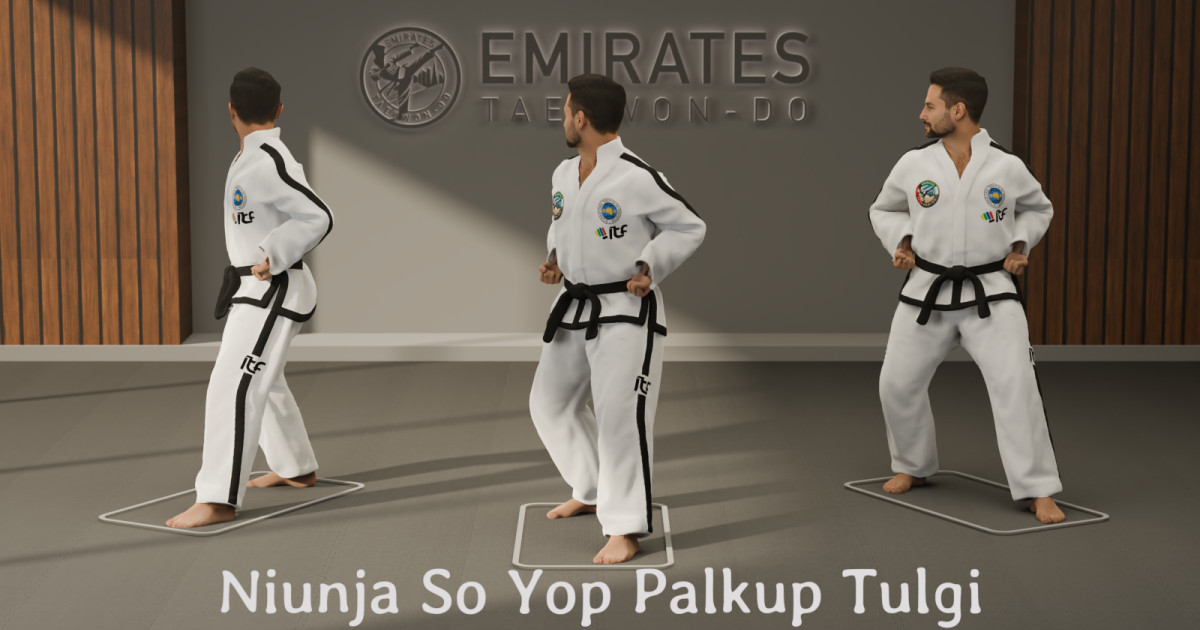
L-Stance Side Elbow Thrust, called Niunja So Yop Palkup Tulgi in Korean terminology, is an ITF Taekwon-Do thrusting technique performed from L-Stance using the side elbow, or Yop Palkup, as the attacking tool.
Side Thrust, or Yop Tulgi, is defined by the body becoming half facing or side facing the target at the moment of impact. In the L-Stance version, the body and shoulders remain half facing, because L-Stance is a half-facing stance.
This article focuses on the single side elbow version. According to the encyclopedia reference, single side elbow is executed from L-Stance, Rear Foot Stance, or Fixed Stance, and is normally performed in a sliding motion.
Key principle
The side elbow thrust is delivered from a half-facing L-Stance, normally with sliding motion, with the thrusting elbow slightly raised and the back fist facing downward at impact.
Technique identity
| Item | Technical reference |
|---|---|
| Technique name | L-Stance Side Elbow Thrust |
| Korean terminology | Niunja So Yop Palkup Tulgi |
| Short technique name | Yop Palkup Tulgi |
| Technique family | Thrusting technique, or Tulgi |
| Thrust type | Side thrust, or Yop Tulgi |
| Stance | L-Stance, or Niunja Sogi |
| Attacking tool | Side elbow, or Yop Palkup |
| Version | Single side elbow, or Wae Yop Palkup |
| Body facing | Half facing at the moment of impact |
L-stance base
| Stance point | Correct standard |
|---|---|
| Length | Approximately 1.5 shoulder widths |
| Length measuring point | From the footsword of the rear foot to the toes of the front foot |
| Foot angle | Toes of both feet point about 15 degrees inward |
| Weight distribution | About 70% on the rear leg and 30% on the front leg |
| Rear leg | Bent and carrying most of the body weight |
| Front leg | Bent proportionally and kept lighter |
| Facing | Half facing |
Side thrust and side elbow rules
| Rule | Technical requirement |
|---|---|
| Side thrust definition | If the body becomes half facing or side facing the target at the moment of impact, it is called a side thrust. |
| Main tools for side thrust | Flat fingertip and side elbow play the main part in this technique. |
| Other frequent tools | Forefinger and twin side elbow are also frequently used. |
| Single side elbow stances | L-Stance, Rear Foot Stance, and Fixed Stance. |
| Twin side elbow stances | X-Stance, Parallel Stance, Close Stance, Sitting Stance, Walking Stance, and One-Leg Stance. |
| Motion | Single side elbow is normally performed in a sliding motion. |
Targets and final position
| Check | Correct standard |
|---|---|
| Main targets | Philtrum and solar plexus |
| Secondary targets | Floating ribs and chest |
| Back fist | Faces downward at the moment of impact |
| Thrusting elbow | Slightly raised at the moment of impact |
| Body line | Half facing in the L-Stance version |
| Impact quality | Compact, direct, and supported by the stance and sliding motion |
How to execute the technique
Begin from a correct L-Stance. The stance should remain narrow, rear-weighted, and half facing. The rear leg carries about 70% of the body weight, while the front leg carries about 30%. Do not let the stance shift into Walking Stance or become full facing during the thrust.
The side elbow is driven toward the target in a compact side-thrusting action. The technique is normally performed in a sliding motion, so the body should move as one unit rather than leaving the elbow disconnected from the stance.
At the moment of impact, keep the back fist facing downward and keep the thrusting elbow slightly raised. The elbow should not point toward the side rear. The direction of the elbow must match the target line.
The main targets are the philtrum and solar plexus. The floating ribs and chest may also be secondary targets. Because the elbow is a close-range tool, the technique should be compact, controlled, and structurally supported by the L-Stance.
Half-facing shoulders
In the L-Stance version, the shoulders should remain half facing at the moment of impact. This matches the definition of a side thrust and preserves the defensive structure of Niunja Sogi.
The half-facing shoulder line should not be created by twisting only the upper body. The stance, hips, shoulders, and elbow must work together. If the shoulders become full facing, the elbow thrust loses its side-thrust structure and the body becomes more exposed.
The correction is simple: keep the L-Stance rear-weighted, keep the shoulders half facing, slide with control, and let the side elbow reach the target without opening the body unnecessarily.
Back fist and elbow position
The back fist must face downward at the moment of impact. This is a specific technical requirement of the side elbow action. The fist position helps keep the elbow and forearm organized and prevents the technique from becoming a loose body movement.
The thrusting elbow should be slightly raised. It should not drop below the target line, and it should not point backward. If the elbow points toward the side rear, the attacking tool cannot reach the target efficiently.
The opposite palm should not be brought incorrectly to the forefist in a way that redirects the elbow backward. The supporting hand relationship must assist the thrust, not distort the elbow line.
Reference checklist
| Check | Correct standard |
|---|---|
| Technique | L-Stance Side Elbow Thrust (Niunja So Yop Palkup Tulgi) |
| Technique family | Thrusting technique, or Tulgi |
| Stance | L-Stance, or Niunja Sogi |
| Tool | Side elbow, or Yop Palkup |
| Version | Single side elbow, or Wae Yop Palkup |
| Main targets | Philtrum and solar plexus |
| Secondary targets | Floating ribs and chest |
| Motion | Normally performed in sliding motion |
| Body facing | Half facing at impact |
| Back fist | Faces downward at impact |
| Thrusting elbow | Slightly raised at impact |
Common technical errors
A common error is pointing the thrusting elbow toward the side rear. When this happens, the elbow no longer travels correctly into the target. The encyclopedia warning connects this error to bringing the opposite palm to the forefist incorrectly.
Another error is losing the half-facing body line. Since the technique is performed from L-Stance and belongs to the side thrust family, the body and shoulders should remain half facing at the moment of impact.
Students also commonly make the motion too large. Side elbow thrust is a close-range technique. The elbow should be compact, direct, and supported by sliding motion rather than being swung loosely.
Another frequent error is forgetting the back fist position. The back fist should face downward at impact. If the fist turns incorrectly, the elbow line and body structure are usually affected.
The final error is disconnecting the elbow from the stance. The L-Stance should remain rear-weighted and stable. The elbow, shoulders, hips, and sliding motion should arrive together at the moment of impact.