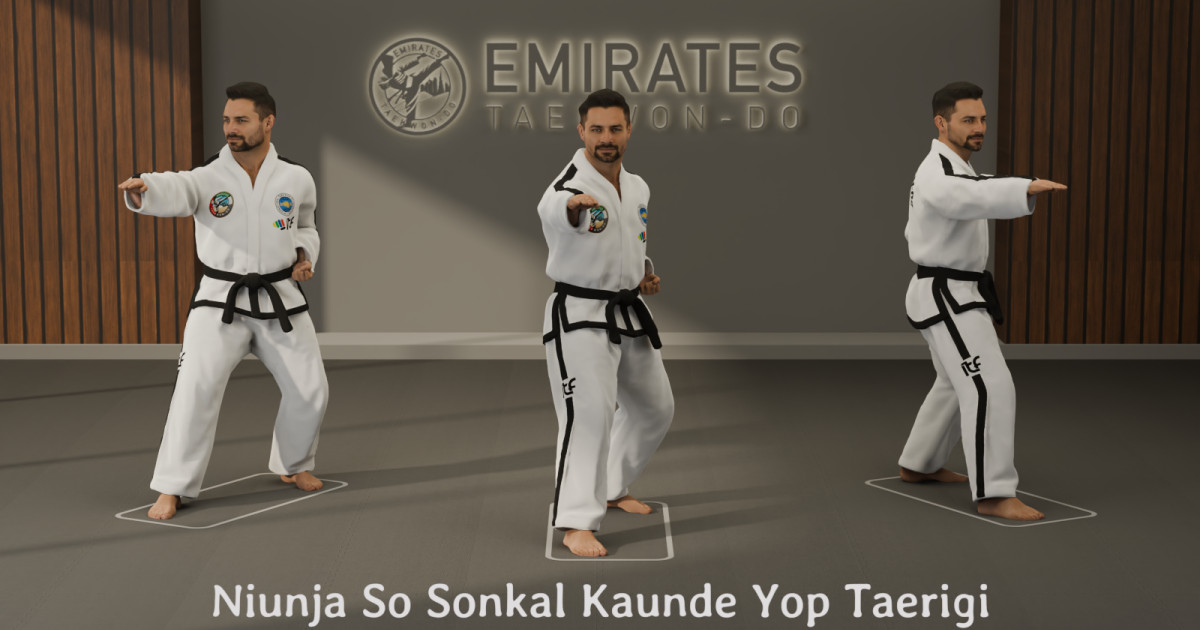

Technique identity
| Item | Technical reference |
|---|---|
| Technique name | L-Stance Middle Side Knife-Hand Strike |
| Korean terminology | Niunja So Sonkal Kaunde Yop Taerigi |
| Short technique name | Sonkal Kaunde Yop Taerigi |
| Technique family | Striking technique, or Taerigi |
| Strike type | Side strike, or Yop Taerigi |
| Stance | L-Stance, or Niunja Sogi |
| Attacking tool | Knife-hand, or Sonkal |
| Target level | Middle section, or Kaunde |
| Body facing | Half facing at the moment of impact |
L-stance base
| Stance point | Requirement |
|---|---|
| Length | 1.5 shoulder widths long |
| Length measuring point | Measured from the inner foot-sword of the rear foot to the toes of the front foot |
| Width | Minimal lateral width, with the heels separated by roughly 1 inch or 2.5 cm |
| Weight distribution | 70% on the rear leg and 30% on the front leg |
| Rear foot | Turns 15 degrees inward |
| Front foot | Points 15 degrees inward from the line of attack |
| Body structure | Compact, rear-weighted, and half facing at the moment of impact |
Side strike rules
| Rule | Technical requirement |
|---|---|
| Body facing | If the body becomes half facing or side facing the target at the moment of impact, the technique is called a side strike. |
| Form of movement | Side strike is executed in the form of an outward strike. |
| Primary tools | The knife-hand and back fist are primary weapons for side strike. |
| Occasional tools | The side fist and back hand may also be used in some cases. |
| Tool alignment | The attacking tool forms a straight line with the center of the shoulders at the moment of impact. |
| Point of focus | The knife-hand must not pass the point of focus. |
Knife-hand side strike use
| Point | Technical reference |
|---|---|
| Mainly used stances | Knife-Hand Side Strike is mainly executed from Sitting Stance, Close Stance, L-Stance, and X-Stance. |
| Occasional stances | It may also be used from Parallel Stance, One-Leg Stance, Vertical Stance, Diagonal Stance, or Walking Stance. |
| L-Stance rule | A reverse strike is normal in L-Stance. |
| This article | Uses L-Stance, middle-section target, knife-hand tool, and half-facing shoulders. |
How to execute the technique
Begin from a correct L-Stance. The stance should be 1.5 shoulder widths long, narrow in lateral width, and rear-weighted. The rear leg carries 70% of the body weight, while the front leg carries 30%. The stance must remain stable and compact before the strike is judged.
The strike is delivered with the knife-hand to the middle section. The action is a side strike, so it is executed in the form of an outward strike. The attacking tool must travel to the target with clear direction and should not swing beyond the intended point of focus.
At the moment of impact, the shoulders should be half facing. The shoulder line should not become full facing. The hips, shoulders, stance, and knife-hand should coordinate together so the body presents a narrower target while the attacking tool reaches the middle-section line.
The attacking knife-hand should form a straight line with the center of the shoulders at the moment of impact. This is one of the main visual checks for the technique. If the hand finishes outside this line or passes too far beyond the focus point, the strike loses its correct structure.
Half-facing shoulders
The shoulders must be half facing at the moment of impact in this version of the technique. This means the chest is not squared fully toward the target. The shoulders are angled so the practitioner keeps the body narrower while the knife-hand reaches the target line.
Half-facing shoulders should not be created by twisting only the upper body. The L-Stance, hips, shoulders, and striking arm must work together. If the shoulders turn independently from the stance, the strike becomes disconnected and the balance may suffer.
The correction is simple: keep the L-Stance rear-weighted, angle the shoulders into half facing, keep the body upright, and let the knife-hand finish on a straight line with the center of the shoulders.
Reverse strike in L-stance
For Knife-Hand Side Strike, a reverse strike is normal in L-Stance. This means the striking hand is commonly the hand opposite the leading or front leg, according to the required movement. The exact side depends on the stance direction and the technique being performed.
The reverse-strike action should not change the stance. L-Stance remains rear-weighted, with 70% of the body weight on the rear leg and 30% on the front leg. The stance should not drift into Walking Stance, and the body should not become square to the target.
The important technical relationship is that the knife-hand reaches the middle-section target while the body remains half facing and the attacking tool aligns with the center of the shoulders at impact.
Point of focus and line of impact
The attacking tool must not pass the point of focus. Passing the focus point is a specific error in the encyclopedia reference because it causes the knife-hand to overtravel and lose the correct target relationship.
The knife-hand should finish at the intended middle-section target, not beyond it. The strike should be outward, controlled, and direct. If the hand continues past the focus point, the body may fail to keep the correct facing and the strike may lose power and accuracy.
At impact, the attacking tool forms a straight line with the center of the shoulders. This line connects the hand to the body structure. The student should check the shoulder line, elbow position, knife-hand angle, and stance together rather than judging the hand in isolation.
Reference checklist
| Check | Correct standard |
|---|---|
| Technique | L-Stance Middle Side Knife-Hand Strike (Niunja So Sonkal Kaunde Yop Taerigi) |
| Technique family | Striking technique, or Taerigi |
| Strike type | Side strike, or Yop Taerigi |
| Stance | L-Stance, or Niunja Sogi |
| Attacking tool | Knife-hand, or Sonkal |
| Target level | Middle section, or Kaunde |
| Facing | Half facing at the moment of impact |
| Shoulders | Half facing, not full facing |
| Movement form | Outward strike |
| L-Stance strike type | Reverse strike is normal |
| Tool line | Attacking tool forms a straight line with the center of the shoulders |
| Focus | Knife-hand must not pass the point of focus |
Common technical errors
A common error is finishing with the shoulders full facing. In this L-Stance version, the shoulders should be half facing at the moment of impact. If the body becomes too square, the movement no longer shows the correct side-strike structure.
Another error is allowing the knife-hand to pass the point of focus. The strike must stop at the intended target line. If the hand overtravels, the technique loses accuracy and the practitioner may fail to keep the correct facing.
Students also commonly lose the straight-line relationship between the attacking tool and the center of the shoulders. At the moment of impact, the knife-hand should align with the shoulder center. If the hand finishes outside that line, the strike becomes disconnected from the body.
Another frequent error is collapsing the L-Stance into a forward-heavy position. L-Stance should remain 70% on the rear leg and 30% on the front leg. The stance must stay compact and rear-weighted to support the half-facing strike.
The final error is treating the movement as a general arm swing. Yop Taerigi is an outward striking action with a defined target, tool, facing, and focus point. The knife-hand, shoulders, hips, and L-Stance must finish together at impact.
Key principle
The knife-hand must strike outward to the middle section while the shoulders remain half facing and the attacking tool forms a straight line with the center of the shoulders at impact.
Technical purpose
L-Stance Middle Side Knife-Hand Strike, called Niunja So Sonkal Kaunde Yop Taerigi in Korean terminology, is an ITF Taekwon-Do striking technique performed from L-Stance to the middle section. It uses the knife-hand, or Sonkal, as the attacking tool.
Side Strike, or Yop Taerigi, is defined by the body becoming half facing or side facing the target at the moment of impact. It is executed in the form of an outward strike. In this article, the required shoulder position is half facing at the moment of impact.
This article is a technical reference. It focuses on the L-Stance base, knife-hand attacking tool, middle-section target, half-facing shoulders, side-strike line, reverse-strike use in L-Stance, point of focus, and common technical errors.