
Exam overview
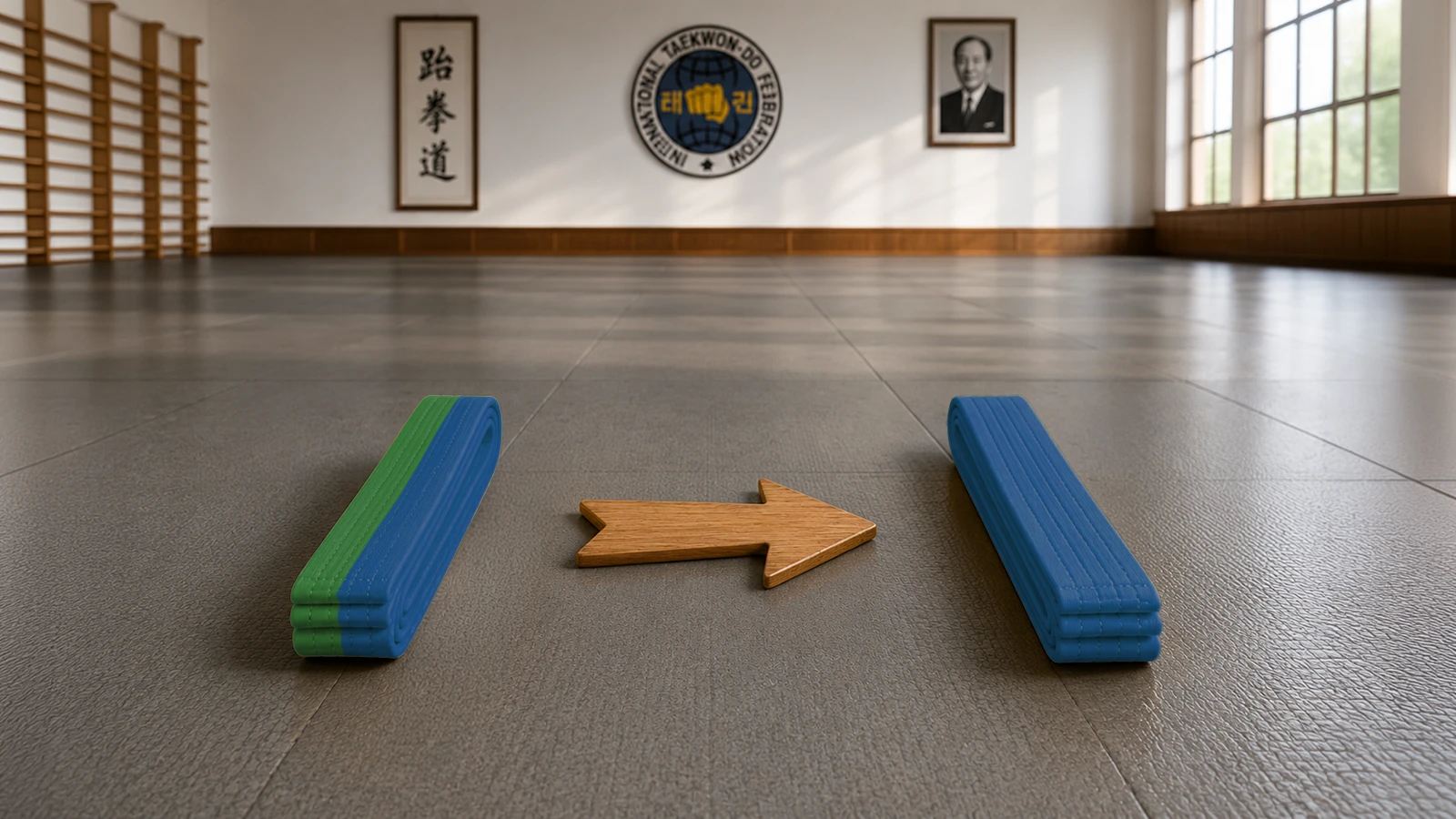
This syllabus is for Green-Blue Belt, 5th Gup students preparing for promotion to Blue Belt, 4th Gup. It gives students one clear online reference for the exam areas they must practise and study before grading.
The exam areas for this level are fundamental movements, the kick, pattern, and theory. Students should be able to demonstrate stronger technical control than in the previous ranks, especially in walking stance, L-stance, elbow striking, twin knife-hand blocking, double forearm blocking, and reverse side kicking. Students must also know Yul-Gok Tul, including its number of movements and exact meaning. The theory for this level compares Taekwon-Do with other martial arts and explains the difference between martial arts and sports.
Green-Blue-syllabus.pdf
Open PDFFundamental movements
The first exam area is fundamental movements. These are the required movements that green-blue belt students must practise before promotion to blue belt. They require accurate stance, correct tool, correct direction, clean preparation, and a clear final position.
- Walking Stance Front Elbow Strike — Gunnun So Ap Palkup Taerigi
- L-Stance Twin Knife-hand Block — Niunja So Sang Sonkal Makgi
- Walking Stance Double Forearm High Block — Gunnun So Doo Palmok Nopunde Makgi
Students should practise each movement slowly first, then with stronger rhythm and breathing. At this grade, the examiner should see that the student understands how stance, tool, height, and technique type work together. Each movement should be deliberate, balanced, and technically clear.
Technique details
In Gunnun So Ap Palkup Taerigi, the stance is walking stance, the tool is front elbow, and the technique type is strike. The elbow must travel on a clear line and finish with the body stable. Do not let the shoulders lift or the stance shorten as the elbow strike finishes.
In Niunja So Sang Sonkal Makgi, the stance is L-stance and the blocking tool is twin knife-hand. The two hands must work together as one defensive action, not as two disconnected movements. In Gunnun So Doo Palmok Nopunde Makgi, the tool is double forearm, the height is high, and the technique type is block. Do not place the word double as a loose description at the end of the name. In ITF terminology, Doo Palmok identifies the tool.
The kick
The required kick for this exam is Reverse Side Kick, called Mondora Yop Chagi. This kick requires stronger control than the earlier side kick because the student must manage rotation, direction, balance, chamber, extension, recovery, and landing.
When practising, begin slowly. Turn the body with control, find the target line, chamber the leg, extend the side kick directly, retract the leg, and land safely. Do not spin blindly or allow the upper body to collapse. The examiner should see awareness before the kick, control during the turn, and balance after the kick. Height is not the priority. A lower reverse side kick with clean mechanics is better than a high kick that loses posture, direction, or recovery.
Pattern requirement
The required pattern is Yul-Gok Tul. Yul-Gok has 38 movements. Students must know the pattern name, number of movements, starting position, sequence, direction changes, diagram, and correct finishing point.
Yul-Gok is a major step in the student’s pattern development. It includes more complex timing, stronger changes of direction, and techniques that require mature coordination. Students should connect the pattern to the fundamental movements for this grade, especially front elbow strike, twin knife-hand block, and double forearm high block. Do not perform Yul-Gok as a memory race. Each movement should show clear stance, correct tool, proper height, breathing, rhythm, and control. Practise slowly until the sequence is reliable, then increase confidence without sacrificing accuracy.
Meaning of Yul-Gok
Students must memorise the meaning of Yul-Gok exactly as follows:
YUL-GOK: It is the pseudonym of a great philosopher and scholar YiI (1536-1584) nicknamed the "Confucius of Korea". The 38 movements of this pattern refer to his birthplace on 38° latitude and the diagram represents "scholar".
This meaning should be learned word by word. During the theory section of the exam, students should be able to say it clearly, without changing the name, dates, movement count, reference to 38° latitude, or the diagram meaning. A short and accurate answer is better than a long answer with mistakes. Students should also remember that every Tul has a name, meaning, movement count, diagram, and role in the student’s progression.
Taekwon-Do and martial arts
The theory for this grade explains how Taekwon-Do differs from other martial arts. Taekwon-Do places strong emphasis on powerful kicking and punching techniques, combined with blocking techniques and stances. It is a dynamic martial art based on movement, speed, strength, and technical precision.
This can be contrasted with systems that focus more on conserving energy, minimising effort, or using highly stylised movements. Taekwon-Do contains both practical and formal elements. The techniques can be used in sparring and self-defence, but there is also an artistic and disciplined component, especially in patterns. Students should understand that they cannot choose only one side of the art for grading. To progress, they must train both the practical side and the formal side: sparring, self-defence, patterns, fundamental movements, and theory.
Martial arts and sports
The theory also explains the difference between martial arts and sports. Martial sports often train with direct competitive rules, timing, pressure, and active resistance. Traditional martial arts may include techniques that are considered dangerous, so they are sometimes practised carefully, slowly, or with modified contact. Both approaches have value, but both also have weaknesses if practised without balance.
Students should not dismiss sport training methods, and they should not dismiss traditional training either. Taekwon-Do students should keep an open mind and continually examine weaknesses in their own training. For self-defence, students need awareness, timing, distance, control, and the ability to respond under pressure. For martial development, they also need discipline, patterns, etiquette, theory, and moral training. A good student studies both the practical and the traditional dimensions of the art.
Exam checklist
Before the exam, students should check that they can demonstrate every area from this syllabus. They should practise Gunnun So Ap Palkup Taerigi, Niunja So Sang Sonkal Makgi, Gunnun So Doo Palmok Nopunde Makgi, Mondora Yop Chagi, and Yul-Gok Tul with 38 movements.
Students should also be able to recite the meaning of Yul-Gok exactly, explain how Taekwon-Do differs from other martial arts, and explain the difference between martial arts and sports. On exam day, wear a clean Dobok, tie the belt correctly, bow properly, listen carefully, and correct mistakes without frustration. Promotion to Blue Belt, 4th Gup should show stronger technical maturity, better pattern control, accurate terminology, and a wider understanding of Taekwon-Do as both a martial art and a disciplined training system.