
Exam overview
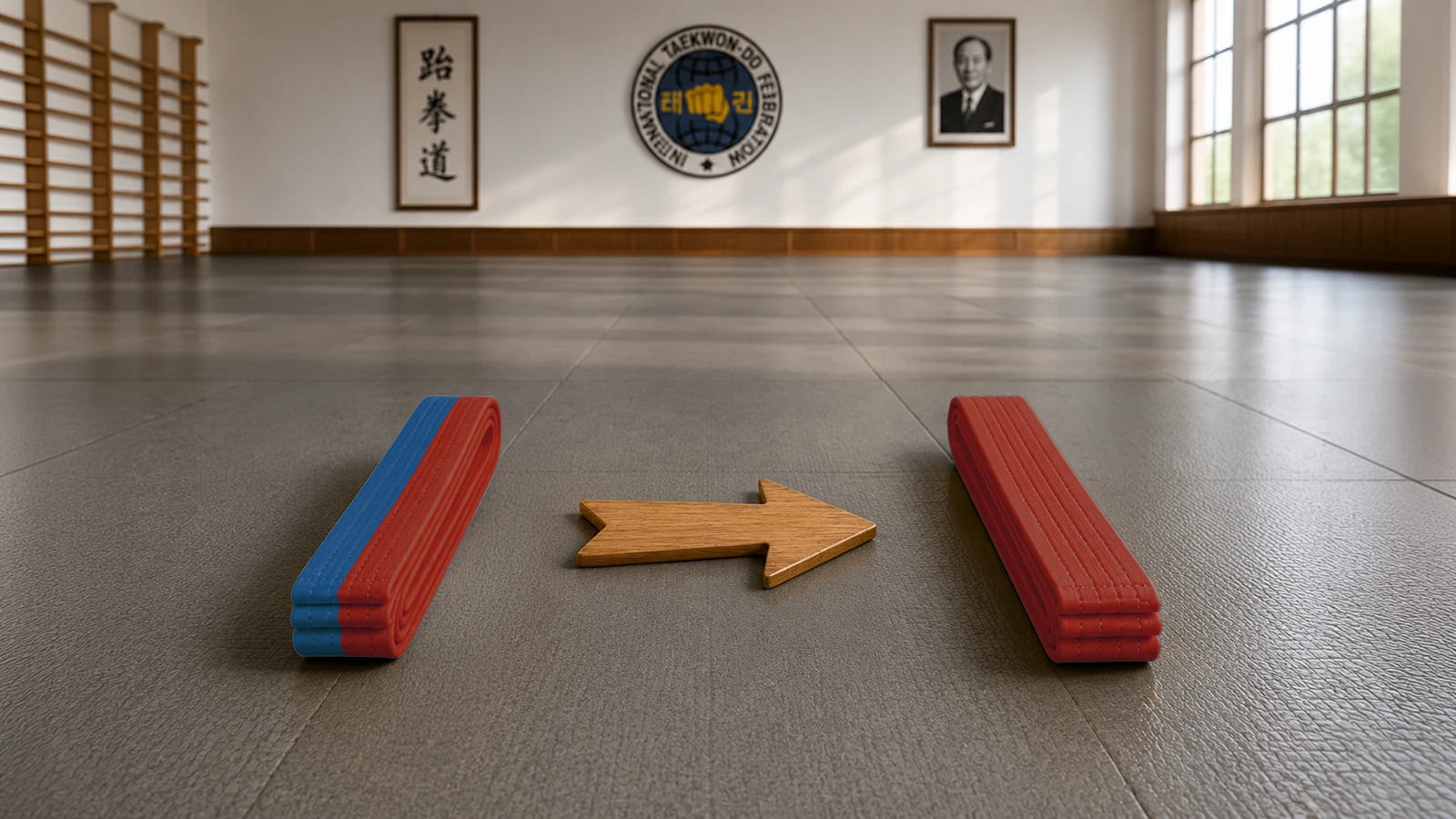
This syllabus is for Blue-Red Belt, 3rd Gup students preparing for promotion to Red Belt, 2nd Gup. It gives students one clear online reference for the exam areas they must practise and study before grading.
The exam areas for this level are fundamental movements, the kick, pattern, and theory. Students should be able to demonstrate more mature control in walking stance, sitting stance, X-fist pressing block, upset fingertip low thrust, and outer forearm W-shape block. They must also know Toi-Gye Tul, including its 37 movements and exact meaning. The theory for this level is the Theory of Power, which explains how force is produced in Taekwon-Do.
Blue-Red-syllabus.pdf
Open PDFFundamental movements
The first exam area is fundamental movements. These are the required movements that blue-red belt students must practise before promotion to red belt. Each movement should be performed with correct stance, correct tool, correct direction, preparation, breath control, and a clean final position.
- Walking Stance X-Fist Pressing Block — Gunnun So Kyocha Joomuk Noollo Makgi
- Walking Stance Upset Fingertip Low Thrust — Gunnun So Dwijibun Sonkut Najunde Tulgi
- Sitting Stance Outer Forearm W-Shape Block — Annun So Bakat Palmok San Makgi
At this grade, the examiner should see accuracy, not only memory. The student must show the correct stance, the correct attacking or blocking tool, the correct height, and the correct technique type.
Technique details
In Gunnun So Kyocha Joomuk Noollo Makgi, the stance is walking stance, the tool is X-fist, the purpose is pressing, and the technique type is block. The block must finish with clear downward pressure and stable posture. Do not lift the shoulders or allow the hands to separate loosely.
In Gunnun So Dwijibun Sonkut Najunde Tulgi, the stance is walking stance, the tool is upset fingertip, the height is low, and the technique type is thrust. The word Dwijibun describes the orientation of the fingertip tool, so it should not be treated as an upset thrust. In Annun So Bakat Palmok San Makgi, the stance is sitting stance, the tool is outer forearm, and San Makgi is W-shape block. The arms must finish symmetrically with strong stance control.
The kick
The required kick for this exam is Twisting Kick, called Bituro Chagi. This kick requires control of the hip, knee, supporting leg, and target line. It should not be confused with turning kick or side kick. The path, direction, and final angle of the attacking tool must be clearly shown.
When practising, begin slowly. Chamber the leg, rotate the hip correctly, twist through the target line, recover the leg, and land with balance. The kick should be controlled from start to finish. Do not chase height before structure. A lower twisting kick with correct line, balance, and recovery is better than a high kick that loses posture or direction. The examiner should see technical understanding, not only flexibility.
Pattern requirement
The required pattern is Toi-Gye Tul. Toi-Gye has 37 movements. Students must know the pattern name, number of movements, starting position, sequence, direction changes, diagram, and correct finishing point.
Toi-Gye is a demanding pattern that requires stronger concentration, precise rhythm, and clear control of stance transitions. The student should connect the pattern to the fundamental movements for this grade, especially X-fist pressing block, upset fingertip low thrust, and sitting stance outer forearm W-shape block. The pattern should not be performed as a memory race. Each movement should show stance, tool, height, direction, breathing, rhythm, and technical control from beginning to end.
Meaning of Toi-Gye
Students must memorise the meaning of Toi-Gye exactly as follows:
TOI-GYE: It is the pen name of the noted scholar Yi Hwang (16th century), an authority on neo-Confucianism. The 37 movements of the pattern refer to his birthplace on 37° latitude, the diagram represents "scholar".
This meaning should be learned word by word. During the theory section of the exam, students should be able to say it clearly, without changing the name, historical reference, movement count, latitude reference, or diagram meaning. A short and accurate answer is better than a long answer with mistakes.
Theory of power
The theory for this grade is Theory of Power, called Him Ui Wolli. Students must understand the six main factors: reaction force, concentration, equilibrium, breath control, mass, and speed. These principles explain why Taekwon-Do techniques can become powerful when the body is used correctly.
The Theory of Power is not only written theory. It must be seen in movement. A technique becomes stronger when the student uses the body as one unit, maintains balance, coordinates breathing, directs the correct tool to the correct target, and completes the movement with speed and control. At blue-red belt level, students should begin connecting these principles to patterns, fundamental movements, kicking, sparring, and self-defence.
Reaction and concentration
Reaction force, or bandong ryok, means that every force has an equal and opposite force. In Taekwon-Do, this can be seen when the opposite hand pulls back to the hip as the punching hand moves forward. The reaction hand helps the attacking hand by coordinating the body in the opposite direction.
Concentration, or jip joong, means focusing the body’s power into the correct tool at the correct moment and directing that force into the opponent’s vital spot. The larger muscles around the hip and abdomen should help the technique, not remain disconnected. This is why the hip and abdomen are used slightly before the hands or feet in attack and defence. Students should practise making one focused action rather than many loose movements.
Balance and breathing
Equilibrium, or kyun hyung, means keeping the body balanced. A technique is more effective when the body is stable before, during, and after impact. Equilibrium includes both static stability and dynamic stability. The student must be able to move quickly without losing the ability to recover. Flexibility, knee spring, and correct weight distribution all help maintain balance.
Breath control, or hohup jojul, affects stamina, speed, and power. Students should exhale at the critical moment of impact and should never inhale while focusing a block or blow. Poor breathing weakens movement and can reduce control. Students should also learn to conceal fatigue through controlled breathing. In patterns and fundamental movements, breathing should support the technique instead of interrupting it.
Mass and speed
Mass, or zilyang, means using body weight correctly. Maximum force is increased when body weight is applied through the motion of turning the hip and coordinating the whole body into the technique. A strike or block should not rely only on the arm or leg. The body must support the tool.
Speed, or sokdo, is the most essential factor of force or power. Scientifically, force is connected to mass and acceleration. In practical training, this means a technique should be sharp, direct, and correctly timed. Speed without balance becomes uncontrolled. Mass without speed becomes heavy and slow. A strong Taekwon-Do technique needs both, supported by correct breathing, concentration, and equilibrium.
Exam checklist
Before the exam, students should check that they can demonstrate every area from this syllabus. They should practise Gunnun So Kyocha Joomuk Noollo Makgi, Gunnun So Dwijibun Sonkut Najunde Tulgi, Annun So Bakat Palmok San Makgi, Bituro Chagi, and Toi-Gye Tul with 37 movements.
Students should also be able to recite the meaning of Toi-Gye exactly and explain the Theory of Power: reaction force, concentration, equilibrium, breath control, mass, and speed. On exam day, wear a clean Dobok, tie the belt correctly, bow properly, listen carefully, and correct mistakes without frustration. Promotion to Red Belt, 2nd Gup should show technical maturity, accurate terminology, strong theory knowledge, and disciplined movement.