
Exam overview
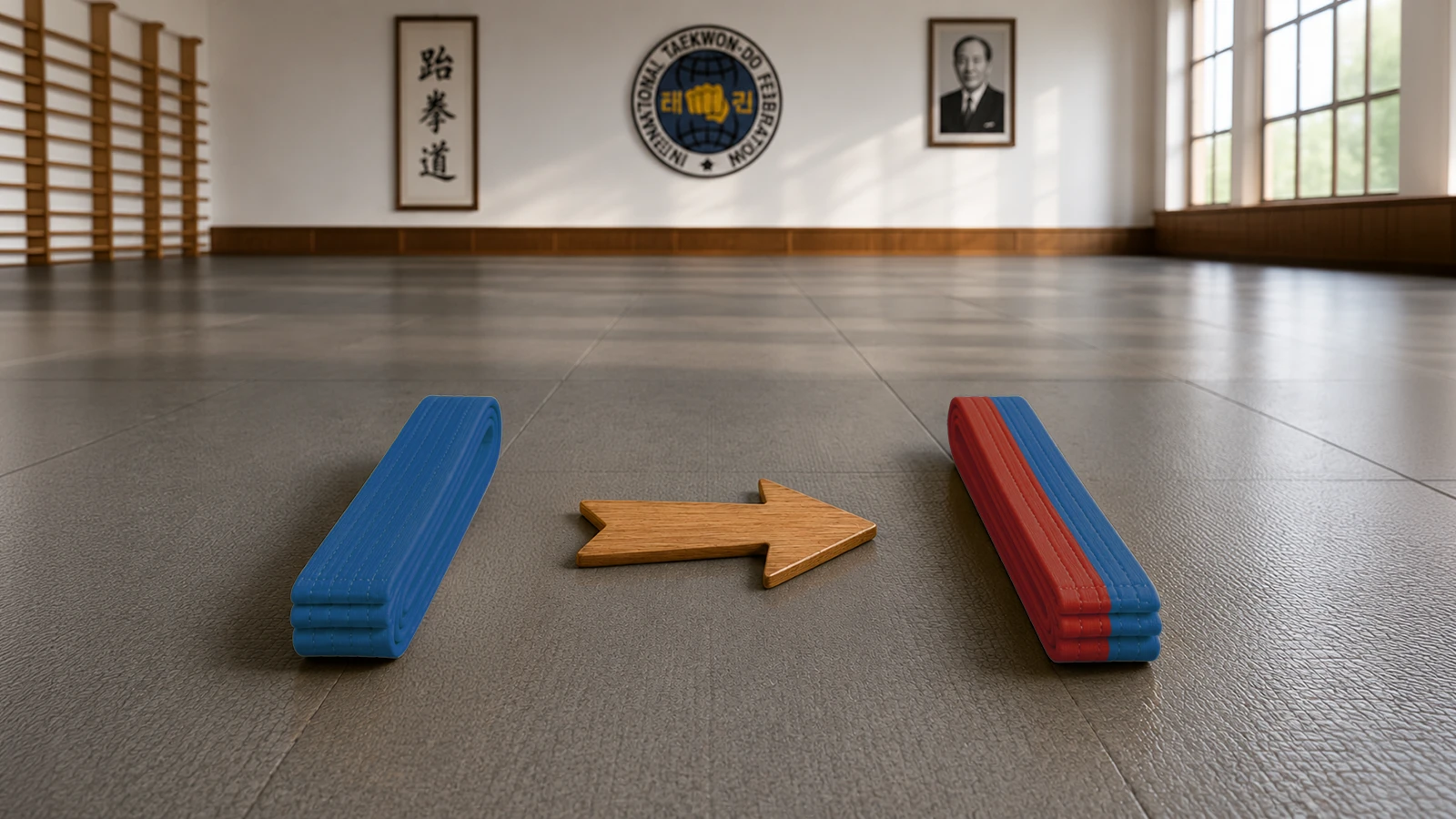
This syllabus is for Blue Belt, 4th Gup students preparing for promotion to Blue-Red Belt, 3rd Gup. It gives students one clear online reference for the exam areas they must practise and study before grading.
The exam areas for this level are fundamental movements, the two kicks, pattern, and theory. Students should be able to demonstrate stronger technical maturity than in the previous grades, especially in L-stance, rear foot stance, walking stance, reverse knife-hand blocking, palm upward blocking, and upper elbow striking. Students must also know Joon-Gun Tul, including its 32 movements and exact meaning. The theory for this level studies the origins and development of martial arts.
Blue-syllabus.pdf
Open PDFFundamental movements
The first exam area is fundamental movements. These are the required movements that blue belt students must practise before promotion to blue-red belt. Each movement should be performed with correct stance, correct tool, correct direction, preparation, breath control, and a clean final position.
- L-Stance Reverse Knife-hand Outward Block — Niunja So Sonkal Dung Bakuro Makgi
- Rear Foot Stance Palm Upward Block — Dwitbal So Sonbadak Ollyo Makgi
- Walking Stance Upper Elbow Strike — Gunnun So Wipalgup Taerigi
Students should practise each movement slowly first, then with stronger focus and timing. At this grade, the examiner should see that the student can control more complex stances and use the correct Taekwon-Do terminology with confidence.
Technique details
In Niunja So Sonkal Dung Bakuro Makgi, the stance is L-stance, the tool is reverse knife-hand, the direction is outward, and the technique type is block. The body should remain stable in L-stance, with the blocking tool finishing clearly on the correct line. Avoid lifting the shoulder, bending the wrist, or allowing the stance to become too tall.
In Dwitbal So Sonbadak Ollyo Makgi, the student must show rear foot stance and palm upward block. This requires balance, control, and accurate hand position. In Gunnun So Wipalgup Taerigi, the student performs walking stance upper elbow strike. The elbow must finish sharply without collapsing the posture or shortening the stance. Each movement should look deliberate, not rushed.
The two kicks
The required kicks for this exam are Reverse Turning Kick, called Bandae Dollyo Chagi, and Reverse Hooking Kick, called Bandae Dollyo Goro Chagi. Both kicks require controlled rotation, balance, target awareness, chamber, extension, recovery, and safe landing.
For Bandae Dollyo Chagi, the student must rotate with control and deliver the kick without spinning blindly. The supporting leg and hip position must guide the direction of the technique. For Bandae Dollyo Goro Chagi, the student must show the hooking action clearly after the reverse turning motion. Do not chase height before structure. A lower kick with correct mechanics, balance, and recovery is better than a high kick that loses posture, direction, or control.
Pattern requirement
The required pattern is Joon-Gun Tul. Joon-Gun has 32 movements. Students must know the pattern name, number of movements, starting position, sequence, direction changes, diagram, and correct finishing point.
Joon-Gun is a more demanding pattern than the previous Tul. It requires better control of balance, more mature timing, and clearer transitions between stances and techniques. Students should connect the pattern to the fundamental movements for this grade, especially reverse knife-hand outward block, rear foot stance palm upward block, and upper elbow strike. The pattern should not be performed as a memory race. Each movement should show correct stance, tool, height, direction, breathing, rhythm, and technical control.
Meaning of Joon-Gun
Students must memorise the meaning of Joon-Gun exactly as follows:
JOON-GUN: It is named after the patriot Ahn Joong-Gun who assassinated Hiro-Bumi Ito, the first Japanese governor-general of Korea, known as the man who played the leading part in the Korea-Japan merger. There are 32 movements in this pattern to represent his age when he was executed at Lui-Shung prison (1910).
This meaning should be learned word by word. During the theory section of the exam, students should be able to say it clearly, without changing the name, historical reference, number of movements, age reference, place, or year. A short and accurate answer is better than a long answer with mistakes.
Origins of martial arts
The theory for this grade studies the origins and development of the martial arts. Students should understand that martial arts did not appear from one single source. The use of hands and feet for survival, protection, hunting, fighting, and physical training developed in many places across history.
Ancient examples include open hand fighting shown in Egyptian tomb paintings and pyramid inscriptions from around 3,000 B.C. There are also reports of open hand fighting among warriors of Mesopotamia and Sumer. As human knowledge and society developed, simple survival methods became more organised and were gradually systematised into martial arts. The important idea is that martial arts grew from practical human needs before becoming formal systems of training, discipline, culture, and sport.
Development across cultures
Students should also know that many cultures developed their own forms of hand and foot fighting. In the Greek city-states, boxing, wrestling, and related combat methods appeared in early athletic events. Greek writings described unarmed combat, and systems such as pancratium used the whole body as a weapon. Later, Roman gladiatorial combat influenced later combat sports and contributed to the foundations of modern boxing and wrestling.
Open hand fighting also developed in China and many other countries. Examples include Kung-Fu in China, Selamban in India, Savate in France, Judo, Karate, Aikido and Jujitsu in Japan, Sambo in Russia, Bosilat in Malaysia, Kick Boxing in Thailand, and Taek-Kyon, Soo-Bak-Gi and Taekwon-Do in Korea. This shows that martial arts reflect the needs, culture, and history of their countries.
Exam checklist
Before the exam, students should check that they can demonstrate every area from this syllabus. They should practise Niunja So Sonkal Dung Bakuro Makgi, Dwitbal So Sonbadak Ollyo Makgi, Gunnun So Wipalgup Taerigi, Bandae Dollyo Chagi, Bandae Dollyo Goro Chagi, and Joon-Gun Tul with 32 movements.
Students should also be able to recite the meaning of Joon-Gun exactly and explain the main ideas behind the origins and development of martial arts. On exam day, wear a clean Dobok, tie the belt correctly, bow properly, listen carefully, and correct mistakes without frustration. Promotion to Blue-Red Belt, 3rd Gup should show stronger technical control, accurate terminology, mature pattern performance, and a deeper understanding of martial arts history.