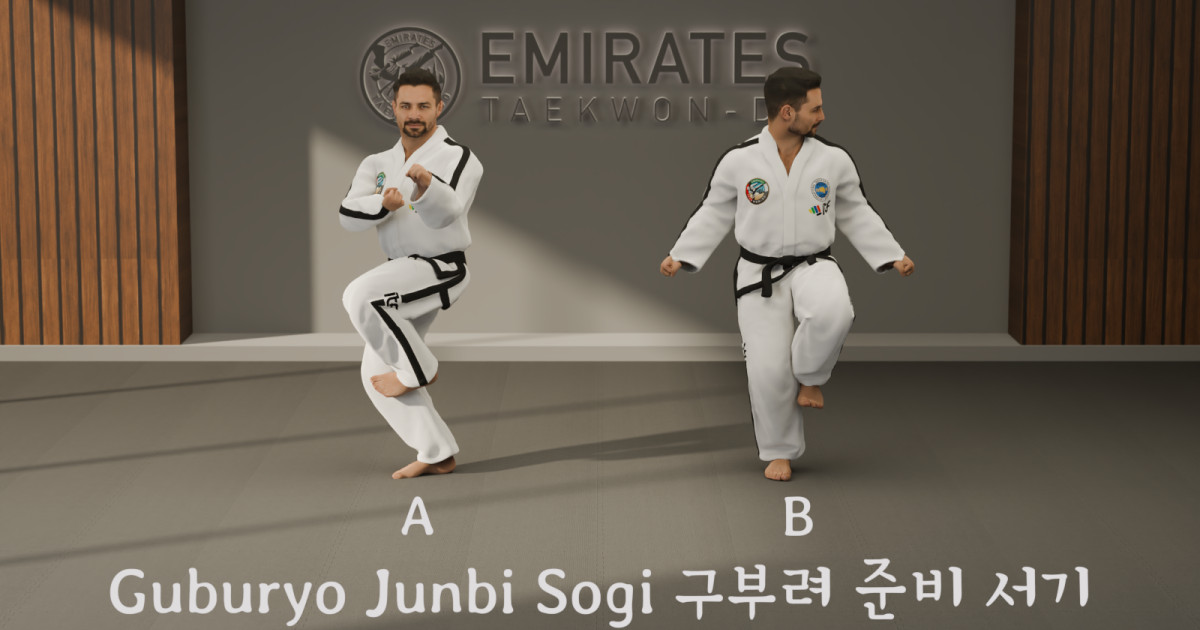

Type A and Type B
| Shoulder facing | Main use | Primary technical idea | |
|---|---|---|---|
| A | Half facing | Preparation for side-piercing kick, side-thrusting kick, or side technique | The body is angled so the next side action can be released efficiently |
| B | Front facing, or full facing | Preparation for back kicking action, especially back-piercing kick preparation | The body is organized more squarely for a direct or turning release of the next kick |
Standing-foot naming rule
Bending Ready Stance is named by the foot that is standing on the floor. When the practitioner stands on the right foot, it is called a right bending ready stance. When the practitioner stands on the left foot, it is called a left bending ready stance.
The encyclopedia reference explains this through the relationship between the standing foot and the guarding arm. When standing with the right foot and executing a left forearm guarding block, it is called a right bending ready stance, and vice versa. The name follows the standing foot, not the lifted leg.
This naming rule is important because students often try to name the position by the lifted leg or by the hand position. For technical accuracy, identify which foot is supporting the body first, then identify whether the ready stance is Type A or Type B.
Type A reference
Guburyo Junbi Sogi Type A is principally used as a preparatory position for side-piercing and side-thrusting kicks. In this version, the shoulders are half facing. This angled shoulder line prepares the body for side-oriented techniques and helps the practitioner release the kicking leg without first reorganizing the whole body.
The standing leg remains bent and carries 100% of the body weight. The lifted leg is controlled close to the body, ready to extend into the side technique. The hands form a guarding structure appropriate to the side-facing action, with the body compact and balanced.
Type A should not be performed with the shoulders full facing. If the shoulders square to the front, the stance loses the preparation needed for side-piercing or side-thrusting action. The stance should feel ready to launch sideways, not forward.
Type B reference
Guburyo Junbi Sogi Type B is a preparatory position for back or front kicking actions, especially back-piercing kick preparation. In this version, the shoulders are front facing, also understood as full facing in the context of body orientation.
The standing leg remains bent and supports the full body weight. The lifted leg is controlled and ready to be released into the next kick. The front-facing shoulder line changes the tactical preparation of the stance. Instead of preparing mainly for a side technique, Type B organizes the body for a different kicking direction.
For Type B, the encyclopedia reference gives two specific hand-position details. The distance between the fists and the thigh is about 25 centimeters, and the elbow should be bent about 30 degrees. These details help distinguish Type B from a casual one-legged balance position.
Type B hand position
| Check | Correct standard |
|---|---|
| Distance from thigh | The distance between the fists and the thigh is about 25 centimeters |
| Elbow angle | The elbow should be bent about 30 degrees |
| Shoulders | Front facing, or full facing |
| Purpose | Preparation for back or front kicking action |
| Balance | Weight remains 100% on the bent standing leg |
How to perform the stance
Begin by placing all body weight onto one supporting leg. The supporting leg must be bent and stable. The lifted leg should be controlled close to the body, not hanging loosely. The body must remain balanced directly over the standing foot.
For Type A, organize the shoulders in half facing. This version prepares the practitioner for side-piercing kick, side-thrusting kick, or another side technique. The body should feel angled and ready to release the kicking leg sideways.
For Type B, organize the shoulders in front facing. This version prepares the body for back or front kicking actions. The fists should remain about 25 centimeters from the thigh, and the elbow should be bent about 30 degrees. The body should remain upright and balanced, without leaning or collapsing into the standing leg.
In both types, the stance is not complete unless the balance, shoulder facing, lifted-leg position, and hand position match the intended ready stance. The position should look deliberate and functional, not like a student simply pausing on one leg.
Reference checklist
| Check | Correct standard |
|---|---|
| Stance | Bending Ready Stance (Guburyo Junbi Sogi) |
| Classification | Type A and Type B |
| Naming | Named by the standing foot |
| Weight | 100% on the bent standing leg |
| Type A shoulders | Half facing |
| Type A purpose | Preparation for side-piercing kick, side-thrusting kick, or side technique |
| Type B shoulders | Front facing, or full facing |
| Type B purpose | Preparation for back kicking action |
| Type B fist distance | About 25 centimeters from the thigh |
| Type B elbow | Bent about 30 degrees |
Common technical errors
A common error is naming the stance by the lifted leg instead of the standing foot. The correct name follows the supporting foot. If the practitioner stands on the right foot, it is a right bending ready stance. If the practitioner stands on the left foot, it is a left bending ready stance.
Another common error is mixing the shoulder facing of Type A and Type B. Type A should use half-facing shoulders because it prepares the body for side-piercing, side-thrusting, or side techniques. Type B should use front-facing shoulders because it prepares the body for back or front kicking actions.
Students also commonly straighten the standing leg. Bending Ready Stance requires the standing leg to be bent. If the supporting leg becomes straight, the stance loses its bending structure and becomes closer to a different one-legged position.
Another error is allowing the lifted leg to hang without control. The lifted leg must remain prepared for the next kick. If it drifts away, drops too low, or becomes loose, the stance no longer functions as a ready position.
For Type B, common errors include placing the fists too close to the thigh, too far from the thigh, or losing the 30-degree elbow bend. The fists should be about 25 centimeters from the thigh, with the elbow bent about 30 degrees. These details should be checked together with the front-facing shoulder line.
Key principle
Bending Ready Stance prepares the body for kicking by placing all the weight on one bent standing leg while the shoulders and hands organize the direction of the next technique.
Technical purpose
Bending Ready Stance, called Guburyo Junbi Sogi in Korean terminology, is a one-legged ready stance used in ITF Taekwon-Do as a preparatory position before kicking. It is based on Bending Stance, but the ready position includes specific hand, shoulder, and tactical preparation depending on whether the stance is performed as Type A or Type B.
This stance is classified into two main types. Type A uses a half-facing shoulder position and is principally used to prepare for side techniques, especially side-piercing and side-thrusting kicks. Type B uses a front-facing shoulder position and is used to prepare for back or front kicking actions, especially back-piercing kick preparation.
This article is a technical reference. It focuses on the one-legged base, standing-foot naming, Type A and Type B differences, shoulder facing, hand position, balance, and common technical errors.
Technique identity
| Item | Technical reference |
|---|---|
| Stance name | Bending Ready Stance |
| Korean terminology | Guburyo Junbi Sogi |
| Stance family | Ready stance, or Junbi Sogi |
| Base position | One-legged bending stance structure |
| Types | Type A and Type B |
| Main purpose | Preparatory position before kicking |
| Naming rule | Named by the standing foot |
One-legged base
| Base point | Requirement |
|---|---|
| Weight distribution | 100% on the standing leg |
| Standing leg | Bent and supporting the full body weight |
| Lifted foot | Held close to the standing leg, prepared for the next kick |
| Balance | Body remains controlled over the standing foot |