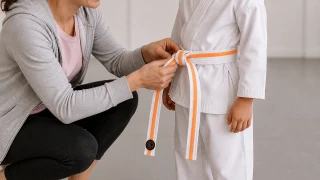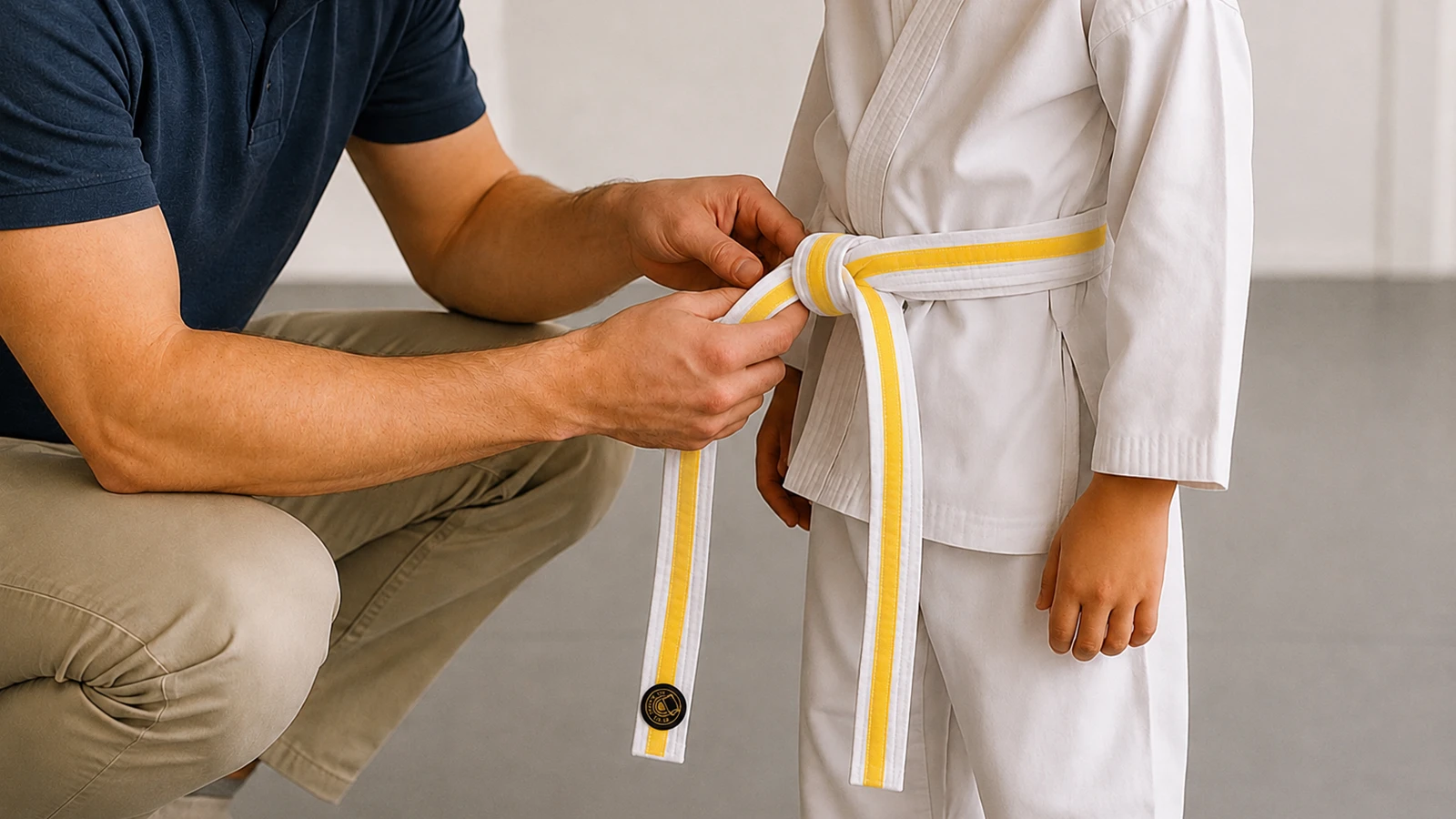
The yellow line stage
This learning is for children aged 3 to 6 who are training from White Belt with Yellow Line toward White Belt with Orange Line. This stage continues the Emirates Taekwon-Do Early Confidence Rank System by giving young children a clear and achievable next step.
At this level, students begin adding more coordination between the arms, legs, eyes, and body. They also continue developing confidence through repetition, class participation, and positive interaction with classmates. The technical requirements are simple, but they are important because they introduce one defensive movement and one new kick.
For parents, the goal is to understand that progress at this age is not only about performing the block or kick perfectly. Progress also includes listening better, waiting for turns, showing respect, reacting faster, and becoming more confident through consistent practice.
Technical requirements
For promotion to White Belt with Orange Line, students must practise one fundamental movement and one kick. These requirements are selected to help children improve coordination, balance, and control while still keeping the goal achievable.
- Walking Stance Outer Forearm Low Block — Gunnun So Palmok Najunde Makgi
- Turning Kick — Dollyo Chagi
The walking stance outer forearm low block teaches children how to use the arm for defence while keeping the legs strong and stable. The turning kick introduces rotation, hip movement, balance, and timing. Both techniques help children learn how the upper and lower body work together.
At this age, the instructor is looking for effort, control, attention, and improvement. The child does not need adult-level precision, but they should begin showing clearer movement and better response to instructions.
Development focus
The main development focus for this stage is coordination between the upper and lower body. Children are learning to move the arms and legs together while maintaining balance and direction. This is a major developmental step for ages 3 to 6.
- Coordination — connecting stance, block, kick, and body position.
- Reaction speed — responding faster to instructor commands and class activities.
- Respectful behaviour — training safely and kindly with classmates.
- Confidence through repetition — becoming more comfortable by practising the same skills many times.
Parents may notice that some children improve quickly in movement but need more time with listening or waiting. Others may listen well but feel shy when performing. Both are normal. The purpose of this stage is to keep building confidence and coordination step by step.
Theory for this stage
The theory focus for this rank is the tenet of Courtesy, called Ye Ui. For young children, Courtesy means learning to be polite, respectful, patient, and kind. It is one of the most important values in Taekwon-Do because it shapes how students behave with instructors, parents, and classmates.
- Courtesy — being polite and respectful.
- Waiting for turns — learning patience during drills and games.
- Helping others — showing kindness and teamwork in class.
Children also learn the next Korean numbers: Net means 4, and Daseot means 5. They should also know that the place where we practise Taekwon-Do is called the Dojang. These small theory pieces help children become familiar with Taekwon-Do language in a simple and age-appropriate way.
How parents can help
Parents can support this stage by encouraging short, positive practice at home. A few seconds of counting, showing the low block, or demonstrating the turning kick position can help a child feel proud and connected to their training.
For Courtesy, parents can reinforce the same behaviour at home by praising polite words, patient waiting, and helpful actions. For example, when a child waits calmly, shares with a sibling, or helps clean up, parents can connect that behaviour to Courtesy in Taekwon-Do.
Keep practice light and positive. Children aged 3 to 6 respond best when parents praise effort, celebrate small improvements, and avoid turning practice into pressure. The goal is to make the child feel capable, respected, and excited to continue learning.
Ready for orange line
A student becomes ready for White Belt with Orange Line when they can demonstrate the required movement and kick with age-appropriate control, follow instructions more consistently, and show respectful behaviour during class.
Readiness does not mean perfection. It means the child is improving, participating, trying with confidence, and beginning to understand the value of Courtesy. The student should recognise Gunnun So Palmok Najunde Makgi, Dollyo Chagi, Net, Daseot, and Dojang at a simple beginner level.
This stage helps children develop the coordination, reaction speed, and respectful habits needed for the next part of the Early Confidence Rank System.