
Exam overview
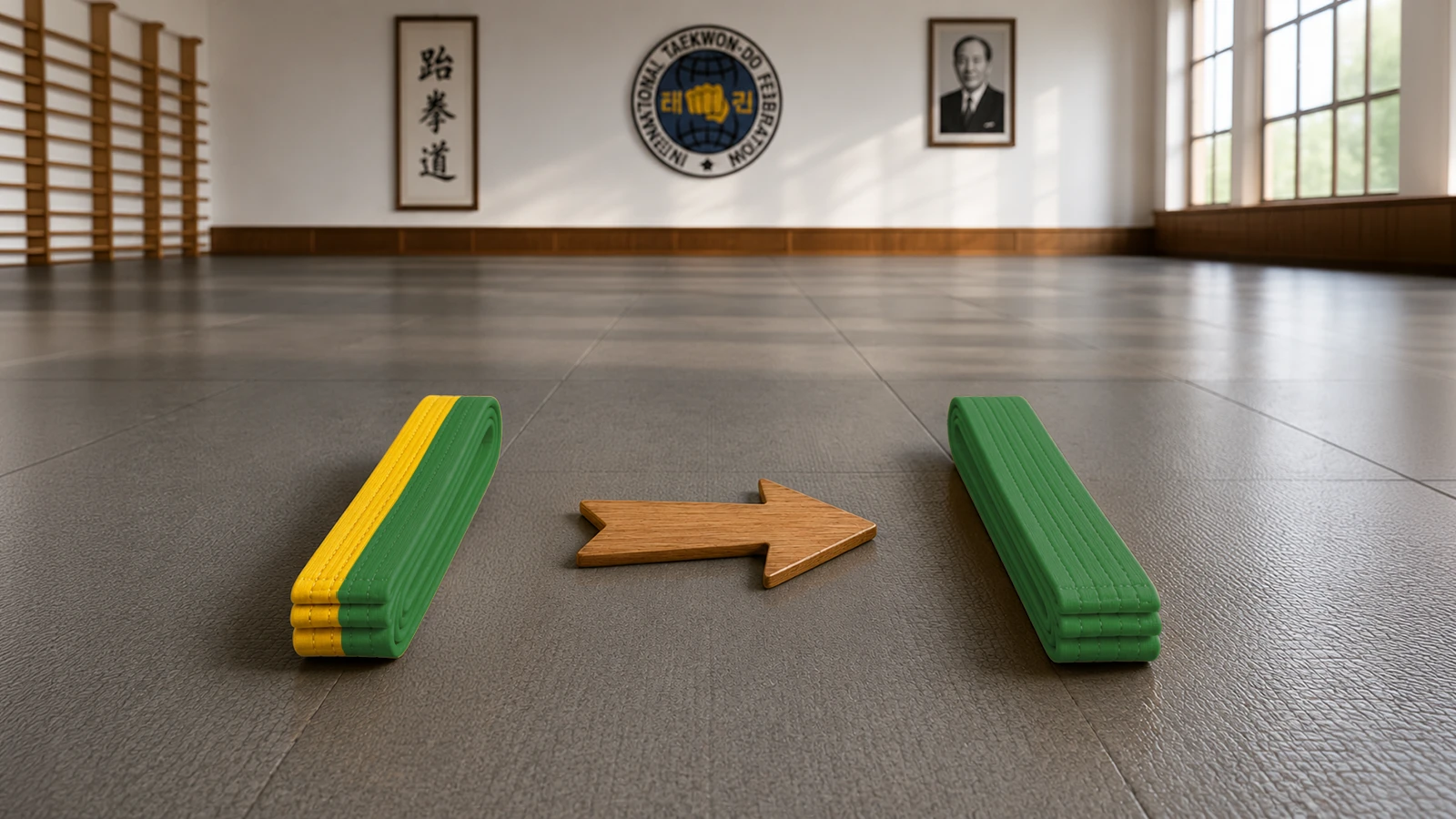
This syllabus is for Yellow-Green Belt, 7th Gup students preparing for promotion to Green Belt, 6th Gup. It gives students one clear online reference for the exam areas they must practise and study before grading.
The exam areas for this level are fundamental movements, the kick, pattern, and theory. Students should be able to demonstrate the required movements with correct stance, tool, height, direction, balance, and control. They must also know the required pattern, Do-San Tul, including its number of movements and meaning. The theory for this grade introduces the purposes for jumping, pattern practice, and board breaking. At this level, the student should show more accuracy, confidence, and understanding than at yellow belt.
Yellow-Green-syllabus.pdf
Open PDFFundamental movements
The first exam area is fundamental movements. These are the specific techniques that yellow-green belt students must practise before promotion to green belt. They require clean walking stance, correct line of movement, accurate height, and proper ITF terminology.
- Walking Stance Outer Forearm High Side Block — Gunnun So Bakat Palmok Nopunde Yop Makgi
- Walking Stance Straight Fingertip Thrust — Gunnun So Sun Sonkut Tulgi
- Walking Stance Back Fist High Side Strike — Gunnun So Dung Joomuk Nopunde Yop Taerigi
Students should practise each technique slowly first. The examiner should see a stable walking stance, correct preparation, correct attacking or blocking tool, correct high line when required, and a clear final position. Do not rush the movement before the structure is correct.
Technique details
In Gunnun So Bakat Palmok Nopunde Yop Makgi, the stance is walking stance, the tool is outer forearm, the height is high, and the direction is side. Do not call it only a high block. The full name teaches what the body is doing and where the technique finishes.
In Gunnun So Sun Sonkut Tulgi, the student performs a straight fingertip thrust from walking stance. The hand must be shaped carefully and the thrust must travel on a clean line. In Gunnun So Dung Joomuk Nopunde Yop Taerigi, the tool is back fist, the height is high, the direction is side, and the type is strike. This technique should finish sharply without the shoulders lifting or the stance becoming unstable.
The kick
The required kick for this exam is Hooking Kick, called Goro Chagi. Students should practise it with balance, control, and clear recovery. The kick must not be thrown loosely or used only as a high leg swing. The examiner should see a deliberate chamber, correct direction, controlled hooking action, retraction, and safe landing.
When practising, begin at a height you can control. A lower hooking kick with balance and accuracy is better than a high kick with poor posture. Keep the supporting leg stable, avoid falling backward, and recover the kicking leg before placing the foot down. The purpose is to show that the student understands the shape and path of the kick, not only that they can lift the leg high.
Pattern requirement
The required pattern is Do-San Tul. Do-San has 24 movements. Students must know the pattern name, number of movements, starting position, sequence, direction changes, diagram, and correct finishing point.
Do-San introduces more demanding coordination than Dan-Gun. Students must combine walking stance, outer forearm high side block, straight fingertip thrust, back fist high side strike, and hooking kick practice with better rhythm and control. The pattern should not be performed as a memory race. Each movement should show correct stance, preparation, breathing, tool, height, direction, and finish. Practise slowly until the sequence is reliable, then practise with exam timing. If the student loses direction, slow down and rebuild the pattern one section at a time.
Meaning of Do-San
Students must memorise the meaning of Do-San exactly as follows:
DO-SAN: It is the pseudonym of the patriot Ahn Chang-Ho (1876-1938). The 24 movements represent his entire life which he devoted to furthering the education of Korea and its independence movement.
This meaning should be learned word by word. During the theory section of the exam, students should be able to say it clearly, without changing the names, years, number of movements, or historical meaning. A short, accurate answer is better than a long answer with mistakes. Students should also understand that each Tul has a name, meaning, diagram, movement count, and purpose within the student’s progression.
Purposes for jumping
The theory for this grade includes the purposes for jumping. Students should know the five reasons and be able to explain them simply.
- To dodge or avoid an obstacle.
- To surprise the opponent.
- To cover a protracted distance quickly.
- To make two movements in one motion.
- To kick higher with no effort.
In practice, jumping is not only about looking impressive. It is used for distance, timing, evasion, height, and tactical advantage. Students at this level are not expected to master advanced flying techniques, but they should begin to understand why jumping exists in Taekwon-Do and why control is more important than simply leaving the floor.
Purpose for patterns
Students must understand the purpose for patterns. Patterns are various fundamental movements, most of which represent either attack or defence techniques, set to a fixed and logical sequence. This means a pattern is not a random collection of movements. It is a structured method for practising Taekwon-Do principles in order.
Pattern practice enables the student to perform many fundamental movements in series. It helps develop sparring techniques, improve flexibility of movement, master body shifting, build muscles and breath control, develop fluid and smooth motion, and gain rhythmical movement. For this grade, students should apply this directly to Do-San Tul. The pattern should show direction, balance, timing, breathing, and technical clarity from beginning to end.
Purpose for board breaking
The theory for this grade also includes the purpose for board breaking. Through breaking, the student learns to clear the mind and remove obstacles that might normally reduce focused power. Board breaking is not only a test of strength. It is a test of concentration, correct technique, distance, accuracy, and commitment.
Using the same principle against a specific target, a diligent student can learn to concentrate their resources with a minimum loss of energy. Breaking helps measure the power of techniques and gives precision to the student. This does not mean students should attempt board breaking without instruction. It means they should understand why breaking is used in Taekwon-Do and why mental focus, correct tool, and clean technique are essential.
Exam checklist
Before the exam, students should check that they can demonstrate every area from this syllabus. They should practise Gunnun So Bakat Palmok Nopunde Yop Makgi, Gunnun So Sun Sonkut Tulgi, Gunnun So Dung Joomuk Nopunde Yop Taerigi, Goro Chagi, and Do-San Tul with 24 movements.
Students should also be able to recite the meaning of Do-San exactly, explain the five purposes for jumping, explain the purpose for patterns, and explain the purpose for board breaking. On exam day, wear a clean Dobok, tie the belt correctly, bow properly, listen carefully, and correct mistakes without frustration. Promotion to Green Belt, 6th Gup should show stronger movement, clearer terminology, better memory, and greater discipline.