
Exam overview
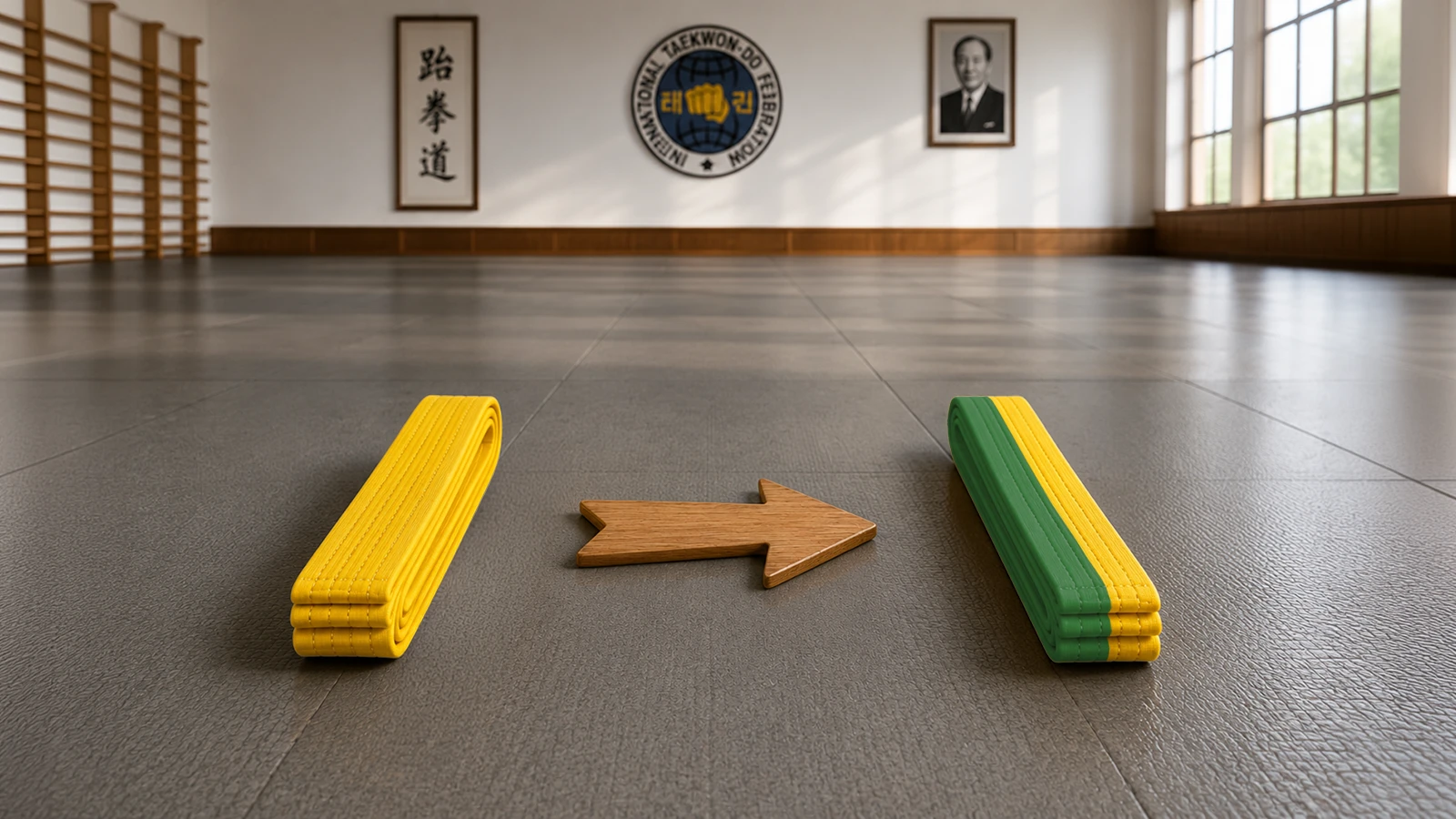
This syllabus is for Yellow Belt, 8th Gup students preparing for promotion to Yellow-Green Belt, 7th Gup. It gives students one clear online reference for the exam areas shown in the booklet page: fundamental movements, the kick, pattern, and theory.
At this grade, students are expected to show a stronger foundation than at beginner level. The examiner should see more confidence in L-stance, walking stance, guarding position, high punch, twin forearm block, stepping side kick, and Dan-Gun Tul. Students should also be able to explain the meaning of Dan-Gun, understand the basic history of Taekwon-Do, and know the meaning of the belt colours. The objective is not only to remember movements, but to demonstrate control, respect, and a clearer understanding of ITF Taekwon-Do.
Yellow-syllabus.pdf
Open PDFFundamental movements
The first exam area is fundamental movements. These movements are the specific techniques that yellow belt students must practise before promotion to yellow-green belt. They connect stance, tool, height, purpose, and correct Taekwon-Do terminology.
- L-Stance Knife-hand Guarding Block — Niunja So Sonkal Daebi Makgi
- Walking Stance High Punch — Gunnun So Nopunde Jirugi
- L-Stance Twin Forearm Block — Niunja So Sang Palmok Makgi
Students should practise each movement slowly and accurately before adding speed. In L-stance, keep the body stable and the weight controlled. In walking stance, keep the stance long and strong without leaning. Every movement should finish with a clear line, correct tool, correct height, and controlled breathing.
Technique details
In Niunja So Sonkal Daebi Makgi, the student must show a stable L-stance and a clear knife-hand guarding position. The hands should protect properly without becoming loose or exaggerated. The elbows should not collapse, and the body should remain balanced.
In Gunnun So Nopunde Jirugi, the student performs a walking stance high punch. Do not call it high section punch. The correct practical name is high punch, and the Korean height term is Nopunde. In Niunja So Sang Palmok Makgi, both forearms must work together as one defensive action. The movement should not look like two separate blocks. The examiner should see preparation, coordination, balance, and a clear final position in every required technique.
The kick
The kick for this exam is Stepping Side Kick, written on the booklet page as Yop Chagi. Students must practise it with a step so the examiner can see distance control, balance, chamber, extension, retraction, and landing.
When practising, begin from a stable position. Step first, lift the knee into a strong chamber, align the body, extend the leg to the side, retract the leg, and place the foot down under control. Do not chase height before structure. A lower kick with correct chamber, balance, and recovery is better than a high kick with poor posture. The supporting leg and hip position are important because they control the direction and stability of the technique. The kick should look deliberate, direct, and safe.
Pattern requirement
The required pattern is Dan-Gun Tul. Dan-Gun has 21 movements. Students must know the pattern name, the number of movements, the starting position, the direction changes, the diagram shown in the booklet, and the correct finishing point.
Dan-Gun includes important movements for this grade, including L-stance knife-hand guarding block, walking stance high punch, and L-stance twin forearm block. This means the pattern and the fundamental movements should be studied together. Students should not perform Dan-Gun as a memory race. Each movement must show the correct stance, tool, height, breath, and rhythm. Practise slowly until the sequence is reliable, then practise with exam timing. If a student loses direction, the best correction is to slow down and rebuild the pattern one section at a time.
Meaning of Dan-Gun
DAN-GUN: Named after the holy Dan-Gun, the legendary founder of Korea in the year of 2,333 B.C.
History of Taekwon-Do
The booklet explains that the origins of martial arts are ancient and connected to physical actions using the hands and feet for self-protection. It also states that Taekwon-Do is believed to originate more than 1300 years ago in Korea, initially known as Taek Kyon, and that it developed through the kingdoms of Silla and Koryo.
After Korea’s release in 1945, General Choi Hong Hi, then a military officer, began teaching his martial art to soldiers. On April 11, 1955, the name Taekwon-Do was given. The International Taekwon-Do Federation, or ITF, was founded by Choi Hong Hi on March 22, 1966, in Seoul, South Korea, to promote and encourage the growth of Taekwon-Do. Students should know these key points as part of their yellow belt theory.
Belt colour meanings
Students must study the meaning of the belt colours. White signifies innocence, as that of a beginning student who has no previous knowledge of Taekwon-Do. Yellow signifies the earth from which a plant sprouts and takes root as the Taekwon-Do foundation is being laid. Green signifies the plant’s growth as Taekwon-Do skills begin to develop.
Blue signifies the Heaven towards which the plant matures into a towering tree as training progresses. Red signifies danger, cautioning the student to exercise control and warning the opponent to stay away. Black is the opposite of white, signifying maturity and proficiency in Taekwon-Do, and also indicating the wearer’s imperviousness to darkness and fear. Students should know all colours, not only their current belt.
Exam checklist
Before the exam, students should check that they can demonstrate every area from this syllabus. They should practise Niunja So Sonkal Daebi Makgi, Gunnun So Nopunde Jirugi, Niunja So Sang Palmok Makgi, Stepping Side Kick, and Dan-Gun Tul with 21 movements.
Students should also be able to explain the meaning of Dan-Gun, give the main points from the history of Taekwon-Do, name General Choi Hong Hi, remember the dates 1955 and 1966, and describe the meaning of the belt colours. On exam day, students should wear a clean Dobok, tie the belt correctly, bow properly, listen carefully, and correct mistakes without frustration. Promotion to Yellow-Green Belt, 7th Gup should show stronger basics, better terminology, and a deeper respect for the art.