
Technical purpose
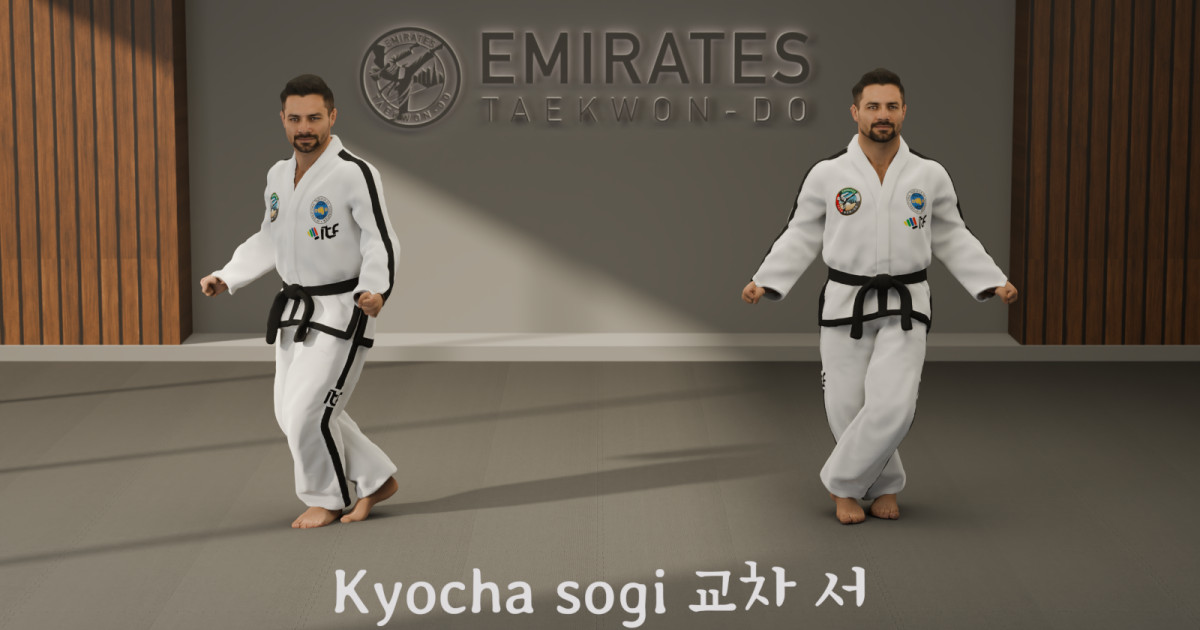
X-Stance, called Kyocha Sogi in Korean terminology, is a compact ITF Taekwon-Do stance used especially for quick movement, blocking, jumping actions, and preparation for the next manoeuvre. It is convenient for attacking the side or front during a jumping motion and is frequently used as a transitional stance.
The stance is defined by one foot crossing over or behind the other, with the crossing foot touching the floor lightly with the ball of the foot. The body weight is placed on the stationary foot. Because the feet cross tightly, the stance has no width and no length in the usual shoulder-width measurement system.
This article is a technical reference. It focuses on crossed-foot structure, stationary-foot weight, right and left naming, side-facing and half-facing shoulders, and common technical errors.
Key principle
X-Stance is a compact crossed stance where the body weight rests on the stationary foot and the crossing foot touches the floor lightly with the ball of the foot.
Main stance structure
| Reference point | Technical requirement |
|---|---|
| Stationary foot | Flat on the floor and carrying the body weight |
| Crossing foot | Touches the floor slightly with the ball of the foot |
| Foot crossing | One foot crosses over or behind the other, depending on the movement |
| Usual crossing rule | One foot usually crosses in front of the other, except in jumping motion |
Stance identity
| Item | Technical reference |
|---|---|
| Stance name | X-Stance |
| Korean terminology | Kyocha Sogi |
| Main use | Blocking, jumping motion, quick transition, and preparation for the next manoeuvre |
| Foot relationship | One foot crosses over or behind the other |
| Weight placement | Body weight rests on the stationary foot |
| Shoulder facing | Side facing or half facing, according to the required movement |
Foot crossing and weight
To form X-Stance, cross one foot over or behind the other. The crossing foot touches the ground only slightly with the ball of the foot. The body weight is placed on the stationary foot, not shared equally between both feet.
In most cases, one foot crosses in front of the other. The main exception is a jumping motion, where the crossing relationship may change according to the direction and landing requirement. This is why the stance is useful in quick movement and transitional actions.
The crossing foot should not press heavily into the floor. If too much weight is placed on it, the stance becomes slow and difficult to move from. If the crossing foot is too loose or too far away, the stance loses its compact structure. The correct position should look crossed, deliberate, and ready for the next movement.
Right and left naming rule
X-Stance is named by the stationary foot that carries the weight. When the weight is rested on the right foot, it is called a right X-Stance. When the weight is rested on the left foot, it is called a left X-Stance.
The other foot is usually placed in front of the stationary foot. This means the stance name does not follow the crossing foot. It follows the foot that supports the body.
For example, if the right foot is stationary and carries the weight, the stance is right Kyocha Sogi. If the left foot is stationary and carries the weight, the stance is left Kyocha Sogi. This naming rule should be checked carefully in patterns because the crossed foot can make the stance visually confusing.
Shoulder facing specification
| Shoulder facing | Technical use in X-Stance |
|---|---|
| Side facing | Used when the body is oriented sideways while the crossed-foot structure remains compact and controlled. |
| Half facing | Used when the shoulders are angled to reduce the target area while preparing for the next movement. |
Side-facing shoulders
When X-Stance is performed with side-facing shoulders, the body is oriented sideways according to the required movement. The stance remains crossed, the stationary foot carries the body weight, and the crossing foot touches the ground lightly with the ball of the foot.
Side-facing shoulders are useful when the next movement, block, or attack is directed along a side line. The student should not change the lower-body structure while turning the shoulders. The feet remain crossed, compact, and ready to move.
Half-facing shoulders
When X-Stance is performed with half-facing shoulders, the shoulders are angled rather than fully side-on. This can reduce the target area and prepare the practitioner for a quick defensive or attacking transition.
Half-facing shoulders should not be created by twisting only the upper body. The stance, hips, shoulders, and intended direction of movement should work together. The student should keep the weight on the stationary foot while maintaining control over the crossing foot.
Technical use
X-Stance is very useful for quick changes of direction. It can be used for attacking the side or front in a jumping motion and is frequently used for blocking. It also serves as a preparatory stance for moving into the next manoeuvre.
Because the stance is compact, students should not try to hold it like a long static stance. Its value is in control, crossing precision, and readiness. The stance should allow the practitioner to land, block, attack, or move again without delay.
The crossing position should be clear but not forced. If the feet are too far apart, the stance loses the crossed shape. If the feet are squeezed together without balance, the stance becomes unstable. The correct X-Stance is compact, balanced, and functional.
Reference checklist
| Check | Correct standard |
|---|---|
| Stance | X-Stance (Kyocha Sogi) |
| Width | No width |
| Length | No length |
| Stationary foot | Carries the body weight |
| Crossing foot | Touches the floor slightly with the ball of the foot |
| Crossing rule | One foot usually crosses in front of the other, except in jumping motion |
| Naming rule | Named by the stationary foot carrying the weight |
| Right X-Stance | Weight rests on the right foot |
| Left X-Stance | Weight rests on the left foot |
| Shoulder facing | Side facing or half facing |
| Main use | Blocking, jumping motion, and preparation for the next manoeuvre |
Common technical errors
A common error is placing too much weight on the crossing foot. The body weight should rest on the stationary foot, while the crossing foot touches the ground slightly with the ball of the foot. If the crossing foot becomes heavy, the stance loses mobility.
Another common error is naming the stance by the crossing foot instead of the stationary foot. X-Stance is named by the foot carrying the weight. Weight on the right foot gives right X-Stance. Weight on the left foot gives left X-Stance.
Students also commonly lose the crossed structure. The feet should cross clearly. If the crossing foot drifts too far away, the stance no longer looks like Kyocha Sogi. If the feet are forced too tightly, balance and readiness may suffer.
Another error is forgetting the exception for jumping motion. One foot usually crosses in front of the other, but jumping motion can change whether the foot crosses over or behind according to the required landing or movement.
The final error is changing the shoulder facing without keeping the lower body organized. Whether the shoulders are side facing or half facing, the stance still has no width, no length, weight on the stationary foot, and light contact through the ball of the crossing foot.