
Exam overview
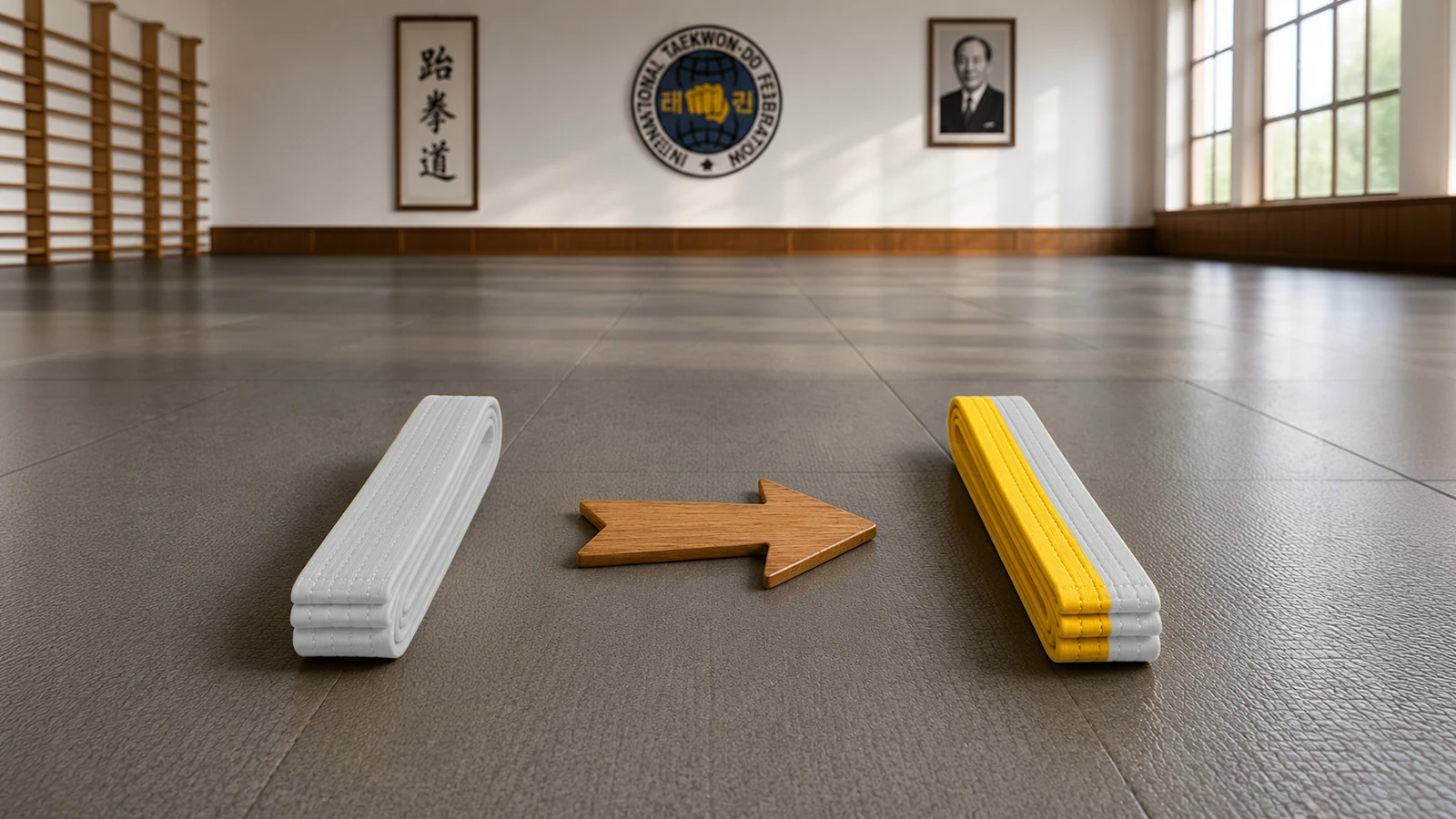
This syllabus is for White Belt, 10th Gup students preparing for promotion to White-Yellow Belt, 9th Gup. It replaces the printed booklet page and gives students one clear online reference for what to practise and study before their exam.
The exam areas are divided into fundamental movements, the three kicks, fundamental exercises, and theory. Students should be able to demonstrate the movements with control, say the Korean names with confidence, and explain the basic meaning and values of Taekwon-Do. At this level, the main objective is not speed or power. The priority is correct posture, clear direction, balance, respect, and understanding of the first Taekwon-Do concepts.
White-syllabus.pdf
Open PDFFundamental movements
The first exam area is fundamental movements. These are the basic techniques that every white belt must practise before moving to the next rank. They teach stance, direction, coordination, correct finishing position, and the connection between movement and terminology.
- Walking stance middle front punch — Gunnun So Kaunde Ap Jirugi
- Walking stance forearm low block — Gunnun So Palmok Najunde Makgi
- Walking stance knife-hand low block — Gunnun So Sonkal Najunde Makgi
When practising these techniques, students should focus on a strong walking stance, a clear preparation, and a clean finish. The punch or block should finish at the correct height, and the body should remain balanced. Each movement should be performed with control, not rushed or forced.
The three kicks
The second exam area is the three kicks. White belt students must practise these kicks slowly first, then with more confidence once balance and control improve. The goal is to understand the basic direction and purpose of each kick.
- Front snapping kick — Ap Chagi or Apcha Busigi
- Turning kick — Dollyo Chagi
- Side piercing kick — Yop Chagi or Yopcha Jirugi
For front snapping kick, lift the knee, snap the foot forward, retract, and place the foot down with control. For turning kick, rotate the hip and keep the supporting leg stable. For side piercing kick, chamber the knee, align the body, extend directly through the target line, retract, and land safely. Students should not chase height before balance. A controlled low or middle kick is better than a high kick with poor posture.
Fundamental exercises
The third exam area is fundamental exercises. These exercises prepare students for formal patterns by teaching direction, stepping, turning, rhythm, and memory. They are simple in structure, but they must be performed carefully.
- Four Directions Punch — Saju Jirugi — 7 movements
- Four Directions Block — Saju Makgi — 8 movements
Both exercises use four directions, shown in the booklet as A, B, C, and D. Students should learn where to turn, how to keep their stance consistent, and how to return to the correct position. In Saju Jirugi, focus on the middle punch and walking stance. In Saju Makgi, focus on low block, preparation, and clean direction changes. These exercises should be practised until the student can perform them without hesitation.
Taekwon-Do meaning
Students must understand the basic meaning of Taekwon-Do. Tae means to kick or smash with the foot. Kwon means to punch or destroy with the hand or fist. Do means an art, a way, or a disciplined path of personal development.
Taken together, Taekwon-Do is the mental training and the techniques of unarmed combat for self-defence, health, and discipline. It includes the skilled use of punches, kicks, blocks, and movement with bare hands and feet. Students should also know that the founder of Taekwon-Do is General Choi Hong Hi. For white belts, this theory is important because it shows that Taekwon-Do is not only physical exercise. It is also a system of respect, self-control, perseverance, and responsibility.
Tenets of Taekwon-Do
White belt students must study the five tenets of Taekwon-Do. These values guide behaviour inside and outside the Dojang.
- Courtesy — Ye Ui: polite and respectful behaviour toward others.
- Integrity — Yom Chi: knowing right from wrong and being honest about one’s actions.
- Perseverance — In Nae: continuing with effort, patience, and determination even when training is difficult.
- Self-Control — Guk Gi: controlling actions, words, emotions, and power, especially in training and sparring.
- Indomitable Spirit — Baekjul Boolgool: facing difficulty or injustice with courage, honesty, and determination.
Students do not only memorise the tenets for the exam. They should try to show them in class by listening, bowing correctly, helping others, training with patience, and correcting mistakes respectfully.

The Tenets of ITF Taekwon-Do Explained
Korean numbers
Students should be able to count from one to ten in Korean. These numbers are commonly used during warm-ups, drills, stretching, and basic exercises.
- 1 — hana
- 2 — dul
- 3 — set
- 4 — net
- 5 — daseot
- 6 — yeoseot
- 7 — ilgop
- 8 — yeodeol
- 9 — ahop
- 10 — yeol
Students should practise saying the numbers clearly and in rhythm. They do not need to speak Korean fluently, but they should recognise the counting commands used by the instructor. Counting correctly also helps students follow class timing and develop confidence when training with others.
Basic terminology
White belt students must also know the basic terminology used in class. The place for practice is the Dojang. The uniform is the Dobok. The belt is the Ti. These words are part of the student’s everyday Taekwon-Do vocabulary.
Students should also know how instructors are addressed. An instructor up to 3rd Dan may be addressed as Bo Sabum or Sabum. An instructor from 4th to 6th Dan is commonly addressed as Sabum or Sabum-Nim. A 7th or 8th Dan Master is addressed as Sa Hyun-Nim. A 9th Dan Grand Master is addressed as Sa Seong-Nim. These titles teach respect for rank, experience, and responsibility. Students are not expected to know every advanced title perfectly at white belt, but they should begin learning the correct way to speak respectfully in the Dojang.

Basic Taekwon-Do terminology for students
Exam checklist
Before the exam, students should check that they can demonstrate all required areas from this syllabus. They should practise the three fundamental movements, the three kicks, Saju Jirugi, and Saju Makgi. They should also review the tenets, the meaning of Taekwon-Do, the founder, Korean numbers, and basic terminology.
On exam day, students should wear a clean Dobok, tie the belt correctly, bow properly, listen carefully to instructions, and correct mistakes without frustration. A good white belt exam is not about being perfect. It is about showing that the student has started correctly, understands the foundation, respects the Dojang, and is ready to continue training as a White-Yellow Belt, 9th Gup.