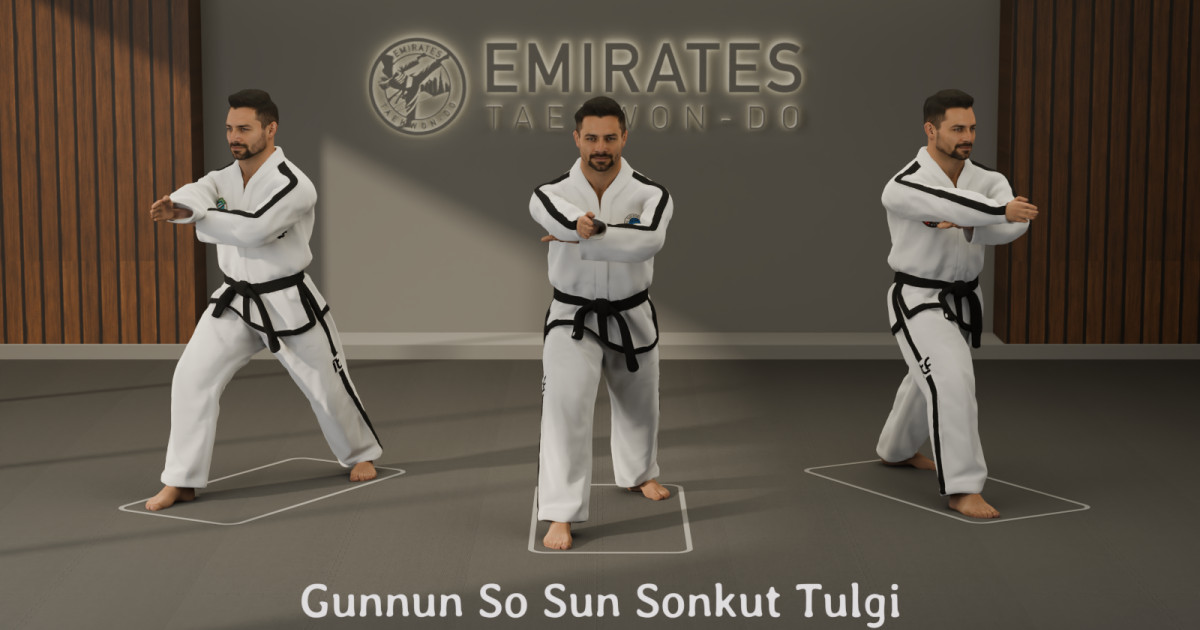

Main action requirements
| Action | Technical requirement |
|---|---|
| Attacking tool | Use the straight fingertip as the thrusting tool. |
| Attacking arm | The thrust is executed almost in the same manner as a forefist technique, except the attacking tool does not have to be drawn from the hip. |
| Opposite hand | Use the palm to block the opponent's attacking tool while executing the thrust. |
| Purpose of the opposite hand | The opposite hand is for protection, not for supporting the attacking arm. |
| Reason for palm protection | The opponent's reach may be greater than yours, so the attack must be covered while the thrust is delivered. |
How to execute the technique
Begin from a correct Walking Stance. The stance must be stable before the thrust is judged. The front knee is bent, the rear leg is firm, the rear foot is correctly angled, and the body weight is shared equally between both legs. A weak stance will make the thrust look long but structurally unreliable.
The straight fingertip is projected forward as the attacking tool. The movement is performed in a manner similar to a forefist technique, but with an important difference: the attacking tool does not have to be drawn from the hip. The student should not force the technique into the exact same preparation as a standard forefist punch when the fingertip thrust requires a different hand relationship.
At the same time, the opposite hand must protect the body by blocking the opponent's attacking tool with the palm. This is not decorative. It is part of the technical logic of the movement. The opponent may have a longer reach, so the thrust should not be delivered while leaving the body open.
Palm protection
The protecting palm is a key feature of Straight Fingertip Thrust. It should be used to block the opponent's attacking tool while the fingertip thrust is executed. The purpose is not to push, hold, or support the attacking arm. The opposite hand has a defensive function.
A common misunderstanding is to place the opposite hand under or beside the attacking arm as if it were there to support it. This is incorrect. The thrusting arm must be its own attacking action, while the opposite palm manages the opponent's possible counterattack or longer reach.
The palm protection also prevents an important tactical error: leaving the center of the body exposed. If the opposite hand is simply pulled back to the hip without covering the opponent's attacking tool, the solar plexus can become open to attack. In this technique, the withdrawing-hand habit used in many punches should not be applied blindly. The palm must be used for protection when required by the movement.
What the opposite hand must not do
| Incorrect use | Why it is wrong |
|---|---|
| Supporting the attacking arm | The opposite hand is not intended to support the thrusting arm. It is used to block the opponent's attacking tool. |
| Pulling directly to the hip | This may expose the solar plexus and allow the opponent to reach the target. |
| Using the wrong blocking surface | The instruction is to block with the palm. Do not replace this with an unsuitable thumb-ridge action. |
| Failing to block | If the palm protection is unsuccessful, the opponent may still reach the target during the thrust. |
Walking stance application
Straight Fingertip Thrust is mainly executed from Walking Stance. This gives the technique a stable forward base while allowing the thrust to reach the opponent directly. The front leg should support the direction of the action, and the rear foot should remain stable enough to keep the body from collapsing or overreaching.
The stance should not be shortened to make the thrust feel easier. It should remain 1.5 shoulder widths long and 1 shoulder width wide. The body should stay organized over the stance so that the thrust is delivered through structure rather than through leaning.
The student should also avoid treating the technique like a simple arm extension. The fingertip thrust, Walking Stance, and palm protection must happen as one coordinated action. The attacking hand reaches the target, the palm covers the opponent's attacking tool, and the lower body provides a stable technical base.
Reference checklist
| Check | Correct standard |
|---|---|
| Technique | Walking Stance Straight Fingertip Thrust (Gunnun So Sun Sonkut Tulgi) |
| Technique family | Thrusting technique, or Tulgi |
| Tool | Straight fingertip |
| Stance | Walking Stance |
| Direction | Front thrust unless otherwise specified |
| Attacking hand | Does not have to be drawn from the hip |
| Opposite hand | Blocks the opponent's attacking tool with the palm |
| Opposite hand purpose | Protection, not support for the attacking arm |
| Main tactical reason | The opponent's reach may be greater than yours |
Common technical errors
The most common error is using the opposite hand to support the attacking arm. This changes the meaning of the technique. The opposite hand should block the opponent's attacking tool with the palm. It should not be placed there only to hold, brace, or reinforce the thrusting arm.
Another common error is pulling the opposite fist directly to the hip. In this technique, that can leave the solar plexus exposed. If the opponent's reach is greater, the opponent may still reach the target while the student is thrusting. The protecting palm must therefore be used correctly.
Students should also avoid trying to replace the palm protection with an unsuitable thumb-ridge action. The reference requires a palm block while the thrust is executed. If the palm does not cover the attack, the defensive part of the movement has failed.
Other errors include leaning forward to gain distance, shortening the Walking Stance, losing equal weight distribution, and treating the thrust as an isolated arm movement. The correct technique requires a measured Walking Stance, a clear straight fingertip thrust, and active palm protection at the same time.
Key principle
The straight fingertip thrust is executed almost like a forefist punch, but the attacking tool does not have to be drawn from the hip, and the opposite palm must protect against the opponent's attack.
Technical purpose
Walking Stance Straight Fingertip Thrust, called Gunnun So Sun Sonkut Tulgi in Korean terminology, is an ITF Taekwon-Do thrusting technique performed from Walking Stance. It uses the straight fingertip as the attacking tool and is treated as a front thrust unless a special direction is given.
In ITF terminology, thrusting techniques are called Tulgi. The principal tools for thrusting are the fingertip and the elbow. In this technique, the straight fingertip is projected toward the opponent while the opposite hand protects the body by blocking the opponent's attacking tool with the palm.
This article is a technical reference. It focuses on the specific requirements of the technique: the Walking Stance base, straight fingertip tool, front-thrust direction, palm protection, attacking-arm action, body structure, and common errors.
Technique identity
| Item | Technical reference |
|---|---|
| Technique name | Walking Stance Straight Fingertip Thrust |
| Korean terminology | Gunnun So Sun Sonkut Tulgi |
| Technique family | Thrusting technique, or Tulgi |
| Stance | Walking Stance |
| Attacking tool | Straight fingertip |
| Direction | Front thrust unless special direction is given |
| Protecting action | The opposite palm blocks the opponent's attacking tool during the thrust |
Walking stance base
| Stance point | Requirement |
|---|---|
| Length | 1.5 shoulder widths, measured from big toe to big toe |
| Width | 1 shoulder width, measured from the centers of the insteps |
| Weight distribution | 50% on the front leg and 50% on the rear leg |
| Front foot | Points straight forward |
| Rear foot | Turns 25 degrees outward |
| Front knee | Bent so the kneecap drops in a vertical line with the heel |