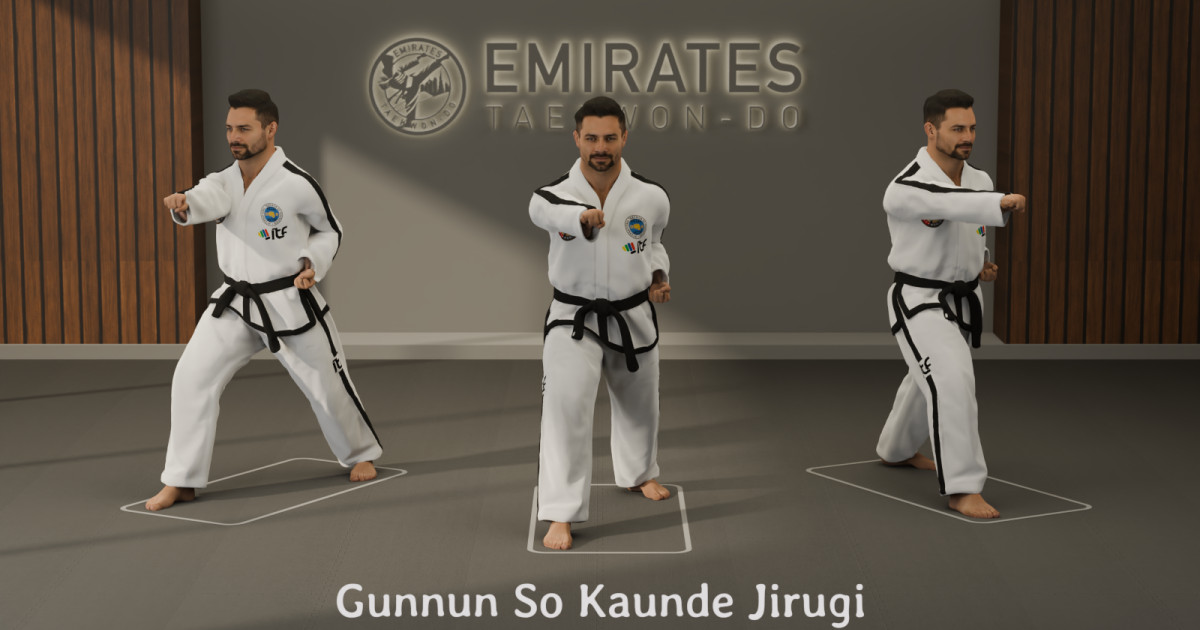

Obverse and reverse punching
| Type | Definition in Walking Stance |
|---|---|
| Obverse punch | The punch is delivered from the same side as the fully bent front leg. For example, if the right leg is forward and bent, the right fist punches. |
| Reverse punch | The punch is delivered from the opposite side of the fully bent front leg. For example, if the right leg is forward and bent, the left fist punches. |
| Middle punch | The punch is directed to the middle section while keeping the fist in the center of the body at the moment of impact. |
Punching principles
| Principle | Technical requirement |
|---|---|
| Fist formation | Clench the fist firmly at the moment of impact so it acts like a hammer, not a soft object. |
| Line of travel | Punch from the hip to the target at full speed using the shortest distance. |
| Relaxation | Avoid unnecessary tension in the arms and shoulders, then relax immediately after reaching the target. |
| Opposite fist | Pull the opposite fist to the hip at the same time as the punching fist moves out. |
| Body posture | Keep the back straight and do not pull the shoulder out at the moment of impact. |
| Fist rotation | The fist turns a full 180 degrees at impact, creating the corkscrew action used in standard punching. |
| Rear foot | The rear foot must be placed firmly at impact to help contain the rebound. |
How to execute the punch
Begin in a correct Walking Stance. The stance must be measured and stable before the punch is judged. The front knee is fully bent, the rear foot is firm, and the body weight is shared equally between both legs. The punching fist begins at the hip, while the opposite fist prepares to withdraw to the other hip.
The punch travels directly from the hip to the middle-section target. The path should be short and straight. The student should not swing the arm, lift the elbow outward, or allow the fist to travel in a curved line. The punch must move efficiently toward the target while the opposite fist pulls back at the same time.
At the moment of impact, the fist completes a full 180-degree rotation. This corkscrew action is a key part of the standard forefist punch. The fist should be clenched firmly only at impact, not held with unnecessary tension throughout the whole movement. After the impact position is reached, the muscles should relax immediately.
Center-line impact
For a front punch, the fist must stay in the center of the body at the moment of impact. This principle applies to middle punches and low punches. In Walking Stance Middle Punch, the striking fist should not finish outside the body line, across the body, or drifting away from the center.
The hip is used as the natural training position for withdrawing the fist. When the opposite hand returns to the hip, the back fist should face downward. This supports the revolving principle and prepares the body for the correct punching action. If the back fist faces upward at the start of punching, the revolving principle has been ignored.
The shoulders must remain controlled. Do not pull the shoulder out at impact. The punch should reach the target through the coordinated movement of the fist, hip, stance, and body alignment, not by overreaching with the shoulder.
Obverse punch in Walking Stance
In a Walking Stance Obverse Middle Punch, the punching fist is on the same side as the fully bent front leg. If the right leg is forward and bent, the right fist punches. If the left leg is forward and bent, the left fist punches. The punch still travels from the hip to the middle-section target, and the opposite fist withdraws to the hip.
The fist must remain in the center of the body at impact. The stance should not twist out of position, and the rear foot should stay firmly placed to contain the rebound. The punch should finish cleanly, with the body upright and the back straight.
Reverse punch in Walking Stance
In a Walking Stance Reverse Middle Punch, the punching fist is on the opposite side of the fully bent front leg. If the right leg is forward and bent, the left fist punches. If the left leg is forward and bent, the right fist punches.
The same punching principles apply. The fist starts from the hip, moves to the target by the shortest distance, rotates fully at impact, and finishes in the center of the body. The opposite fist must withdraw correctly to the hip with the back fist facing downward. The body should remain stable, and the rear foot must be firm at impact.
Reference checklist
| Check | Correct standard |
|---|---|
| Technique | Walking Stance Middle Punch (Gunnun So Kaunde Jirugi) |
| Tool | Forefist |
| Target level | Middle section |
| Punch path | From hip to target by the shortest distance |
| Impact position | Fist stays in the center of the body |
| Fist rotation | Full 180-degree turn at impact |
| Opposite fist | Withdraws to the hip at the same time |
| Back fist at hip | Faces downward |
| Back posture | Straight at impact |
| Rear foot | Firmly placed at impact |
Common technical errors
A common error is failing to rotate the fist fully. The forefist punch should complete a 180-degree turn at the moment of impact. If the fist fails to revolve, the technique loses an important part of its punching mechanics.
Another common error is allowing the back fist to face upward when it is pulled to the hip. The back fist should face downward at the hip. This detail prepares the punching hand for the correct revolving action and keeps the movement consistent with the standard punching principle.
Students should also avoid pulling the shoulder out at impact. Reaching with the shoulder may make the punch appear longer, but it weakens structure and can disturb the center line. The fist should stay in the center of the body at the moment of impact.
Other errors include punching from a weak stance, relaxing the rear foot, leaning the back, holding unnecessary tension in the arms and shoulders, and failing to pull the opposite fist to the hip at the same time as the punch is delivered.
Key principle
The punch travels from the hip to the target by the shortest distance, rotates fully at impact, and stays in the center of the body at the moment of impact.
Technical purpose
Walking Stance Middle Punch, called Gunnun So Kaunde Jirugi in Korean terminology, is a fundamental ITF Taekwon-Do punching technique delivered from Walking Stance to the middle section. It is normally practiced as a front punch unless a special direction is given.
This article is a technical reference. It focuses on the specific requirements of the punch: the forefist tool, direct line of travel, fist rotation, opposite-hand withdrawal, center-line impact, body posture, rear-foot stability, and the difference between obverse and reverse punching in Walking Stance.
Technique identity
| Item | Technical reference |
|---|---|
| Technique name | Walking Stance Middle Punch |
| Korean terminology | Gunnun So Kaunde Jirugi |
| Stance | Walking Stance |
| Target level | Middle section |
| Tool | Forefist |
| Hand type | Single fist |
| General direction | Front punch unless otherwise specified |
Walking stance base
| Stance point | Requirement |
|---|---|
| Length | 1.5 shoulder widths, measured from big toe to big toe |
| Width | 1 shoulder width, measured from the centers of the insteps |
| Weight distribution | 50% on the front leg and 50% on the rear leg |
| Front foot | Points straight forward |
| Rear foot | Turns 25 degrees outward and must be firm at impact |
| Front knee | Bent so the kneecap drops in a vertical line with the heel |