

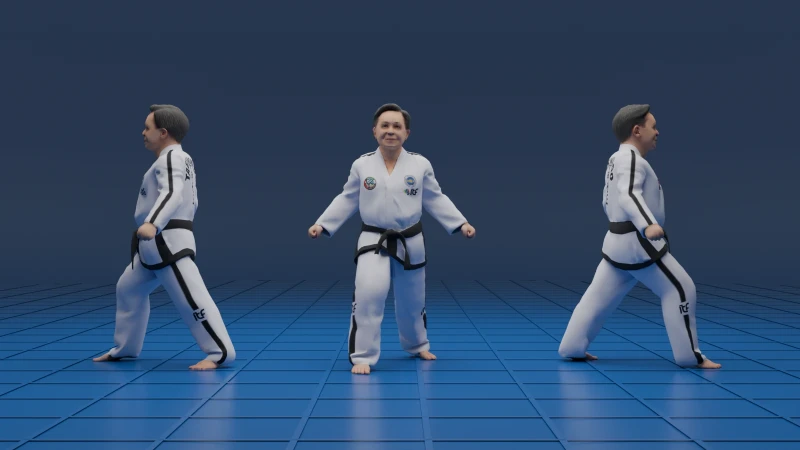
Definition and classification
Walking stance, known in Korean as Gunnun Sogi, is one of the most fundamental positions in traditional ITF Taekwon-Do. It is introduced at beginner level and remains central throughout all grades because it forms the structural base for countless hand techniques and pattern movements.
Technically, it is classified as an asymmetrical stance with even weight distribution. One leg is positioned in front and the other behind, yet the body weight is divided equally between both legs. Because one leg is clearly in front, the stance has left and right versions determined by the leading foot. However, unlike uneven stances, the load on each leg is identical.
In the Encyclopedia of Taekwon-Do by Gen. Choi Hong Hi, walking stance is presented as a primary forward stance for both offensive and defensive techniques. Its design supports stability, linear movement, and effective application of reaction force and sine wave motion.
Stance measurements and structure
Precision in measurement is essential for adult practitioners. The length of walking stance should be approximately one and a half shoulder widths, measured from the big toe of the rear foot to the big toe of the front foot. The width of the stance should be one shoulder width, measured from the center of the instep of the rear foot to the center of the instep of the front foot. These proportions ensure both stability and mobility.
The front foot points straight forward, while the rear foot is angled outward by approximately 25 degrees. The body weight is distributed evenly, with 50 percent on the front leg and 50 percent on the rear leg. The front knee is bent so that it forms a vertical line with the heel. The hips and shoulders may be either full facing or half facing, depending on the technique being executed and its tactical requirement.
If the stance is too short, balance and power are reduced. If it is too long, mobility suffers and unnecessary tension accumulates. Adult practitioners must consistently verify their measurements during training to prevent gradual shortening or distortion of the stance over time.
Weight distribution and balance
Walking stance requires equal weight distribution, expressed as 50-50. This balance allows immediate transition between attack and defense and ensures efficient force transmission through the ground.
When weight shifts unintentionally toward the front leg, the practitioner loses structural integrity and reduces the effectiveness of reaction force. Conversely, placing too much weight on the rear leg limits forward penetration and weakens linear techniques.
The rear heel must remain grounded. Lifting the heel breaks the kinetic chain between the floor and the striking tool. Stability in walking stance is not passive heaviness but controlled engagement of the legs, hips, and core. Adult practitioners should cultivate awareness of pressure beneath both feet, maintaining equal grounding while remaining ready to move.
Posture and body alignment
Correct posture is critical in walking stance. The spine remains upright, the head level, and the chin slightly tucked. The abdomen is lightly engaged to stabilize the trunk without creating stiffness.
The hips and shoulders must remain square to the front. Excessive twisting compromises balance and weakens straight line techniques such as middle punch. The back should not lean forward or backward. Forward leaning shifts weight improperly and disrupts the vertical alignment of the skeleton.
Gen. Choi emphasized scientific principles in Taekwon-Do. Proper alignment allows efficient application of mass and acceleration during impact. When posture is correct, power flows naturally from the legs through the hips and torso into the striking tool. When posture is incorrect, force dissipates before reaching the target.
Application in fundamental techniques
Walking stance is widely used for forefist punches, low blocks, rising blocks, and various strikes and thrusts. In fundamental exercises such as Four Direction Punch and Four Direction Block, the stance forms the base structure for coordinated movement and breath control.
When executing a middle punch in walking stance, the hips remain square and the technique travels along the center line. Reaction force is generated by pulling the opposite hand sharply to the hip while maintaining equal grounding through both legs.
In defensive techniques such as low block, the stance provides lateral stability against incoming force. Adults should avoid superficial stepping. Each transition into walking stance must land with precise length and width, followed by a clear moment of balance before the technique is completed.
Common errors in adults
Adult practitioners frequently develop subtle errors that reduce technical quality. One common mistake is shortening the stance unconsciously to reduce muscular effort. Over time, this habit weakens structural integrity.
Another frequent error is uneven weight distribution, usually favoring the front leg. This imbalance decreases stability and disrupts proper application of sine wave. Lifting the rear heel is also common, particularly during punching drills, but this removes grounding and reduces transmitted force.
Excessive tension in the shoulders or locking of the rear knee must be corrected. Walking stance should demonstrate controlled engagement rather than rigidity. Awareness and deliberate correction during slow practice are essential to maintain technical standards.
Training methodology for mastery
Adults should train walking stance through progressive methods. Static holding develops leg strength and structural awareness. Maintaining the stance for extended periods builds endurance in the quadriceps and hip stabilizers.
Step by step forward and backward movement reinforces consistent measurements. Practitioners should perform three consecutive steps forward with middle punch, then three steps backward, ensuring identical length and equal weight distribution in each position.
Slow motion practice enhances balance and posture control. Once alignment is stable, controlled power drills can be introduced to integrate hip engagement and reaction force. Mastery of walking stance is not achieved through speed alone but through repetition with precision and conscious correction.