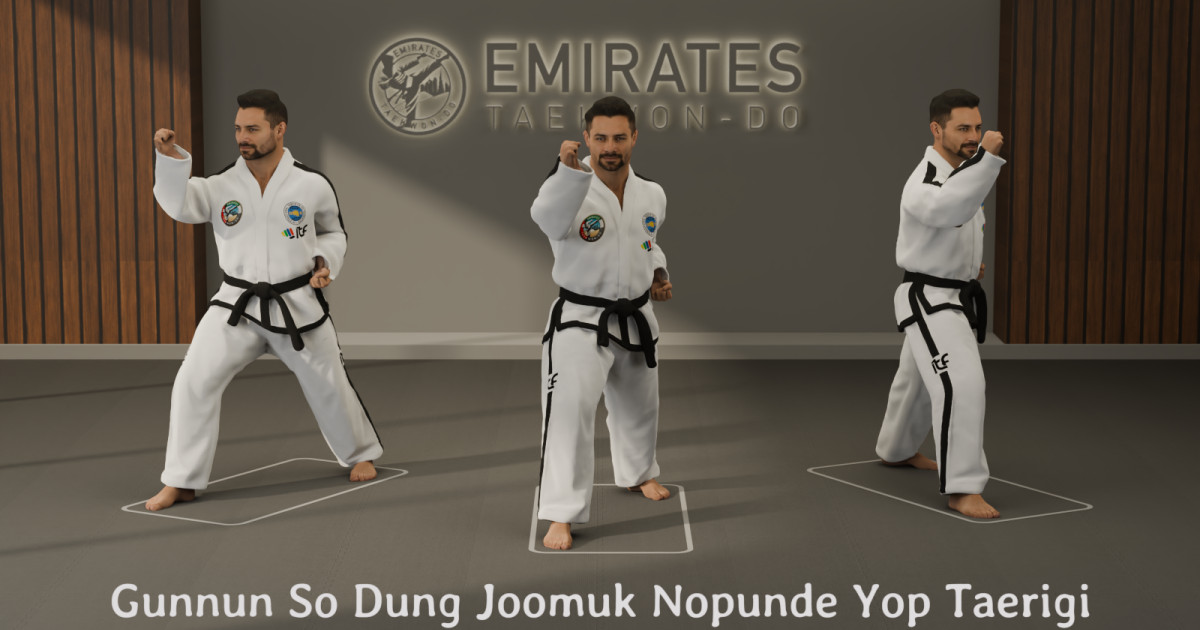

Technique identity
| Item | Technical reference |
|---|---|
| Technique name | Walking Stance Back Fist High Side Strike |
| Korean terminology | Gunnun So Dung Joomuk Nopunde Yop Taerigi |
| Short technique name | Dung Joomuk Nopunde Yop Taerigi |
| Technique family | Striking technique, or Taerigi |
| Strike type | Side strike, or Yop Taerigi |
| Stance | Walking Stance, or Gunnun Sogi |
| Attacking tool | Back fist, or Dung Joomuk |
| Target level | High section, or Nopunde |
| Typical target | Temple |
| Shoulder facing | Half facing at the moment of impact |
Walking stance base
| Stance point | Requirement |
|---|---|
| Length | 1.5 shoulder widths, measured from big toe to big toe |
| Width | 1 shoulder width, measured from the centers of the insteps |
| Weight distribution | 50% on the front leg and 50% on the rear leg |
| Front foot | Points straight forward |
| Rear foot | Turns 25 degrees outward and remains firm at impact |
| Front knee | Bent so the kneecap drops in a vertical line with the heel |
Side strike rules
| Rule | Technical requirement |
|---|---|
| Body facing | If the body becomes half facing or side facing the target at the moment of impact, the technique is called a side strike. |
| Form of movement | Side strike is executed in the form of an outward strike. |
| Primary tools | The knife-hand and back fist are primary weapons for side strike. |
| Tool alignment | The attacking tool forms a straight line with the center of the shoulders at the moment of impact. |
| Tool facing | The back fist stays half facing the target at the moment of impact. |
| Arm position | The attacking arm is slightly bent at the moment of impact. |
| Point of focus | The back fist must not pass the point of focus. |
How to execute the technique
Begin from a correct Walking Stance. The stance should be 1.5 shoulder widths long and 1 shoulder width wide. The front knee is bent, the rear foot is firm, and the body weight remains equally distributed between both legs.
The strike is delivered with the back fist to the high section. The normal target is the temple. The action is a side strike, so it is performed in the form of an outward strike rather than a straight front punch.
At the moment of impact, the shoulders should be half facing. The chest should not become fully square to the target. The stance, hips, shoulders, and striking arm must coordinate together so the back fist reaches the target while the body maintains the correct angled structure.
The back fist should remain half facing the target, and the arm should be slightly bent at impact. The striking arm should not be locked straight. A slight bend keeps the tool structured and prevents the strike from becoming overextended.
Half-facing shoulders
The shoulders must be half facing at the moment of impact in this version of the technique. This means the shoulders are angled toward the target rather than fully squared. The half-facing position supports the side-strike structure and keeps the body narrower.
Half-facing shoulders should not be made by twisting only the upper body. The Walking Stance, hips, shoulders, and back fist must work together. If the shoulders turn independently from the stance, the strike becomes disconnected and the student may lose balance or power.
The correction is simple: keep the Walking Stance measured, keep the body upright, angle the shoulders into half facing, and allow the back fist to finish on the correct high-section line without passing the point of focus.
Target and tool
The back fist is normally used for attacking the temple. In this technique, the target level is high section, or Nopunde. The student should not let the strike drop to middle section or drift away from the high target line.
The attacking tool is the back fist, not the forefist, side fist, or knife-hand. The name Dung Joomuk identifies the tool. At impact, the back fist should be half facing the target, and the arm should remain slightly bent.
The strike should be precise. A back fist high side strike is not a wide arm swing. It is an outward side strike with a defined target, tool, facing, and point of focus.
Point of focus and impact line
The back fist must not pass the point of focus. If the strike travels beyond the target, the body may lose the correct half-facing position and the attacking tool may become weak or exposed.
At the moment of impact, the attacking tool should form a straight line with the center of the shoulders. This connects the strike to the body structure. The student should check the back fist, elbow, shoulder line, hips, and stance together rather than judging the hand position alone.
The rear foot should remain firm at impact. A weak rear foot causes the stance to lose support, which affects the transfer of power into the strike. The final position should be controlled, balanced, and ready for the next movement.
Reference checklist
| Check | Correct standard |
|---|---|
| Technique | Walking Stance Back Fist High Side Strike (Gunnun So Dung Joomuk Nopunde Yop Taerigi) |
| Technique family | Striking technique, or Taerigi |
| Strike type | Side strike, or Yop Taerigi |
| Stance | Walking Stance, or Gunnun Sogi |
| Attacking tool | Back fist, or Dung Joomuk |
| Target level | High section, or Nopunde |
| Normal target | Temple |
| Shoulders | Half facing at the moment of impact |
| Tool facing | Back fist half facing the target |
| Arm position | Slightly bent at the moment of impact |
| Tool line | Attacking tool forms a straight line with the center of the shoulders |
| Focus | Back fist must not pass the point of focus |
Common technical errors
A common error is finishing with full-facing shoulders. In this version, the shoulders should be half facing at the moment of impact. If the body becomes fully square, the technique no longer shows the correct side-strike structure.
Another error is locking the striking arm. The arm should be slightly bent at impact. A locked arm can overextend the strike, weaken control, and expose the joint.
Students also commonly use the wrong attacking surface. The strike must use the back fist, or Dung Joomuk. If the student turns the fist incorrectly and uses the forefist, side fist, or another surface, the technique no longer matches the required tool.
Another frequent error is allowing the back fist to pass the point of focus. The strike must finish at the intended high-section target, normally the temple. If the tool overtravels, the strike loses accuracy and the body may fail to maintain the correct facing.
The final error is disconnecting the strike from Walking Stance. The stance must remain measured, stable, and equally weighted. The back fist, half-facing shoulders, hips, and stance should arrive together at the moment of impact.
Key principle
The back fist strikes the high-section target while remaining half facing the target, with the arm slightly bent and the shoulders half facing at the moment of impact.
Technical purpose
Walking Stance Back Fist High Side Strike, called Gunnun So Dung Joomuk Nopunde Yop Taerigi in Korean terminology, is an ITF Taekwon-Do striking technique performed from Walking Stance to the high section. It uses the back fist, or Dung Joomuk, as the attacking tool.
The back fist is normally used for attacking the temple. Because this is a side strike, or Yop Taerigi, the body becomes half facing or side facing at the moment of impact. In this article, the required shoulder position is half facing.
This article is a technical reference. It focuses on the Walking Stance base, back fist attacking tool, high-section target, half-facing shoulders, arm position, tool alignment, point of focus, and common technical errors.