
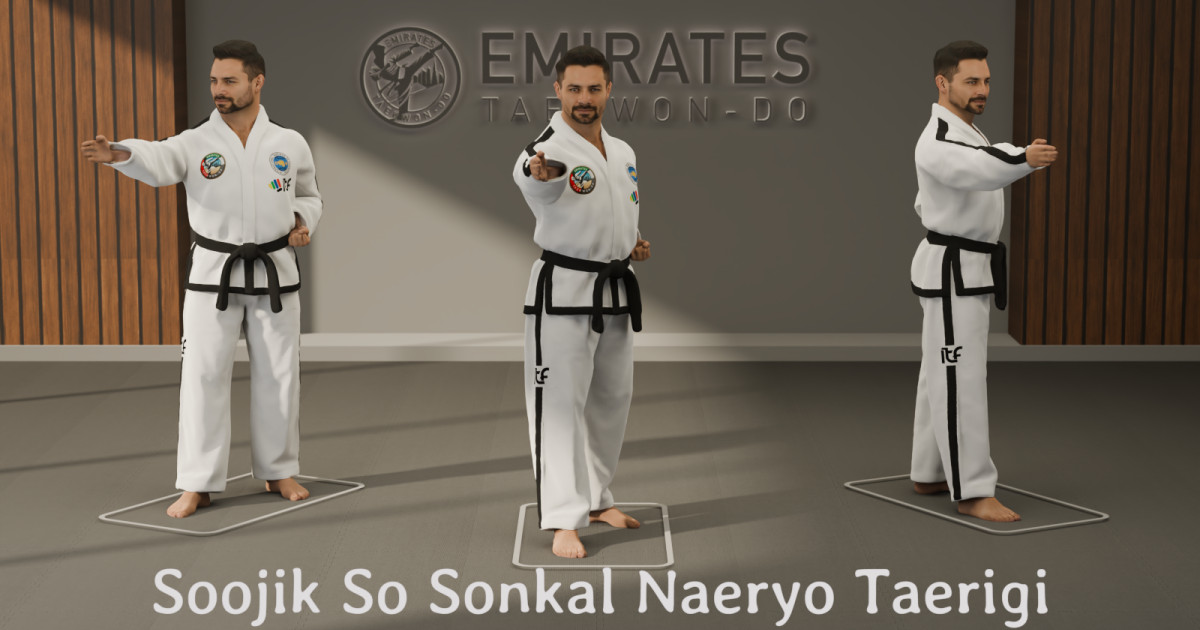
Technical purpose
Vertical Stance Knife-Hand Downward Strike, called Soojik So Sonkal Naeryo Taerigi in Korean terminology, is an ITF Taekwon-Do striking technique performed from Vertical Stance using the knife-hand, or Sonkal, as the attacking tool.
Downward Strike, or Naeryo Taerigi, is divided into front downward strike and side downward strike. Unless special directions are given, downward strikes are considered side downward strikes. This means the body is organized in a half-facing or side-facing structure while the attacking tool reaches the target in a downward circular motion.
This article focuses on the Vertical Stance version. Because Vertical Stance is always half facing, the body and shoulders should remain half facing at the moment of impact.
Key principle
The knife-hand reaches the target in a circular downward motion while the body remains half facing and the attacking tool finishes level with the shoulders at impact.
Technique identity
| Item | Technical reference |
|---|---|
| Technique name | Vertical Stance Knife-Hand Downward Strike |
| Korean terminology | Soojik So Sonkal Naeryo Taerigi |
| Short technique name | Sonkal Naeryo Taerigi |
| Technique family | Striking technique, or Taerigi |
| Strike type | Downward Strike, or Naeryo Taerigi |
| Stance | Vertical Stance, or Soojik Sogi |
| Attacking tool | Knife-hand, or Sonkal |
| Body facing | Half facing at the moment of impact |
Vertical stance base
| Stance point | Correct standard |
|---|---|
| Distance | 1 shoulder width between the big toes |
| Weight distribution | 60% on the rear leg and 40% on the front leg |
| Foot angle | Toes of both feet point approximately 15 degrees inward |
| Legs | Both legs are straight |
| Naming rule | Named by the rear foot |
| Facing | Always half facing, both in attack and defense |
Downward strike rules
| Rule | Technical requirement |
|---|---|
| Main tools | The knife-hand and back fist are the main tools for downward strike. |
| This technique | Uses the knife-hand as the attacking tool. |
| Motion | The attacking tool reaches the target in a circular motion. |
| Impact level | In a side downward strike, the attacking tool becomes level with the shoulders at the moment of impact. |
| Knife-hand arm position | Keep the arm straight when using the knife-hand. |
| Suitable stances | L-Stance, Rear Foot Stance, Vertical Stance, and X-Stance are especially suitable for side downward strike. |
Starting position and motion
At the start of the movement, keep the forearms crossed in front of the chest with both back fists facing upward. The striking hand is placed under the other hand before the strike is released. This preparation helps organize the circular route of the downward strike.
The knife-hand then travels to the target in a circular motion. The motion should not be a straight push, a flat sideways swing, or a loose drop of the arm. It should show a clear downward striking path with the tool controlled through the whole movement.
At the moment of impact, the attacking tool becomes level with the shoulders. The arm remains straight because the attacking tool is the knife-hand. The body remains half facing because the stance is Vertical Stance.
Half-facing body line
Vertical Stance is always half facing. For this reason, the shoulders and hips should remain half facing at the moment of impact. The body should not become full facing, and it should not turn away so far that the strike loses its target line.
The half-facing body line supports the side downward strike. It keeps the body narrower while allowing the knife-hand to reach the target through a circular route. The stance, hips, shoulders, and striking arm must work together.
A common correction is to check the body before checking the arm. If the Vertical Stance has lost its half-facing structure, the knife-hand strike will usually lose its correct line as well.
Knife-hand tool
The attacking tool is the knife-hand. The hand should be formed clearly and used as the striking surface. The student should not replace it with the palm, back hand, side fist, or back fist unless the technique being practiced specifically calls for a different tool.
For knife-hand downward strike, the arm remains straight at the moment of impact. This is different from downward strikes using the back fist or back hand, where the arm may be slightly bent. The straight arm should still be controlled; it should not lock aggressively or continue past the point of focus.
The strike should finish with a clear relationship between the tool, shoulder line, and stance. If the knife-hand passes beyond the focus point, the movement loses precision and exposes the body.
Reference checklist
| Check | Correct standard |
|---|---|
| Technique | Vertical Stance Knife-Hand Downward Strike (Soojik So Sonkal Naeryo Taerigi) |
| Technique family | Striking technique, or Taerigi |
| Strike type | Downward Strike, or Naeryo Taerigi |
| Stance | Vertical Stance, or Soojik Sogi |
| Attacking tool | Knife-hand, or Sonkal |
| Motion | Circular downward motion |
| Impact level | Attacking tool level with the shoulders |
| Arm | Straight at the moment of impact |
| Body facing | Half facing at the moment of impact |
| Starting hand position | Forearms crossed in front of the chest, back fists facing upward, striking hand underneath |
Common technical errors
A common error is failing to use a circular motion. The encyclopedia reference specifically warns against a strike that is not executed in a circular motion. The knife-hand must travel through a clear downward arc.
Another error is losing the half-facing body line. In Vertical Stance, the body should remain half facing. If the body becomes full facing or turns away incorrectly, the strike loses its correct side downward structure.
Students also commonly bend the arm when using the knife-hand. For this technique, the arm should be straight at the moment of impact. A bent arm changes the shape and weakens the line of the strike.
Another frequent error is letting the attacking tool pass the point of focus. The strike must stop at the target line. If the knife-hand overtravels, the body can become exposed and the technique loses accuracy.
The final error is using the wrong preparation. The forearms should cross in front of the chest with both back fists facing upward, and the striking hand should start underneath the other hand. If this preparation is careless, the circular route and final impact line are usually incorrect.