
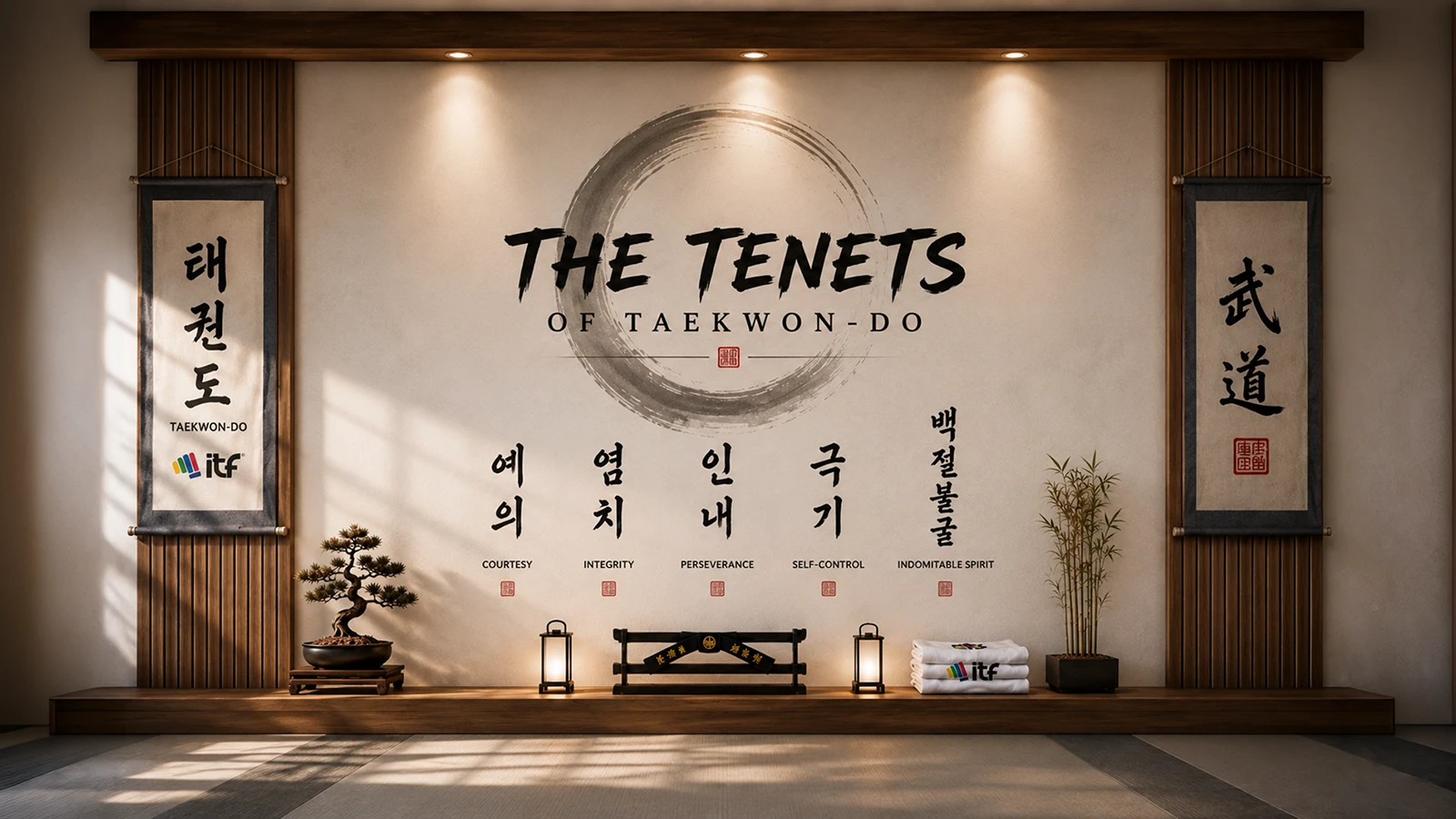
The spirit of Taekwon-Do
The tenets of Taekwon-Do are the moral foundation of the art. General Choi Hong Hi explained that the success or failure of Taekwon-Do training depends largely on how students observe and implement these tenets in their daily lives. They are not only words for memorisation during grading. They are practical principles that should guide behaviour inside and outside the Dojang.
The five tenets are Courtesy, Integrity, Perseverance, Self-Control, and Indomitable Spirit. Together, they shape the character of the student and help transform physical training into a disciplined way of life. A strong Taekwon-Do practitioner is not measured only by kicking ability or competition results, but also by attitude, honesty, humility, discipline, and courage.
Courtesy
Courtesy, or Ye Ui, teaches students to behave with respect, humility, and consideration toward others. General Choi explained that Taekwon-Do students should practise courtesy to build noble character and conduct training in an orderly manner.
The principles of courtesy include promoting mutual respect, being polite to one another, encouraging justice and humanity, distinguishing instructor from student and senior from junior, behaving according to etiquette, respecting other people possessions, and handling matters with fairness and sincerity. Students should also avoid accepting gifts or favours when the situation creates doubt or unfairness.
Courtesy appears in simple daily actions: bowing correctly, listening without interruption, helping junior students, speaking respectfully, arriving prepared for class, and treating training partners safely. In Taekwon-Do, respect is not weakness. It is discipline and self-awareness.
Integrity
Integrity, or Yom Chi, means understanding right from wrong and having the conscience to feel responsibility when acting incorrectly. General Choi explained that integrity in Taekwon-Do has a deeper meaning than the simple dictionary definition. It requires honesty in training, behaviour, teaching, and personal conduct.
Examples of lacking integrity include students requesting rank they did not earn, attempting to purchase promotion, pretending skill they do not possess, or seeking status only for ego and power. It also includes instructors who misrepresent themselves, teach poor technique carelessly, or promote the art only for materialistic gain.
A student with integrity trains honestly, accepts correction, admits mistakes, and does not hide weakness behind excuses. Integrity also means keeping actions consistent with words. A practitioner who speaks about discipline, respect, and self-control should demonstrate those values through behaviour, not only through speech.
Perseverance
Perseverance, or In Nae, is the ability to continue despite difficulty, frustration, or delay in success. General Choi quoted the old Oriental saying: Patience leads to virtue or merit. He also explained that one can build a peaceful home by being patient many times.
In Taekwon-Do, progress does not happen instantly. Techniques require repetition, correction, failure, adjustment, and continued effort. A student may struggle with flexibility, patterns, sparring, fitness, or confidence, but perseverance allows improvement over time. One of the greatest secrets in becoming a leader in Taekwon-Do is overcoming difficulty through persistence.
Perseverance also applies outside training. Students should continue pursuing goals even when results are slow. Confucius stated that a person who is impatient in trivial matters can rarely achieve success in matters of great importance. The disciplined student understands that long-term improvement requires patience and consistency.
Self-control
Self-Control, or Guk Gi, is one of the most important tenets inside and outside the Dojang. General Choi explained that a loss of self-control in sparring can become disastrous for both the student and the opponent. Self-control means managing emotions, reactions, words, decisions, and physical power responsibly.
In training, self-control means remaining calm during sparring, following rules, respecting limits, and avoiding reckless behaviour. Outside training, it means acting within one capability, avoiding impulsive decisions, and maintaining discipline in personal affairs.
According to Lao-Tzu, the truly stronger person is the one who wins over oneself rather than over another person. This idea is central to Taekwon-Do. A student who can control anger, ego, fear, frustration, and aggression demonstrates real strength. Self-control allows technique to remain disciplined instead of becoming dangerous or uncontrolled.
Indomitable spirit
Indomitable Spirit, or Baekjul Boolgool, is the courage to stand for what is right even when facing overwhelming difficulty. General Choi used the example of Leonidas and the 300 Spartans at Thermopylae to explain this principle. Although greatly outnumbered, they demonstrated extraordinary courage and determination.
Indomitable spirit appears when a person and their principles are tested against difficult circumstances. A serious student of Taekwon-Do should remain modest and honest, but should also face injustice without fear or hesitation. The tenet does not encourage arrogance or aggression. It teaches moral courage, resilience, and commitment to values.
Confucius declared that it is an act of cowardice to fail to speak out against injustice. History repeatedly shows that people who pursue their goals earnestly and with indomitable spirit are capable of overcoming extraordinary obstacles. In Taekwon-Do, this spirit is developed through disciplined training, perseverance, and moral conviction.
Applying the tenets daily
The tenets are not separate from technique. They should influence every aspect of Taekwon-Do training. Courtesy affects how students bow, speak, and help others. Integrity affects honesty during grading and competition. Perseverance affects attendance, practice, and long-term improvement. Self-control affects sparring, behaviour, and emotional discipline. Indomitable spirit affects courage and determination during difficult moments.
Students should also apply the tenets outside the Dojang. Respecting parents, teachers, classmates, colleagues, and society reflects Courtesy. Acting honestly reflects Integrity. Continuing despite setbacks reflects Perseverance. Managing emotions reflects Self-Control. Standing for what is right reflects Indomitable Spirit.
General Choi taught that Taekwon-Do is not only a method of fighting. It is a way of developing character and building a better society. The tenets are the ethical foundation that gives meaning to the physical techniques of the art.