
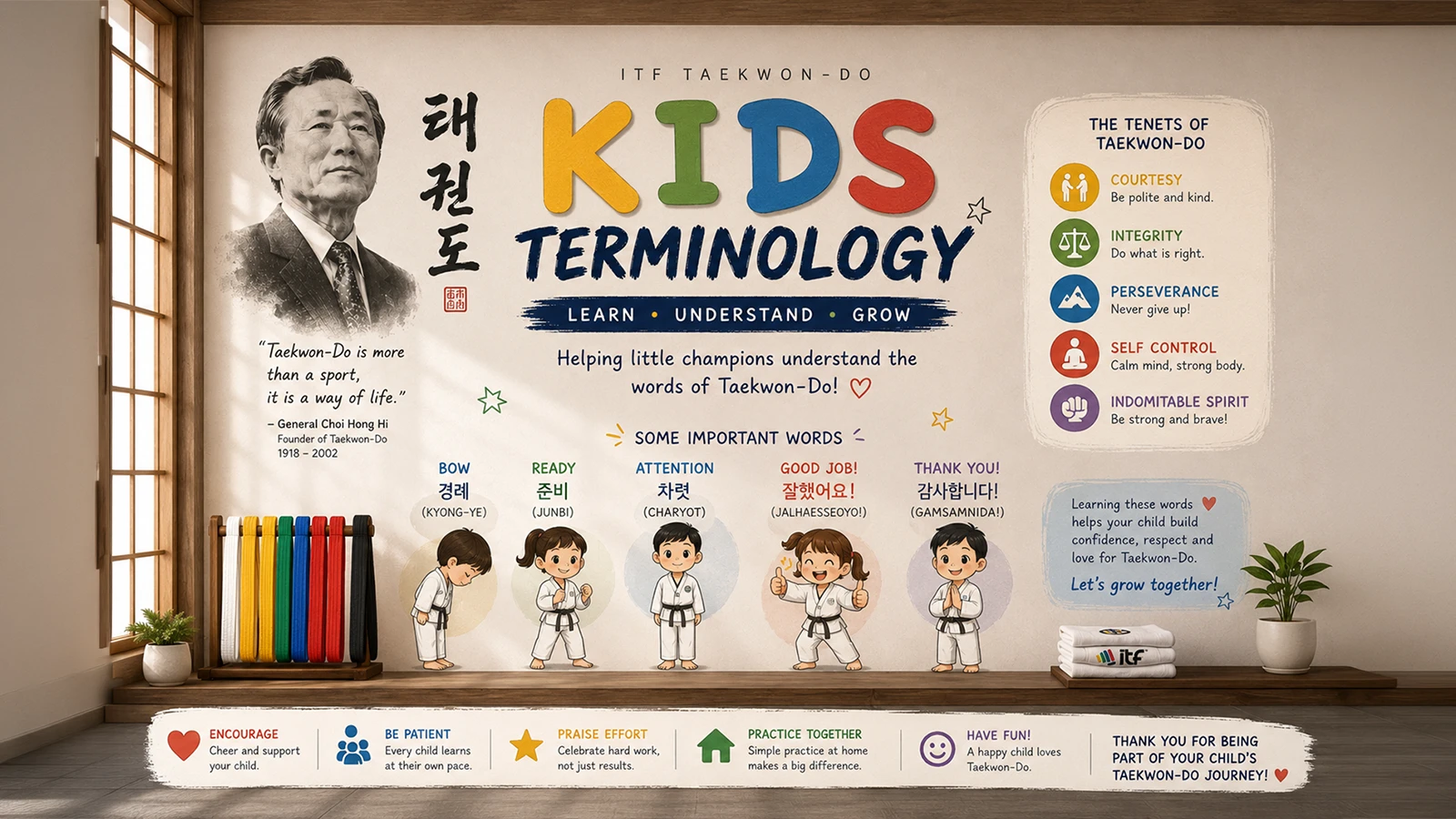
Why words matter
For children aged three to six, Taekwon-Do terminology is not a language lesson in the adult sense. It is a gentle way to build listening, respect, confidence, and routine. When a young student hears Charyot and stands tall, or hears Kyong-Ye and bows, the word becomes connected to an action. This is how small children learn best: one clear word, one clear movement, repeated with patience.
At Emirates Taekwon-Do, parents can help by treating Korean terms as special class words. The goal is not perfect spelling or memorisation. The goal is recognition. A child who understands a few words will settle faster in the Dojang, respond more confidently to the instructor, and begin to feel that Taekwon-Do has its own respectful language.
First dojang words
Begin with the words that children hear every lesson. Dojang means the training hall, the place where we practise with care. Dobok is the Taekwon-Do uniform. Charyot means attention, so the child stands still with eyes forward. Kyong-Ye means bow, used to show respect. Junbi means ready, and it tells the student that training is about to begin.
Two other useful words are Baro, meaning return, and Swiyo, meaning at ease. Parents can practise these at home in a playful way: say the word, show the action, then let the child copy. Keep each practice short. One minute of happy repetition is better than a long test. Children should feel that the words help them join the class, not that they are being examined.
Counting with confidence
Counting is one of the easiest ways for young children to enjoy Korean terminology. For this age group, start with one to five: Hana, Dul, Set, Net, and Daseot. When the child is comfortable, add Yeoseot, Ilgob, Yeodeol, Ahop, and Yeol for six to ten.
Use counting during simple actions such as clapping, stepping, or holding a balanced ready position. The parent does not need to correct every sound. Clear rhythm matters more than perfect pronunciation at this stage. A useful routine is: instructor or parent says the number first, the child repeats, then performs one movement. This builds timing, attention, and turn-taking. Over time, children begin to connect Korean numbers with movement, which prepares them for line work, pad work, and safe group training.
Action words to know
Young students should learn a few action words before they learn long technique names. Sogi means stance, the way the feet and body are placed. Chagi means kick. Jirugi means punch. Makgi means block. Tul means pattern, a set order of movements. Matsogi means sparring, although children at this age should understand it simply as controlled partner practice.
These words can be taught through matching. Ask the child to show a strong stance when they hear Sogi, a safe air kick when they hear Chagi, or a gentle guarding movement when they hear Makgi. Avoid overloading the child with many names at once. A three to six year old can understand that every Taekwon-Do movement has a name, but they do not need the full naming system yet. The priority is safe movement, good listening, and enjoyment.
Good naming habits
Even with very young children, instructors and parents should model correct ITF language. Use Taekwon-Do, not a shortened careless form. Use Tul for pattern. Use Chagi for kick, Jirugi for punch, and Makgi for block. When speaking about height, use simple English first: high, middle, and low. Later these become Nopunde, Kaunde, and Najunde.
Do not teach unnecessary nicknames as the main words. For example, the ITF term Dollyo Chagi is turning kick, not roundhouse kick. Golcho Chagi is hooking kick, not just hook kick. Very young children do not need to know these distinctions in detail, but adults should speak correctly around them. Children absorb what they hear. Consistent wording now prevents confusion later when they begin formal Tul and grading preparation.
What progress looks like
Progress for this age group is visible in small behaviours. A child may enter the Dojang more calmly, recognise where to stand, bow without being reminded, or copy Junbi quickly when the class begins. These are meaningful achievements. They show that the child is connecting language, movement, and respect.
Parents should not expect a three to six year old to explain technical terms such as obverse, reverse, tool, or specification. Those ideas belong to older students. For now, the correct learning outcome is simple: the child recognises important class words, responds safely, and begins to enjoy the sound and rhythm of Taekwon-Do terminology. This foundation makes future learning easier, because the words already feel familiar rather than strange, and it gives the instructor a calmer, more confident student to teach.
Parent practice routine
A simple weekly routine works best. Choose one class word and use it for a few days. On Monday, practise Charyot. On Tuesday, add Kyong-Ye. Later in the week, use Junbi before a short balance game. Keep the tone calm and positive. If the child forgets, simply demonstrate again. The aim is familiarity, not pressure.
Parents can also ask small questions after class: What word did the instructor say before bowing? What do we call the training hall? Which word means kick? These questions help the child recall the lesson without turning it into homework. By the end of this stage, a child should recognise the main commands, count a little in Korean, and understand that Taekwon-Do words are used to show respect, listen carefully, and train safely with the group.