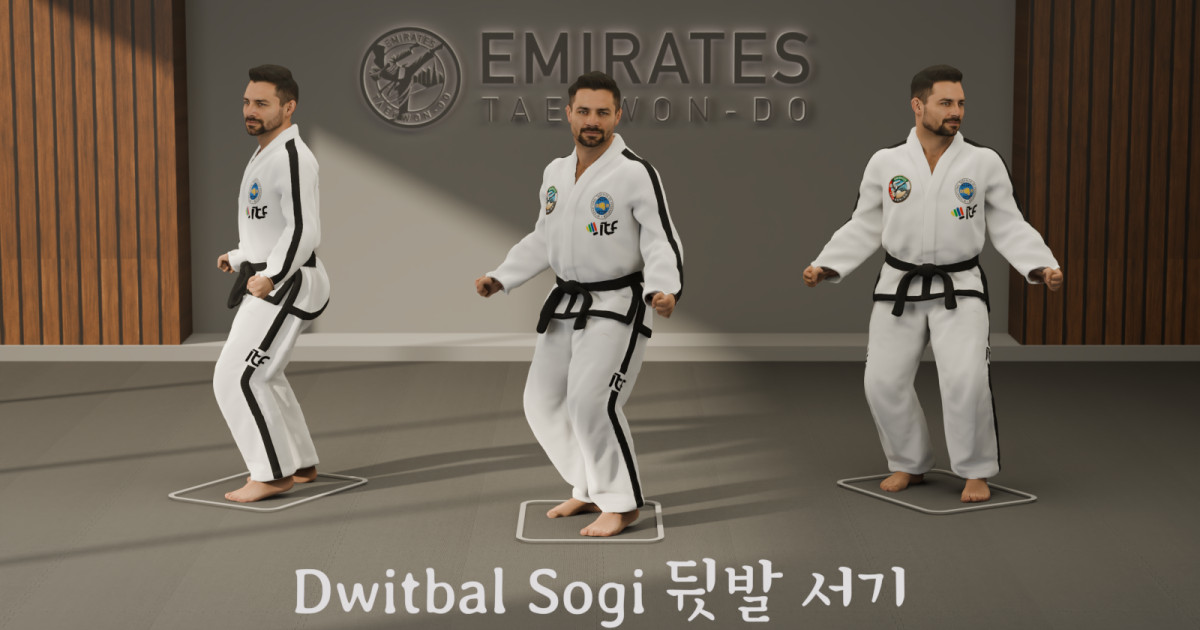

Main stance dimensions
| Reference point | Measurement |
|---|---|
| Width | Minimal lateral width |
| Width detail | The heels are separated laterally by roughly 1 inch or 2.5 cm |
| Length | 1 shoulder width long |
| Length measuring point | Measured from the inner foot-sword of the rear foot to the toes of the front foot |
| Weight distribution | 90% on the rear leg and 10% on the front leg |
Foot and leg structure
| Body part | Technical requirement |
|---|---|
| Rear foot | Turns 15 degrees inward |
| Front foot | Points straight forward or slightly inward, approximately 15 degrees |
| Rear leg | Carries 90% of the body weight |
| Front leg | Carries only 10% of the body weight |
| Front heel | Lifted from the floor, with only the ball of the foot touching |
How to measure the stance
The length of Rear Foot Stance is 1 shoulder width. It is measured from the inner foot-sword of the rear foot to the toes of the front foot. This measuring point is important because the stance is not measured from big toe to big toe like some other stances. The rear foot-sword is the reference for the rear side of the stance.
The width is minimal. The heels are separated laterally by roughly 1 inch or 2.5 cm. This small separation keeps the stance narrow while preventing both feet from being placed directly on the same line. The stance should feel compact and defensive, not wide or spread out.
Students should not widen the stance to feel more stable. Rear Foot Stance depends on correct weight placement and compact structure. If the feet are too far apart sideways, the stance loses its defensive character. If the length is too short or too long, the body will not sit correctly over the rear leg.
Weight distribution and front heel
Rear Foot Stance uses a 90% and 10% weight distribution. The rear leg carries 90% of the body weight, while the front leg carries only 10%. This is one of the defining features of the stance. The body should clearly sit over the rear leg without leaning backward or collapsing the posture.
The front heel is lifted off the ground. Only the ball of the front foot touches the floor. This makes the front foot light and ready to move. The front leg should not carry heavy weight, and the heel should not press down as it would in a stance with equal weight distribution.
The rear-weighted structure is useful for defending, pulling back, and preparing fast counter-kicks with the front leg. The stance should feel controlled and alert. If the front foot becomes too heavy, the stance loses its purpose. If the body leans too far back, the practitioner may lose balance and readiness.
Half facing in Rear Foot Stance
Rear Foot Stance is executed strictly in Half Facing. In half facing, the body is angled to present a narrower target. This supports the defensive purpose of the stance and helps keep the front leg ready for quick movement or counter-kicking.
The facing must not change the stance measurements. The length remains 1 shoulder width, the lateral heel separation remains roughly 1 inch or 2.5 cm, and the weight remains 90% on the rear leg and 10% on the front leg. The front heel stays lifted, with only the ball of the foot touching the floor.
Students should avoid turning only the shoulders while leaving the hips and feet disconnected. The stance must work as one structure. The rear foot, front foot, hips, shoulders, and direction of the technique should all support the half-facing position.
Reference checklist
| Check | Correct standard |
|---|---|
| Stance name | Rear Foot Stance (Dwit Bal Sogi) |
| Width | Minimal lateral width |
| Width detail | Heels separated laterally by roughly 1 inch or 2.5 cm |
| Length | 1 shoulder width |
| Measuring point | From the inner foot-sword of the rear foot to the toes of the front foot |
| Weight | 90% rear leg and 10% front leg |
| Front heel | Lifted, with only the ball of the foot touching the floor |
| Rear foot angle | 15 degrees inward |
| Front foot angle | 0 to 15 degrees inward |
| Facing | Strictly half facing |
Common technical errors
The most common error in Rear Foot Stance is placing too much weight on the front foot. The front foot should carry only 10% of the body weight. If the front heel drops heavily or the front leg becomes too loaded, the stance loses its correct structure and no longer supports quick front-leg movement.
Another common error is widening the stance. Rear Foot Stance should have minimal lateral width, with the heels separated by roughly 1 inch or 2.5 cm. A wider stance may feel safer, but it changes the compact defensive character of Dwit Bal Sogi.
Students should also check the foot angles. The rear foot turns 15 degrees inward, while the front foot points straight forward or slightly inward from 0 to 15 degrees. If the feet turn too far outward, the stance may lose alignment. If the front foot is not light, the practitioner may be slow to counter or shift.
The final check is the facing. Rear Foot Stance is strictly half facing. The body should be angled to minimize the target area, with the stance remaining compact, balanced, and ready for defensive movement or a fast counter-kick.
Key principle
Rear Foot Stance protects the body by placing 90% of the weight on the rear leg while keeping the front foot light and ready to move or kick.
Technical purpose
Rear Foot Stance, called Dwit Bal Sogi in Korean terminology, is a compact defensive stance used in ITF Taekwon-Do. It places most of the body weight on the rear leg while keeping the front foot light, with only the ball of the foot touching the floor. This makes the front leg available for quick movement, fast counter-kicks, or adjustment after a defensive action.
This article is a technical reference. It focuses on the specific structure of the stance: length, minimal width, measuring point, weight distribution, front heel position, foot angles, and facing. Students should use it to check the position accurately, while instructors may use it as a simple correction guide in the Dojang.