

Definition and classification
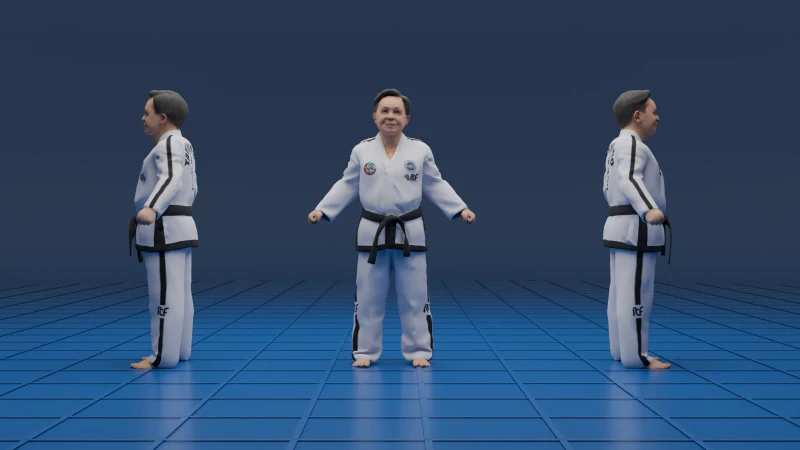
Parallel stance, known as Narani Sogi, is a fundamental symmetrical stance in traditional ITF Taekwon-Do. It is introduced at beginner level and serves as a structural reference point for ready posture, command positions, and transitional movement.
It is classified as a symmetrical stance because there is no distinguishable left or right version. The weight distribution is equal on both legs, and neither leg is positioned in front of the other. Because of this symmetry, the concepts of obverse and reverse do not apply.
According to the principles described in the Encyclopedia of Taekwon-Do by Gen. Choi Hong Hi, parallel stance represents structural neutrality. It is not designed for forward penetration but for balance, readiness, and efficient transition into other stances.
Stance measurements and structure
The feet are positioned parallel to each other and point straight forward. The width of the stance should be one shoulder width, measured from the outer edge of one foot to the outer edge of the other foot.
The legs remain straight without locking the joints. The body weight is distributed evenly, expressed as 50 percent on each leg. Because the stance is symmetrical, it provides equal support on both sides of the body.
If the stance is too narrow, stability decreases. If it is too wide, mobility is restricted and unnecessary muscular tension develops. Consistent measurement ensures structural efficiency and prepares the practitioner for accurate transitions into other positions.
Facing direction and alignment
Parallel stance may be either full facing or side facing, depending on the technique or drill being performed. In full facing position, the hips and shoulders are aligned squarely toward the front. In side facing position, the torso is turned so that one shoulder is closer to the target.
Regardless of facing direction, the spine remains upright and the head level. The abdomen is lightly engaged to stabilize the trunk without creating stiffness.
Alignment must be controlled and deliberate. Unintentional twisting or leaning compromises balance and reduces efficiency in technique execution. Adult practitioners should verify that the weight remains evenly grounded through both feet.
Narani Sogi
Weight distribution and balance
Parallel stance requires equal weight distribution, with 50 percent of the body weight supported by each leg. This balanced grounding allows immediate movement in any direction.
Because no leg is dominant, the practitioner must maintain symmetrical engagement of both hips and thighs. Leaning to one side disrupts equilibrium and reduces readiness.
In adult training, balance should not be passive. The stance must feel stable yet prepared for action. Proper grounding enhances reaction speed and reinforces structural control before initiating stepping or striking.
Application of sine wave
Although parallel stance is neutral, it plays a role in the application of sine wave motion. According to ITF principles, sine wave is generated by coming up onto the balls of the feet and then dropping the body’s weight in coordination with the technique.
From parallel stance, the practitioner rises slightly onto the balls of the feet during transitional movement and then drops the body weight at the moment of execution. This vertical motion contributes to effective force generation.
Adults must avoid exaggerated rising or collapsing. The movement should be controlled, synchronized with breathing, and integrated smoothly into the technique being performed.
Use in ready position
Parallel stance is commonly used in the ready position, known as Narani Junbi Sogi. In this posture, the feet remain shoulder width apart and parallel, while the hands assume the prescribed ready position.
This stance appears at the beginning and conclusion of patterns, during instructor commands such as Ready, and in preparation for fundamental exercises. It provides a neutral base from which techniques can be initiated with precision.
Adult practitioners should treat ready stance as a disciplined posture rather than a relaxed standing position. Correct structure reflects mental focus and respect for training.
Common technical errors
One common error is allowing the feet to angle outward or inward instead of remaining parallel. This misalignment affects overall posture and balance.
Another frequent mistake is shifting weight unevenly onto one leg, often without awareness. Even slight asymmetry reduces structural neutrality and readiness.
Excessive stiffness in the upper body or leaning forward and backward also diminishes efficiency. Adults should periodically reassess foot alignment, weight distribution, and spinal posture to maintain technical accuracy in this fundamental stance.