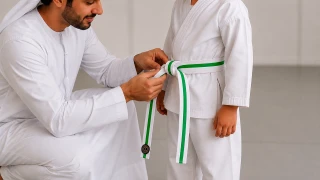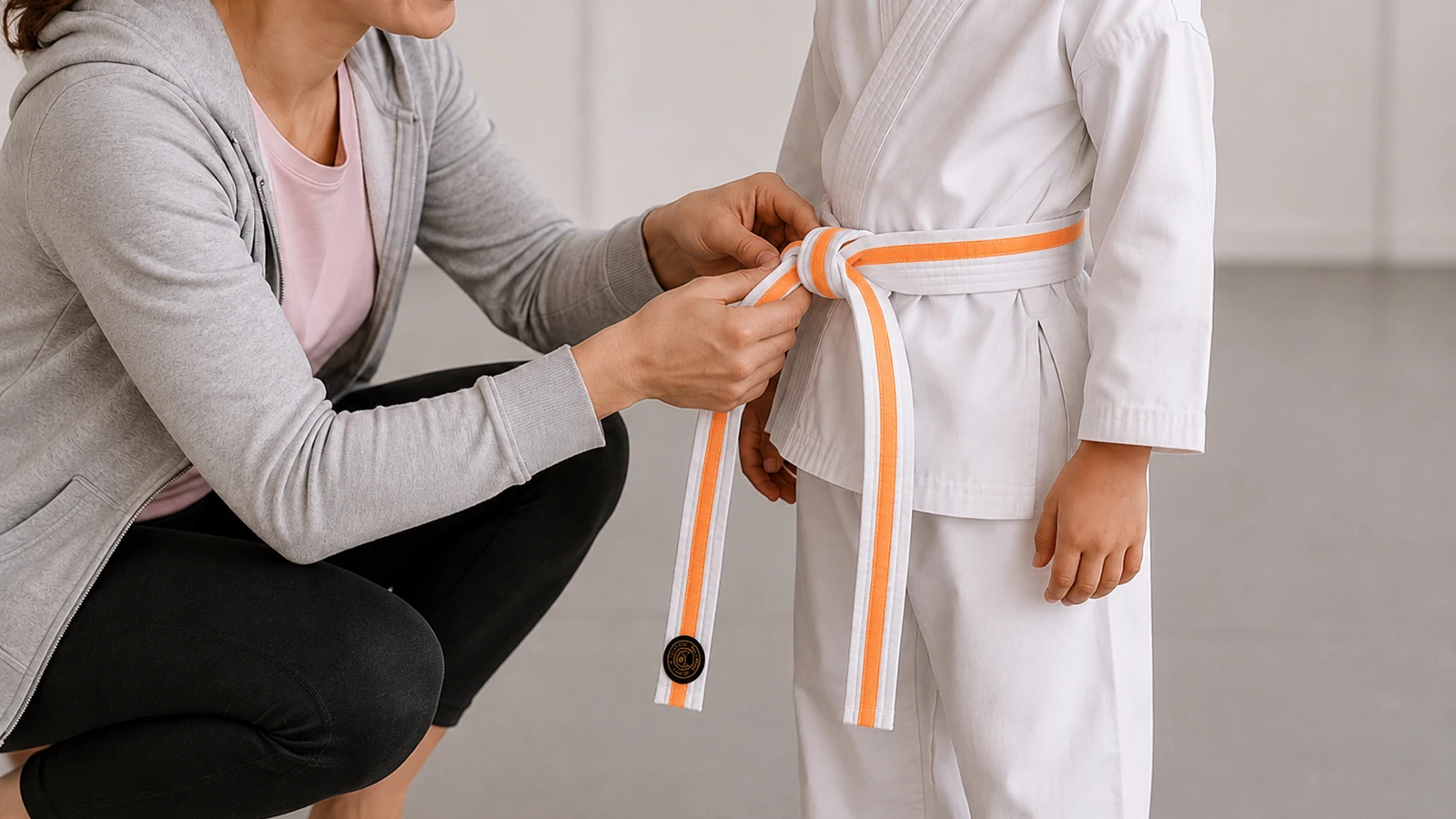
The orange line stage
This stage is for children aged 3 to 6 progressing from White Belt with Orange Line toward White Belt with Green Line. At this level, students continue developing stronger body control, balance, confidence, and awareness of movement.
The techniques introduced during this stage require children to control their posture more carefully while moving in different directions. The objective is not perfection. The goal is helping children become more comfortable using their bodies with confidence, coordination, and discipline.
This stage also introduces the tenet of Integrity, helping children understand honesty, responsibility, and the importance of doing the right thing even when mistakes happen.
Technical requirements
For promotion to White Belt with Green Line, students must demonstrate one new fundamental movement and one kick.
- Walking Stance Knife-hand Low Block — Gunnun So Sonkal Najunde Makgi
- Side Piercing Kick — Yop Chagi
The walking stance knife-hand low block teaches children how to use a different hand shape while maintaining a stable walking stance. This movement develops coordination, concentration, and arm control.
The side piercing kick introduces stronger side movement, body alignment, balance, and directional awareness. Many children initially find side kicking more difficult because it requires standing on one leg while controlling the body position. Through repetition and encouragement, students gradually become more comfortable controlling their movement safely.
Development focus
The main development focus for this stage is improving balance, stability, and control of movement. These abilities are extremely important during early childhood because they support confidence, coordination, and overall physical development.
- Balance — learning to control the body while standing, kicking, and moving.
- Stability — maintaining stronger posture during drills and exercises.
- Spatial awareness — understanding direction, distance, and body positioning.
- Teamwork exercises — cooperating safely and respectfully with classmates.
- Control of movement — avoiding rushed or uncontrolled actions.
At this age, children are still discovering how their bodies move through space. Activities that improve balance and coordination also help strengthen focus, confidence, listening skills, and emotional development.
Theory for this stage
The theory focus for this level is the tenet of Integrity, called Yom Chi. For young children, Integrity means learning honesty, responsibility, and accountability in simple everyday situations.
- Doing what is right — behaving properly even when nobody is watching.
- Telling the truth — being honest with instructors, parents, and classmates.
- Admitting mistakes — accepting correction and trying again positively.
Students also learn the Korean numbers Yeoseot meaning 6 and Ilgop meaning 7. In addition, children learn that the Taekwon-Do uniform is called the Dobok. These theory lessons help children become familiar with Taekwon-Do culture and terminology in a simple and age-appropriate way.
How parents can help
Parents play an important role in helping children succeed during this stage. Encouraging honesty, calm correction, patience, and respectful behaviour at home reinforces the same lessons children are learning in class.
Parents can support training by encouraging children to practise balance safely, review simple terminology, or demonstrate their side piercing kick position. Asking questions such as What is a Dobok? or Can you count to seven in Korean? helps children feel proud of what they are learning.
It is also important to praise effort and honesty rather than only focusing on technical performance. When children admit mistakes, continue trying, and stay positive after difficulty, they are demonstrating Integrity and building important emotional skills.
Ready for green line
A student becomes ready for White Belt with Green Line when they can demonstrate the required movement and side piercing kick with improving balance and control while continuing to show respectful and honest behaviour during class.
At this age, readiness is measured through participation, confidence, effort, and positive behaviour more than technical perfection. Students should recognise Gunnun So Sonkal Najunde Makgi, Yop Chagi, Yeoseot, Ilgop, and Dobok at a beginner level.
This stage continues building the physical coordination, emotional confidence, and disciplined habits that prepare children for the next steps of the Emirates Taekwon-Do Early Confidence Rank System.