
Technique Overview
The middle punch in walking stance, known as gunnun sogi ap kaunde jirugi, is a fundamental hand technique in ITF Taekwon-Do. For children, this technique develops body awareness and introduces the correct relationship between stance, movement, and hand technique.
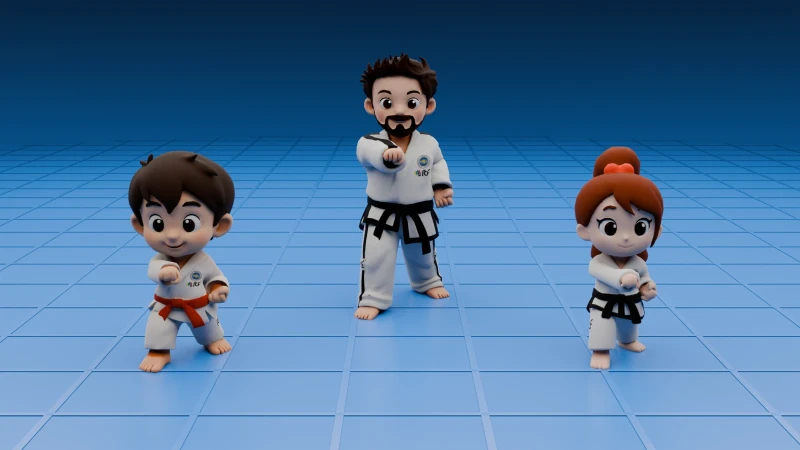
Middle Punch - Kaunde Jirugi
When your child practices the middle punch, begin by checking their stance. One foot should be in front, knees slightly bent, and the body upright. The shoulders must be full facing, meaning the chest faces straight forward and is not turned to the side. Make sure the punching hand starts at the hip while the other hand is relaxed in front. As the punch begins, observe that the fist travels straight forward along the center line of the body, not in a curve or swinging motion. Just before the punch finishes, the fist rotates so the palm faces downward and the punch lands with the two large knuckles of the forefist (ap joomuk). These knuckles should be aligned with the center of the body and stop at shoulder height, which is the correct middle level (kaunde). At the same time, the opposite hand must pull back firmly to the hip. Finally, the child should breathe out briefly at the moment the punch finishes and then relax immediately. By checking these points—full facing shoulders, straight punch line, correct knuckles, correct height, and controlled breathing—parents can confidently help their child correct and improve their middle punch.
Click to load the interactive view.
Walking Stance (Kids)
The walking stance is a fundamental Taekwon-Do position that teaches students balance, stability, and correct body alignment. By practicing proper foot placement, weight distribution, and posture, students develop a strong foundation for powerful and controlled techniques.
Discover this related learning.
Learn More 
Practice At Home
To practice at home, parents should give clear and simple instructions, just like in class. Begin by saying “Junbi”, which means “ready.” The child should adopt a ready position with the feet parallel and one shoulder width apart, standing upright, and the fists held in front of the belt, slightly apart, showing readiness and control. Next, the parent counts “hana”, then waits patiently until the child completes one correct movement. After the technique is finished, the parent counts “dul”, waits again, and then “set”, allowing the child to perform one movement per count. Once the child has completed three steps forward, repeat the same process moving backward, again counting “hana, dul, set” and waiting for each movement to be completed. Practice this sequence a few times, calmly correcting posture, balance, and control using the instructions learned above if needed. When the child is ready for the next stage, instead of counting each movement, the parent gives the command “Si-jak” (the Taekwon-Do command for “begin”). The child should then perform three movements forward and three movements backward independently. At this stage, parents should focus on steady pace, making sure the child breathes correctly and includes a small pause between movements, encouraging calm control rather than rushing.
Frequently Asked Questions
Frequently Asked Questions
- What is the purpose of the middle punch in Taekwon-Do? The middle punch helps develop posture, balance, and coordination while reinforcing discipline.
- How can I help my child practice the middle punch at home? Use clear instructions and count movements to guide your child through the practice.