
Terminology as grammar
Adult students should study Taekwon-Do terminology as a technical grammar, not as a collection of labels. General Choi Hong Hi’s ITF system names movements by identifying their important parts: the stance, the attacking or blocking tool, the height, the relationship between stance and hand, the technical specification, and the type of technique. This allows a practitioner to understand a movement before seeing it demonstrated.
Correct terminology also protects the character of the art. It supports International Instructor Courses, gradings, umpire work, Tul study, and clear instruction across countries. An instructor who says Gunnun So Nopunde Jirugi is not merely speaking Korean; they are describing walking stance high punch according to a structured ITF convention. The aim is not to sound complicated. The aim is to be accurate, consistent, and faithful to the Taekwon-Do system.
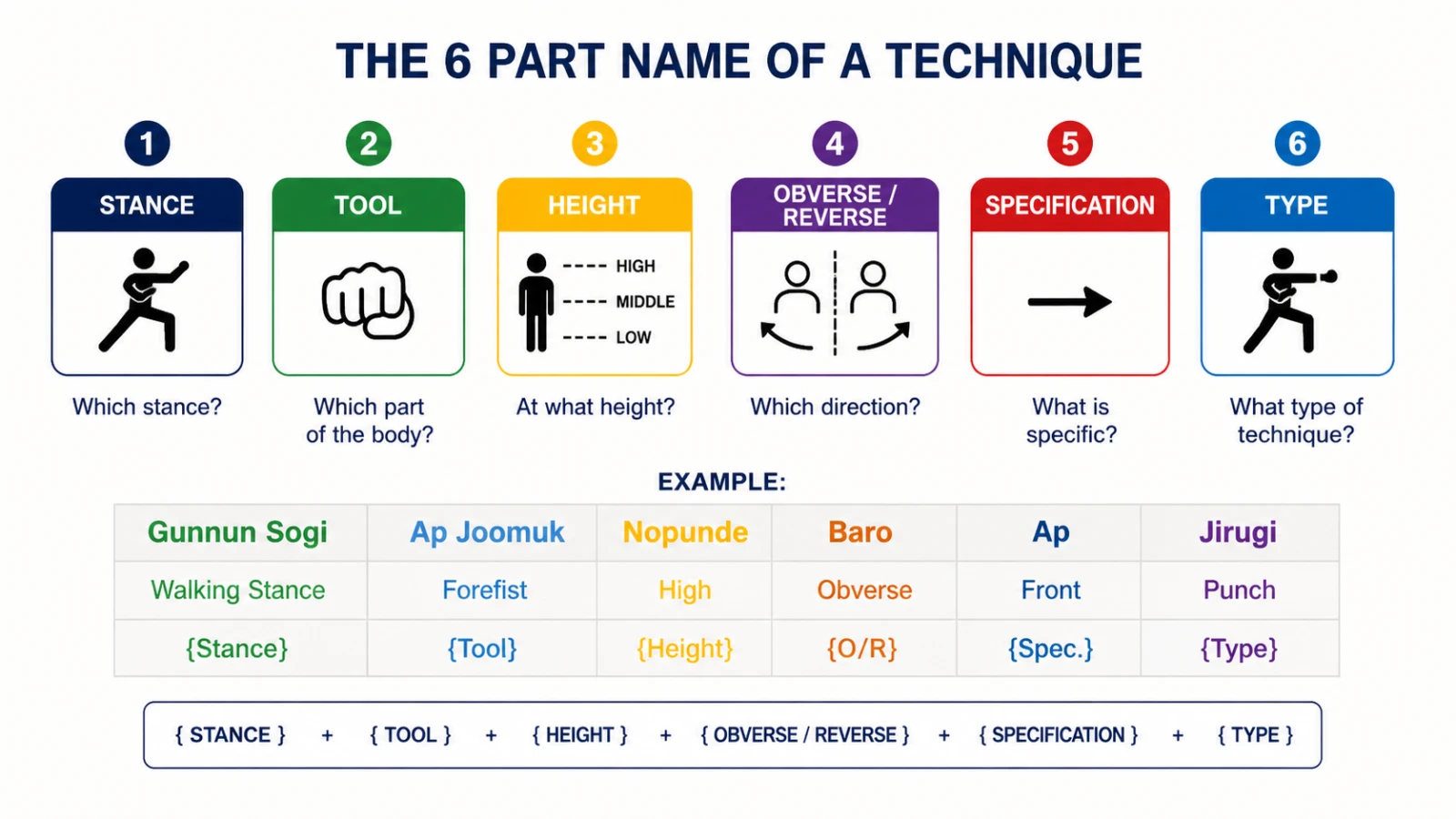
The six part name
The standard teaching model is stance, tool, height, obverse or reverse, specification, and type. A full example is Gunnun Sogi Ap Joomuk Nopunde Baro Ap Jirugi: walking stance, forefist, high, obverse, front, punch. In normal use this can become Gunnun So Nopunde Jirugi, because forefist, obverse, front, and punch direction are usually implied for a standard punch unless otherwise stated.
There are two useful rules. First, only the final word in a technique name normally keeps the gi ending, so Sogi becomes So inside the name. Second, an omitted word is not an error if the default is clear. Adults should learn both the expanded analysis and the accepted short form. This prevents the opposite mistakes of over-naming simple techniques and under-naming movements where the tool or specification is essential.
Stance controls relationship
Stance is the first identifier because it establishes body position, facing, weight distribution, and left or right relationship. Symmetrical stances such as Narani Sogi, Charyot Sogi, Moa Sogi, and Annun Sogi have no true left or right version. Asymmetrical even stances, including Gojung Sogi, Sasun Sogi, Gunnun Sogi, and Nachuo Sogi, are usually named by the front leg. Uneven stances such as Niunja Sogi, Dwitbal Sogi, Soo Jik Sogi, Kyocha Sogi, and Guburyo Sogi are named by the leg carrying most weight.
This distinction explains Baro and Bandae. Baro means obverse: the active front hand is on the same side as the stance. Bandae means reverse: the active front hand is on the opposite side. Symmetrical stances cannot use this relationship, so left and right are identified with Wen and Orun when necessary.
Tools versus specifications
The tool is the body part used and, in some cases, its orientation. Examples are Ap Joomuk, forefist; Dung Joomuk, back fist; Yop Joomuk, side fist; Sonkal, knifehand; Sonkal Dung, reverse knifehand; Bakat Palmok, outer forearm; An Palmok, inner forearm; Doo Palmok, double forearm; Kyocha Joomuk, X-fist; and Palkup, elbow. These terms must be placed early in the name because they identify what part of the body is doing the work.
A specification describes position, direction, shape, orientation, or purpose. Examples include Ap, front; Yop, side; Dwit, back; Anuro, inward; Bakuro, outward; Naeryo, downward; Chookyo, rising; Dollyo, turning; Miro, pushing; Momchau, checking; Daebi, guarding; and Hechyo, wedging. A common adult-level error is misplacing the term. Doo Palmok is a tool, not a specification. Dwijibun Sonkut describes an upset fingertip tool, while Dwijibo Jirugi describes an upset punch.
Height without section
ITF technique height uses Nopunde, high; Kaunde, middle; and Najunde, low. For attacks and kicks, high generally means the attacking tool reaches the attacker’s eye level at impact. Middle reaches shoulder level. Low reaches the level of the attacker’s umbilicus. For blocks, the level is judged by the defender’s tool and the target being intercepted.
Do not substitute the word section when naming techniques. Body sections are a separate anatomical idea: Nopun Bubun, high section; Kaunde Bubun, middle section; and Najun Bubun, low section. Therefore Nopunde Jirugi is high punch, not high section punch. Some techniques also have implied heights. Noollo Makgi, pressing block, is low by nature, while Chookyo Makgi, rising block, is not simply a high block because its final position is above eye level.
Types and combinations
The final word identifies the type of technique. The main types are Jirugi, punch; Taerigi, strike; Tulgi, thrust; Ghutgi, cross-cut; Makgi, block; and Chagi, kick. Because the type is the final category, it carries the final gi ending in the name. This is why word order matters: Sonkal Nopunde Anuro Taerigi is knifehand high inward strike, not an inward knifehand high technique.
When two techniques are named in succession, the first technique may change the final gi to go. For example, a sequence can be named with Makgo before the second Makgi. Adults do not need to use this every time in beginner teaching, but they should recognise it in formal explanations and advanced Tul study. It shows that ITF terminology describes both single techniques and connected motions.
Common ITF corrections
Several familiar martial arts words are not the preferred ITF terms. Use Dollyo Chagi, turning kick, instead of roundhouse kick. Use Golcho Chagi, hooking kick, instead of hook kick. Use Bandae Dollyo Goro Chagi, reverse hooking kick, where that specific motion is intended. Use Naeryo Chagi, downward kick, and Gokaeng-i Chagi, pick-shape kick, accurately rather than grouping them under axe kick. Use Yop Joomuk, side fist, rather than hammer fist, and Sonkal Dung, reverse knifehand, rather than ridge hand.
Instructors should correct terminology with courtesy and integrity. Students should be encouraged to ask why a name is used, then analyse it through the six part model. The best test is practical: can the name guide the body into the correct stance, tool, height, specification, and technique type? If it can, terminology becomes a training method rather than a memory burden.