

Exam overview
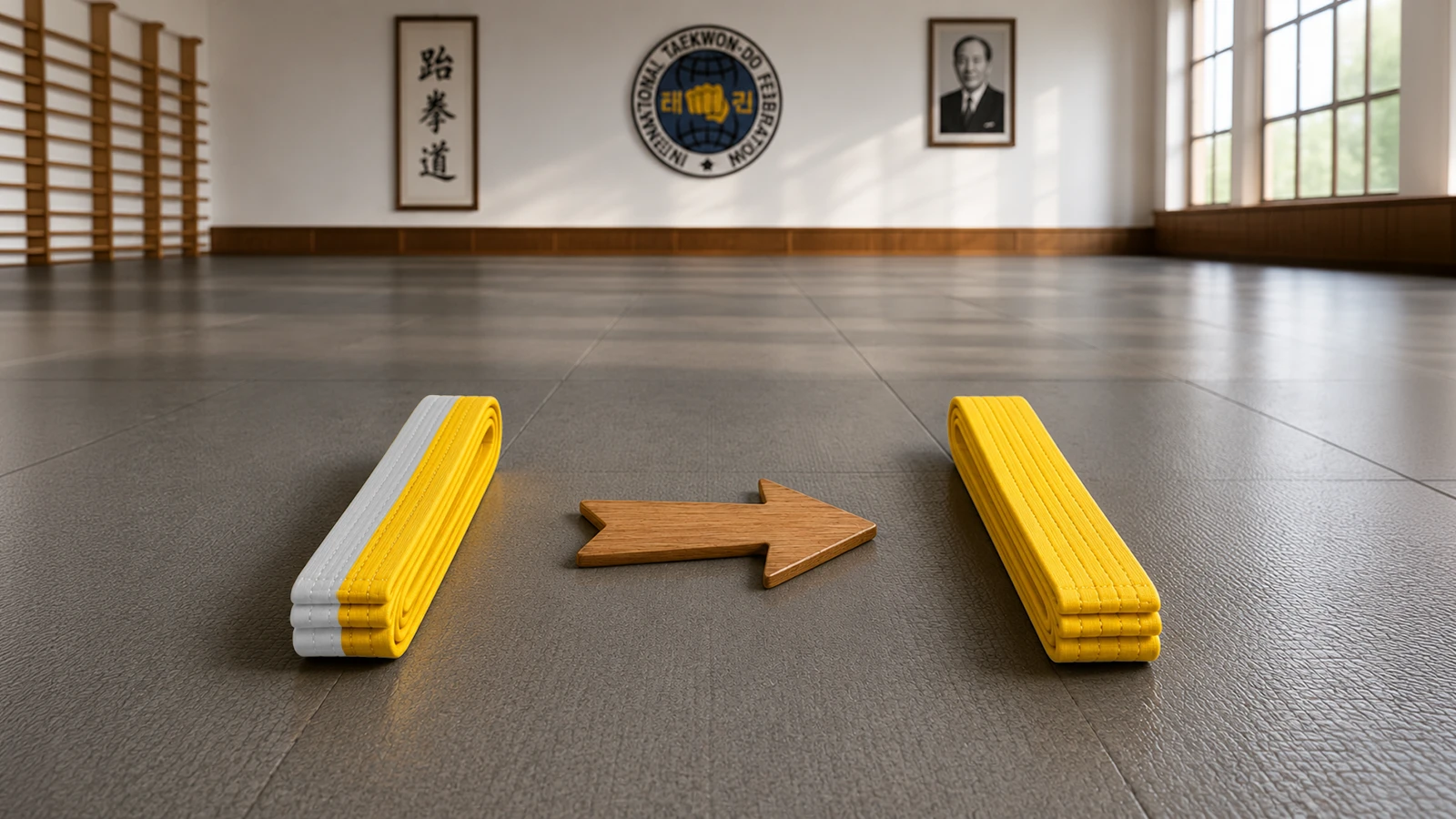
This syllabus is for White-Yellow Belt, 9th Gup students preparing for promotion to Yellow Belt, 8th Gup. It gives students one clear online reference for what to practise and study before their exam.
The exam areas for this level are divided into fundamental movement, the kick, pattern, and theory. Students should be able to perform the required movement with a stable L-stance, demonstrate the kick with control, practise Chon-Ji Tul with correct direction and rhythm, and understand the theory connected to Chon-Ji and student behaviour. At this grade, the main objective is to show that the student is becoming more organised, more disciplined, and more confident with the basic language of ITF Taekwon-Do.
White-Yellow.pdf
Open PDFFundamental movement
The fundamental movement for this exam is L-Stance Inner Forearm Middle Block, called Niunja So An Palmok Kaunde Makgi. This is one of the most important beginner defensive movements because it teaches the student to combine stance, body facing, blocking tool, height, and finishing position.
- L-Stance — Niunja So
- Inner forearm — An Palmok
- Middle — Kaunde
- Block — Makgi
Students should avoid saying middle inner forearm block. The correct ITF order is inner forearm middle block. When practising, form a clear L-stance, keep the body stable, prepare the arm correctly, and finish the block on the middle line. The wrist should not bend, the shoulder should not lift, and the stance should not collapse during the movement.
The kick
The required kick for this exam is Downward Kick, called Naeryo Chagi. This technique must be named correctly. Students should not call it axe kick, chop kick, or cut down kick for exam terminology. In ITF Taekwon-Do, the correct English name is downward kick, and the Korean name is Naeryo Chagi.
To practise the kick, lift the leg under control, extend to the correct line, bring the attacking tool downward, then recover and land safely. Balance is more important than height at this level. Students should avoid throwing the leg without control or leaning the upper body too far back. The examiner should see clear preparation, controlled direction, safe recovery, and disciplined posture. A correct downward kick should look deliberate, not rushed or uncontrolled.
Pattern requirement
The required pattern for this exam is Chon-Ji Tul. Chon-Ji has 19 movements. Students must know the pattern name, the number of movements, the starting position, the diagram, the direction changes, and the correct finishing point.
In the booklet, the pattern diagram is shown with the directions A, B, C, and D. Students should use these directions to understand where the body is moving, not only to memorise the sequence. Practise Chon-Ji slowly until each turn is clear and each stance is consistent. The pattern should not be performed as a race. Each movement should show preparation, correct stance, correct tool, correct height, breath control, and a clean finish. If the student loses direction, the best correction is to slow down and rebuild the pattern one line at a time.
Meaning of Chon-Ji
CHON-JI: Means literally "the Heaven the Earth". It is, in the Orient, interpreted as the creation of the world or the beginning of human history, therefore, it is the initial pattern played by the beginner. This pattern consists of two similar parts; one to represent the Heaven and the other the Earth.
Student behaviour
White-yellow belt students must study the expected behaviour of a Taekwon-Do student. The first rule is to never tire of learning. A good student can learn anywhere and at any time. Students should also be willing to sacrifice time and effort for their art and instructor, and should always set a good example for lower ranking students.
A student must be loyal to the instructor, Taekwon-Do, and the teaching methods. If the instructor teaches a technique, the student should practise it and attempt to use it correctly. Students must remember that their conduct outside the Dojang reflects on the art and the instructor. This means discipline is not only for class. The way a student speaks, behaves, and treats others is also part of their Taekwon-Do training.
Respect and loyalty
The booklet also explains important rules about respect and loyalty. If a student adopts a technique from another Dojang and the instructor disapproves of it, the student must discard it immediately or train at the gym where the technique was learned. This rule teaches consistency, trust, and respect for the system being studied.
Students must never be disrespectful to the instructor. A student may disagree with an instructor, but the correct behaviour is to first follow the instruction and then discuss the matter later in a respectful way. Students should always be eager to learn and ask questions. Asking questions is positive when it is done with courtesy and a genuine desire to improve. Finally, students must never betray the instructor or Taekwon-Do. These behaviour rules are part of the theory for this grade and should be understood, not only memorised.
Exam checklist
Before the exam, students should check that they can demonstrate every required area from this syllabus. They should practise Niunja So An Palmok Kaunde Makgi, Naeryo Chagi, and Chon-Ji Tul with 19 movements. They should also be able to explain the meaning of Chon-Ji and understand the Taekwon-Do student behaviour rules.
On exam day, students should wear a clean Dobok, tie the belt correctly, bow properly, listen carefully to instructions, and correct mistakes without frustration. A good white-yellow belt exam is not only about remembering techniques. It is about showing that the student can follow direction, train with respect, practise with discipline, and continue building the foundation needed for Yellow Belt, 8th Gup.