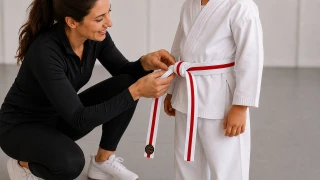

The purple line stage
This stage is for children aged 3 to 6 progressing from White Belt with Purple Line to White Belt with Red Line. At this level, students begin demonstrating stronger confidence, better coordination, and greater independence during class activities.
Children are now expected to follow more complex sequences, maintain focus for longer periods, and perform movements with improved control under pressure. This stage also introduces stronger teamwork and leadership concepts, helping children understand how their behaviour influences younger or less confident classmates.
The theory focus for this stage is the tenet of Indomitable Spirit. Children begin learning that confidence does not mean never feeling nervous. Confidence means continuing to try even when something feels difficult.
Technical requirements
For promotion to White Belt with Red Line, students must demonstrate one fundamental exercise and one flying kick.
- Four Directions Block — Saju Makgi
- Flying Side Piercing Kick
Saju Makgi teaches children how to follow movement sequences using defensive techniques in four directions. Students develop stronger memory, coordination, focus, and directional awareness while learning how to stay balanced during turning and blocking movements.
The flying side piercing kick introduces more advanced jumping coordination and body control. Students learn how to jump, align the body, extend the kick safely, recover, and land with better control. At this age, the objective is not power or height. The goal is helping children move confidently while remaining disciplined and balanced.
Development focus
The main development focus for this stage is helping children improve coordination, focus, and confidence under pressure. Children are beginning to perform more independently and become role models for newer students.
- Stronger coordination — combining turning, blocking, balance, and direction together.
- Focus and discipline — maintaining attention during longer sequences and instructions.
- Leadership through example — behaving positively and respectfully around classmates.
- Confidence under pressure — continuing even when feeling nervous or challenged.
- Teamwork and partner awareness — training safely and cooperating respectfully with others.
Children at this stage often begin showing noticeable improvements in confidence, independence, and classroom behaviour both inside and outside the Dojang.
Theory for this stage
The theory focus for this level is the tenet of Indomitable Spirit, called Baekjul Boolgool. For young children, this means learning courage, resilience, and self-belief.
- Being brave — trying even when feeling nervous or unsure.
- Believing in yourself — building confidence through effort and practice.
- Trying even when things are difficult — continuing after mistakes or challenges.
Students also learn the instructor titles used for senior black belts:
- Instructor 4th to 6th Dan — Sabum or Sabum-Nim
- Instructor 7th and 8th Dan — Sa Hyun-Nim
- Grand Master 9th Dan — Sa Seong-Nim
These lessons help children continue building respect, confidence, and familiarity with Taekwon-Do etiquette and structure.
How parents can help
Parents can support this stage by encouraging children to continue trying even when movements feel difficult or when they become frustrated. This stage often includes more challenging coordination and memory tasks, so positive encouragement is very important.
Parents can help by asking children to demonstrate parts of Saju Makgi, review instructor titles, or explain what it means to be brave and keep trying. Praising effort, courage, patience, and respectful behaviour helps reinforce the same values taught in class.
Children at this age benefit greatly from feeling emotionally safe while learning. When parents celebrate effort and persistence rather than only perfect performance, children become more confident, resilient, and willing to continue challenging themselves.
Ready for red line
A student becomes ready for White Belt with Red Line when they can demonstrate Saju Makgi and flying side piercing kick with improving coordination, confidence, and focus while continuing to show respectful and disciplined behaviour during class.
Students should recognise Saju Makgi, flying side piercing kick, Sabum-Nim, Sakhyo-Nim, and Sasung-Nim at a beginner level while showing stronger confidence and teamwork during training.
This stage prepares children for the final step of the Emirates Taekwon-Do Early Confidence Rank System before entering the traditional White-Yellow Belt grading path.