

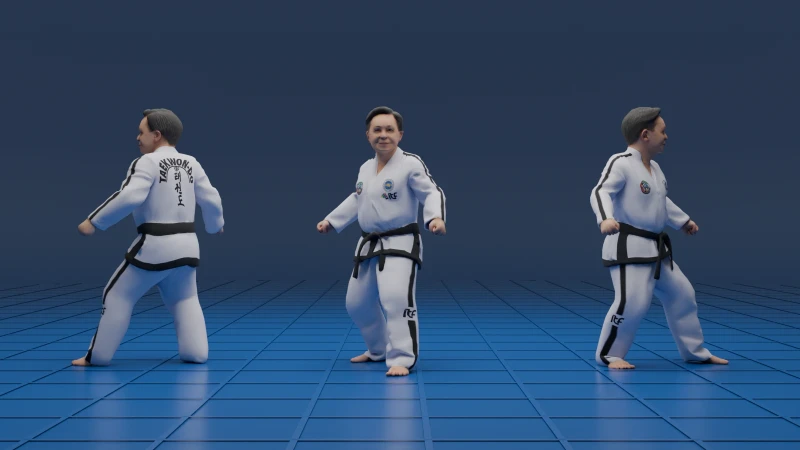
What L-stance is
L-stance (Niunja Sogi) is one of the most frequently used stances in traditional ITF Taekwon-Do because it supports reliable defense while still allowing quick counter-attack. The stance is always half facing, which reduces your exposed target area and helps you shift the body smoothly when blocking or preparing a follow-up technique. A key advantage is that the front foot stays ready for kicking with only a slight shift of body weight, so you can react quickly without sacrificing balance.
Think of L-stance as a stance that keeps you prepared rather than committed. You should feel stable enough to absorb pressure, but light enough to move, pivot, or lift the front leg immediately. When performed correctly, the stance supports strong guarding motion, effective body shifting, and clean transitions into other stances. When performed incorrectly, it can strain the legs, slow your reaction, and open you to sweeps or timing attacks. Mastery starts with correct distance, correct angles, and correct alignment.
Distance and foot position
To form L-stance, move one foot to either the front or the rear so the distance is approximately one and a half times shoulder width. The common measurement point is from the footsword of the rear foot to the toes of the front foot. The feet should form almost a right angle, creating the characteristic shape that gives the stance its name.
A practical detail that improves stability is the direction of the toes. It is recommended that the toes of both feet point about 15 degrees inward. This helps you lock the structure without twisting the knees. For additional steadiness, place the front heel slightly beyond the heel of the rear foot by about 2.5 centimeters. This small offset helps control lateral movement and keeps the stance from feeling unstable.
When you check your stance, make sure the front foot is not placed too far inside. If the front foot crosses too much toward the center line, you become more susceptible to foot sweeps and your base becomes narrower than intended. Keep the feet set with clarity and purpose.
Knees, hips, and alignment
After setting the feet, focus on the legs and joints. Bend the rear leg until the kneecap forms a vertical line with the toes. This is an important checkpoint because it places the knee in a supported position and allows the rear leg to carry most of the body weight without collapsing. The front leg should be bent proportionally, not locked straight and not excessively bent. You want a stance that is ready, not strained.
Hip position is another critical requirement. Keep the hip aligned with the inner knee joint. This alignment helps the stance hold under pressure and prevents the pelvis from drifting backward or twisting away from the supporting leg. When the hips are correct, the stance supports strong blocks and clean counters because the torso remains connected to the base.
A common error is pushing the bottom too far to the rear. This may feel stable at first, but it often causes the upper body to lose effective reach and timing, which can reduce blocking effectiveness. Another error is excessively bending the supporting leg, which can place unnecessary stress on the leg and reduce mobility. Aim for controlled, functional alignment.
Weight distribution and half facing
The standard weight distribution in L-stance is about 70 percent on the rear leg and 30 percent on the front leg. This ratio supports a defensive posture because the rear leg provides most of the stability, while the front leg stays lighter and ready to lift. When you shift slightly forward, the front foot becomes immediately available for kicking. When you settle back, the stance supports strong guarding and body shifting.
L-stance is always half facing for both attack and defense. Half facing helps you protect the center line while still letting the hips and shoulders work efficiently for blocks, strikes, and counters. It also supports body shifting, which is a major reason the stance is so useful in patterns and sparring-like movement.
When the right leg is bent, it is called a right L-stance. When the left leg is bent, it is called a left L-stance. The naming follows the bent supporting leg, not the front leg. This is important for consistent communication in class and for correct performance in patterns.
If you lose the 70/30 feeling, your stance will change function. Too much weight forward can make you slow and vulnerable to timing attacks. Too much weight back can make you unable to reach or react effectively.
Why it supports defense
L-stance is widely used for defense because it offers a stable base for blocking while keeping your movement options open. The half-facing posture helps narrow the target area, and the strong rear-leg support helps you receive and redirect force. This makes the stance especially useful when performing guarding blocks, forearm blocks, and other defensive actions where body shifting is needed to control distance.
At the same time, L-stance is not only defensive. It is also used in attack because it positions the body for quick counter-attack. With the front foot light, you can execute fast kicks with minimal preparation, and you can shift your weight and angle to create openings. In patterns, you often see L-stance used as a bridge between techniques, allowing the practitioner to combine stability, precision, and readiness.
The stance also teaches discipline in alignment. Because the measurements and joint positions are specific, practicing L-stance builds awareness of foot angle, knee alignment, hip position, and weight control. These habits transfer directly into better movement in other stances and improve overall balance.
The key is to remember the purpose. L-stance is not meant to be a wide, heavy stance that locks you in place. It is meant to be stable, defensive, and ready to respond immediately.
Common mistakes to avoid
Mistakes in L-stance usually come from changing the stance away from its intended function. One common mistake is excessively bending the supporting leg. This can place stress on the leg and reduce your ability to move smoothly. In the long term, it can also encourage poor knee mechanics. Keep the rear knee aligned and bent enough to support the stance, but not forced into an extreme angle.
Another common mistake is placing the front foot too far inside. When the front foot crosses inward, the stance becomes narrow and vulnerable to sweeps. It also reduces your ability to lift the front leg quickly because your base is unstable. Keep the foot position clear, with the feet forming almost a right angle and the front heel slightly beyond the rear heel.
Pushing the hips too far to the rear is also incorrect. This often causes you to fail to block effectively because your upper body becomes disconnected from the stance. You may feel like you are leaning away from the action rather than controlling it. Keep the hips aligned with the inner knee joint so the torso remains supported.
Finally, avoid making the stance too wide. When the stance becomes too wide, an opponent can attack before you have a chance to raise your foot since your movement is delayed. The correct distance keeps you mobile and responsive.