
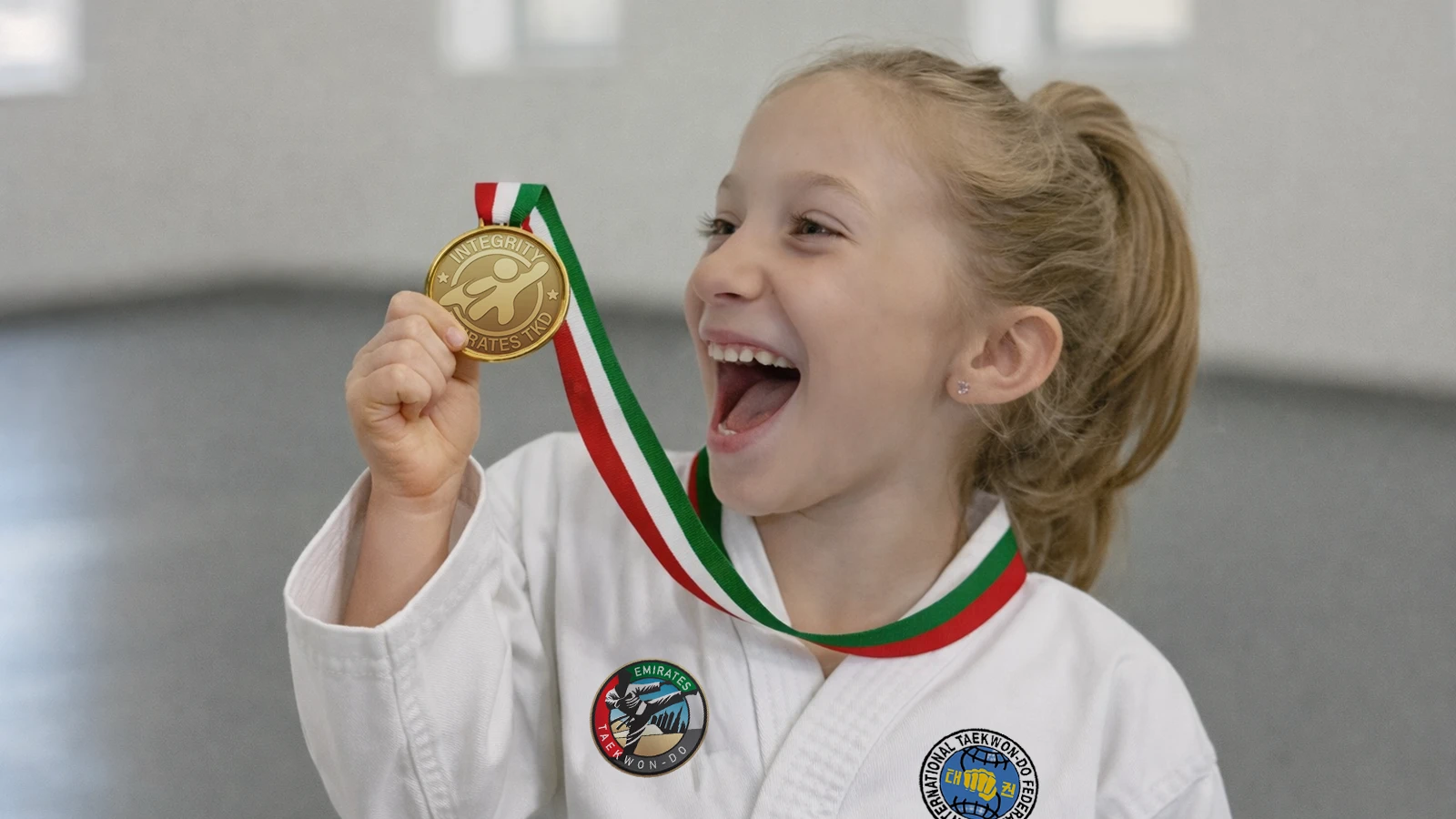
More than physical training
Traditional ITF Taekwon-Do is not only a system of physical techniques. According to the philosophy defined by General Choi Hong Hi, Taekwon-Do is also a method of mental, moral, and personal development.
For many children, training becomes a structured environment where they gradually develop confidence, emotional regulation, discipline, focus, respect, resilience, and social skills. The objective is not simply to create stronger children physically, but more balanced and capable young people overall.
At Emirates Taekwon-Do, instructors work to create a positive environment where children learn to challenge themselves safely while developing the Tenets of Taekwon-Do:
- Courtesy
- Integrity
- Perseverance
- Self-Control
- Indomitable Spirit
Helping hyperactive children develop focus
Hyperactive children often struggle with impulse control, attention regulation, emotional overstimulation, and maintaining focus for long periods.
Traditional ITF Taekwon-Do provides structured physical activity combined with discipline and repetition. Classes require students to:
- Listen carefully
- Follow sequences
- Control movement precisely
- Wait for instructions
- React at the correct moment
- Manage energy appropriately
The combination of movement, routine, physical exercise, and structured discipline often helps children gradually improve concentration, body awareness, patience, and self-regulation.
Rather than suppressing energy, Taekwon-Do teaches children how to channel it constructively.
Helping aggressive children develop self-control
One of the biggest misconceptions about martial arts is that they encourage aggression. Traditional ITF Taekwon-Do teaches the opposite.
Students are constantly taught that techniques must be controlled, respectful, and used responsibly. The philosophy of Taekwon-Do strongly emphasizes self-control and discipline.
Aggressive children often benefit from:
- Structured rules
- Clear boundaries
- Respectful authority
- Controlled physical activity
- Learning consequences
- Practicing emotional regulation
Through training, many students gradually learn how to control reactions, manage frustration, respect others, and use strength responsibly rather than impulsively.
Helping children deal with bullying
Bullying affects children emotionally, socially, and psychologically. Traditional ITF Taekwon-Do approaches bullying prevention through confidence, awareness, communication, discipline, and self-respect.
Students progressively develop:
- Confidence in body language
- Assertiveness
- Situational awareness
- Emotional resilience
- Respectful communication
- Self-defence skills appropriate to their age
Confident children are often less likely to become targets of bullying. At the same time, Taekwon-Do philosophy strongly discourages students from becoming bullies themselves.
Students are taught that martial arts are for protection, not intimidation or aggression.
Helping children with emotional frustration
Many children struggle with frustration when they fail, lose games, receive correction, or cannot immediately perform something successfully.
Traditional ITF Taekwon-Do naturally teaches emotional resilience because progress requires repetition, patience, correction, and continuous effort.
Students gradually learn:
- How to accept mistakes
- How to continue after failure
- How to receive correction respectfully
- How to improve through practice
- How to stay calm under pressure
This process helps many children develop healthier emotional responses to challenges both in training and in daily life.
Helping children improve social interaction
Classes require constant respectful interaction with instructors and classmates. Students practice:
- Partner drills
- Group exercises
- Leadership activities
- Teamwork
- Communication
- Respectful behavior
This environment often helps children improve social confidence, cooperation, empathy, and communication skills over time.
Teaching long-term discipline
One of the most valuable aspects of Traditional ITF Taekwon-Do is the gradual development of discipline through routine and consistency.
Students learn that improvement comes from:
- Regular practice
- Patience
- Respect
- Listening
- Persistence
- Self-control
The structured rank system reinforces the understanding that progress is earned progressively through effort and behavior, not instant reward.
Different children develop differently
Every child develops at a different pace. Some children show changes quickly while others require more time and consistency.
Traditional ITF Taekwon-Do is not a magical solution for every challenge. However, the combination of physical activity, structure, discipline, social interaction, goal progression, and positive mentorship can provide an extremely beneficial environment for many children during important developmental years.
The real objective
The ultimate objective of Traditional ITF Taekwon-Do is not simply creating stronger fighters. According to the philosophy of General Choi Hong Hi, the true purpose is developing better human beings through physical, mental, and moral education.
For many children, the confidence, discipline, emotional control, and resilience developed through Taekwon-Do extend far beyond the Dojang and positively influence school, friendships, family relationships, and daily life.
Helping shy children build confidence
Many shy children struggle with self-expression, social interaction, fear of failure, or anxiety in group environments. Traditional ITF Taekwon-Do helps gradually build confidence through small achievable challenges.
Students learn:
- How to speak clearly during class
- How to perform in front of others
- How to interact respectfully with partners
- How to handle mistakes without embarrassment
- How to progressively overcome fear
The structured progression system allows children to experience regular success through realistic goals. Over time, many shy students become more comfortable participating, communicating, and expressing themselves both inside and outside the Dojang.