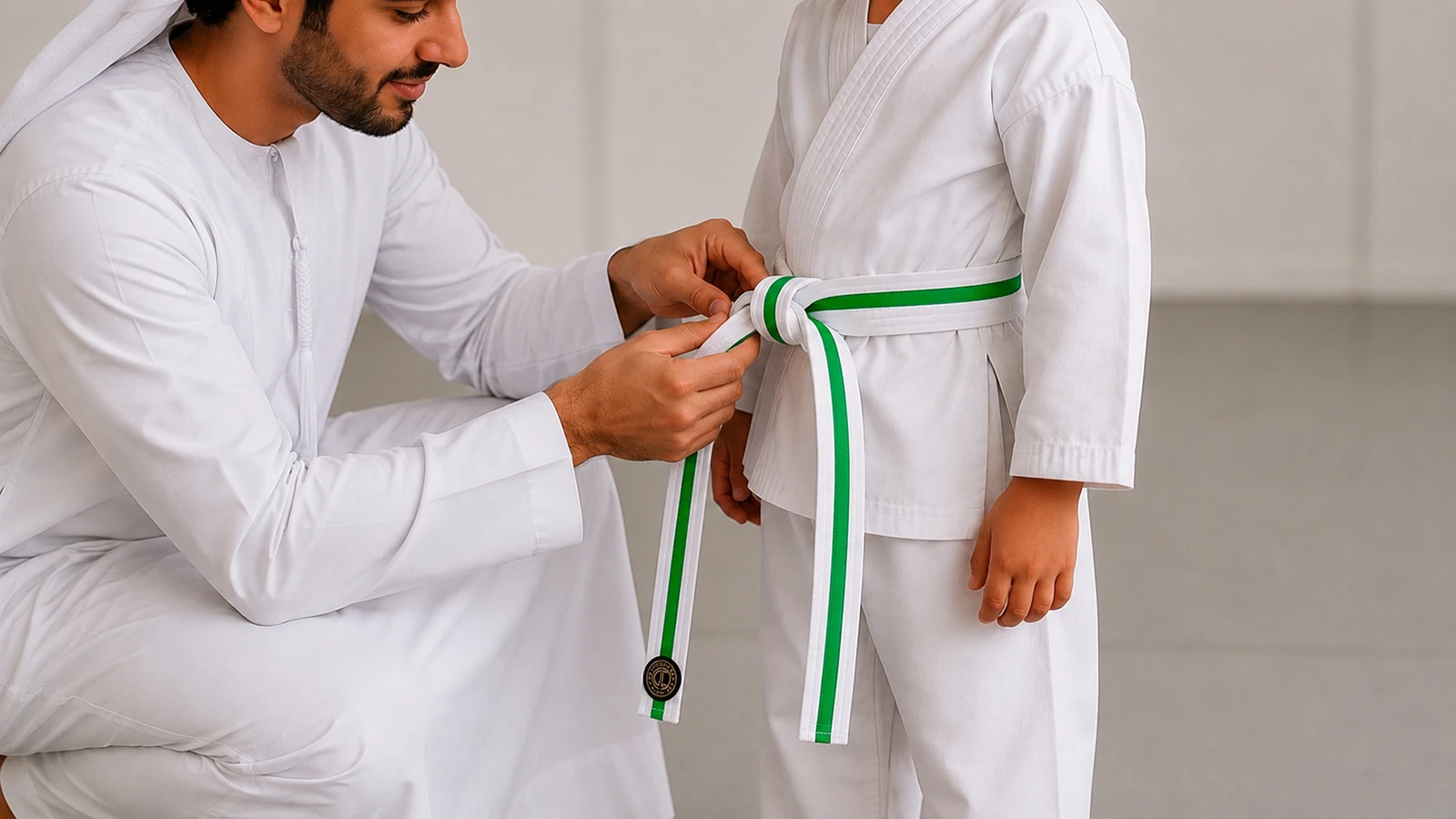
The green line stage
This learning is for children aged 3 to 6 who are training from White Belt with Green Line toward White Belt with Blue Line. At this stage, children begin developing more dynamic movement, stronger balance, and greater confidence using their bodies.
The introduction of jumping movements is an exciting milestone for many children. Jumping techniques naturally encourage enthusiasm, athletic development, confidence, and coordination. At the same time, children are learning how to control movement safely instead of simply moving with uncontrolled energy.
This stage also introduces the important life value of Perseverance. Children begin learning that improvement comes through repetition, patience, and continuing to try even after mistakes.
Technical requirements
For promotion to White Belt with Blue Line, students must demonstrate one new fundamental movement and one jumping kick.
- Walking Stance Inner Forearm Middle Block — Gunnun So An Palmok Kaunde Makgi
- Flying Front Kick
The walking stance inner forearm middle block teaches children how to control the arm and body together while protecting the middle area of the body. This movement develops coordination, posture, focus, and stability.
The flying front kick introduces jumping movement combined with kicking mechanics. Children learn how to jump safely, lift the knee correctly, maintain balance, and land under control. At this age, the purpose is not height or power. The goal is helping children become more comfortable moving dynamically while staying coordinated and disciplined.
Development focus
The main development focus for this stage is helping children improve balance and coordination during more athletic movement. Jumping techniques encourage children to explore how their body moves while building confidence and spatial awareness.
- Balance during jumping — controlling the body before, during, and after movement.
- Body awareness — understanding direction, posture, and positioning.
- Discovering athletic abilities — helping children become confident using their bodies.
- Coordination and timing — connecting movement, reaction, and control.
- Confidence during movement — overcoming hesitation and trying new challenges.
Children often feel excited and proud when learning flying techniques. This creates excellent opportunities to build self-esteem while teaching discipline and control at the same time.
Theory for this stage
The theory focus for this rank is the tenet of Perseverance, called In Nae. For young children, Perseverance means continuing to try even when something feels difficult.
- Never giving up — continuing even when a movement feels challenging.
- Continuing after mistakes — understanding that errors are part of learning.
- Trying again — building confidence through repetition and effort.
Children also learn the next Korean numbers: Yeodeol means 8, and Ahop means 9. In addition, students learn that the Taekwon-Do belt is called the Ti. These small theory lessons continue building familiarity with Taekwon-Do language and culture in a positive and manageable way.
How parents can help
Parents can support this stage by encouraging children to keep trying even when movements feel difficult. Jumping techniques sometimes require more balance and confidence than earlier beginner skills, so positive encouragement is extremely important.
Parents can safely review simple jumping movements at home, encourage children to count in Korean, or ask them to explain what Perseverance means. Praising effort, courage, and willingness to try is more important than correcting every technical detail.
This stage is also a good opportunity to help children understand that mistakes are normal. Children who learn to continue after failure often become more resilient, confident, and emotionally strong both inside and outside the Dojang.
Ready for blue line
A student becomes ready for White Belt with Blue Line when they can demonstrate the required movement and flying front kick with improving coordination and confidence while continuing to show respectful and positive behaviour in class.
Readiness at this age is measured through participation, effort, confidence, and control rather than perfect technique. Students should recognise Gunnun So An Palmok Kaunde Makgi, flying front kick, Yeodeol, Ahop, and Ti at a simple beginner level.
This stage helps children discover new physical abilities while continuing to strengthen confidence, coordination, and perseverance through positive training experiences.