
Exam overview
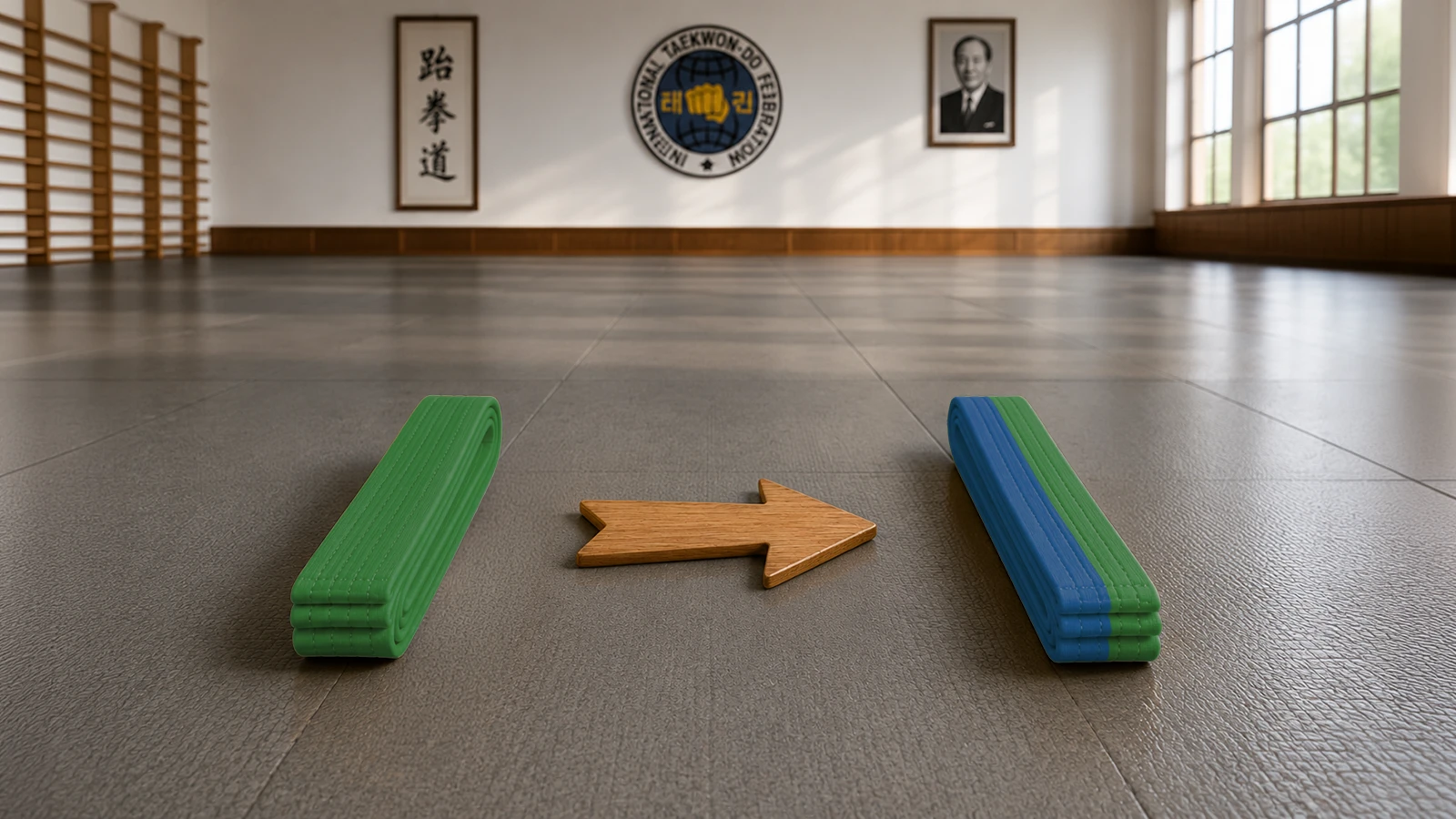
This syllabus is for Green Belt, 6th Gup students preparing for promotion to Green-Blue Belt, 5th Gup. It gives students one clear online reference for the exam areas they must practise and study before grading.
The exam areas for this level are fundamental movements, the kick, pattern, and theory. Students should be able to demonstrate the required movements with correct stance, correct tool, accurate direction, balance, and control. They must also know the required pattern, Won-Hyo Tul, including its number of movements and meaning. At this level, the student should show more maturity in posture, preparation, terminology, and the connection between individual techniques and the wider composition of Taekwon-Do.
Green-syllabus.pdf
Open PDFFundamental movements
The first exam area is fundamental movements. These are the specific techniques that green belt students must practise before promotion to green-blue belt. They introduce more advanced stance control and require the student to understand how stance, tool, height, direction, and technique type work together.
- L-Stance Knife-hand High Inward Strike — Niunja So Sonkal Nopunde Anuro Taerigi
- Bending Ready Stance A — Goobooryo Junbi Sogi A
- Fixed Stance Middle Punch — Gojung So Kaunde Jirugi
Students should practise these movements slowly first, then with clearer rhythm and confidence. The examiner should see a stable stance, correct preparation, correct line of movement, and a precise final position.
Technique details
In Niunja So Sonkal Nopunde Anuro Taerigi, the stance is L-stance, the tool is knife-hand, the height is high, the direction is inward, and the technique type is strike. Do not reduce the name to only knife-hand strike. The full name tells the student exactly how the movement should be organised.
Goobooryo Junbi Sogi A, bending ready stance A, requires balance and leg control. The body must remain upright and stable while the student prepares for kicking. Do not lean excessively or rush the position. In Gojung So Kaunde Jirugi, fixed stance middle punch, students must show a strong fixed stance and a clean middle punch. The punch should finish on the correct line without twisting the stance or lifting the shoulders.
The kick
The required kick for this exam is Back Piercing Kick, called Dwit Chagi. Students must practise it with strong balance, clear chamber, correct direction, and controlled recovery. The kick should travel directly to the rear line and should not become a loose backward swing.
When practising, begin slowly. Check the target line first, chamber the leg, align the hip and body, extend the kick with purpose, retract the leg, and land safely. A correct back piercing kick requires trust in body alignment and good control of the supporting leg. Height is not the main objective. The examiner should see that the student can kick backward with accuracy, stability, and discipline while maintaining awareness of direction and recovery.
Pattern requirement
The required pattern is Won-Hyo Tul. Won-Hyo has 28 movements. Students must know the pattern name, number of movements, starting position, sequence, direction changes, diagram, and correct finishing point.
Won-Hyo introduces movements that require stronger balance and more precise coordination, including L-stance knife-hand high inward strike, bending ready stance A, fixed stance middle punch, and back piercing kick preparation. The pattern should not be performed as a memory race. Each movement should show correct stance, preparation, breathing, tool, height, direction, and finish. Practise slowly until the sequence is reliable, then practise with exam timing. If the student loses direction, slow down and rebuild the pattern section by section.
Meaning of Won-Hyo
Students must memorise the meaning of Won-Hyo exactly as follows:
WON-HYO: Was the noted monk who introduced buddhism to the Silla dynasty in the year of 686 A.D.
This meaning should be learned word by word. During the theory section of the exam, students should be able to say it clearly, without changing the name, historical reference, dynasty, or year. A short and accurate answer is better than a long answer with mistakes. Students should also understand that each Tul has a name, meaning, movement count, diagram, and purpose within the student’s progression. Won-Hyo represents a new stage where the student’s movement, memory, and theory must become more organised.
Composition of Taekwon-Do
The theory for this grade includes the composition of Taekwon-Do. Students should know that Taekwon-Do is composed of five connected areas:
- Fundamental movements.
- Patterns.
- Face to face training.
- Training with accessories.
- Self-defense and sparring.
These areas are not separate subjects. They work together. Fundamental movements are needed for both patterns and sparring. Patterns and sparring help perfect the fundamental movements. Face to face training helps students master techniques and test what they have learned through patterns. Training with accessories develops stamina, focus, resistance, and power. Self-defense and sparring combine the other areas into practical application.
How areas connect
Students should understand why the composition of Taekwon-Do matters. A movement practised alone is a fundamental movement. The same movement placed into a fixed sequence becomes part of a pattern. When practised with a partner, it becomes face to face training or sparring preparation. When developed with pads, targets, or other training equipment, it becomes training with accessories.
This means the student should not treat Won-Hyo Tul, fundamental movements, and kicking as disconnected exam items. The L-stance, fixed stance, bending ready stance, and back piercing kick all help develop useful body control. The aim of this grade is to show that the student can connect technique, theory, and practical training. A green belt student should begin to see Taekwon-Do as a complete system, not only a list of techniques to memorise.
Exam checklist
Before the exam, students should check that they can demonstrate every area from this syllabus. They should practise Niunja So Sonkal Nopunde Anuro Taerigi, Goobooryo Junbi Sogi A, Gojung So Kaunde Jirugi, Dwit Chagi, and Won-Hyo Tul with 28 movements.
Students should also be able to recite the meaning of Won-Hyo exactly and explain the composition of Taekwon-Do: fundamental movements, patterns, face to face training, training with accessories, and self-defense and sparring. On exam day, wear a clean Dobok, tie the belt correctly, bow properly, listen carefully, and correct mistakes without frustration. Promotion to Green-Blue Belt, 5th Gup should show stronger control, clearer terminology, better memory, and a deeper understanding of Taekwon-Do as a complete martial art.