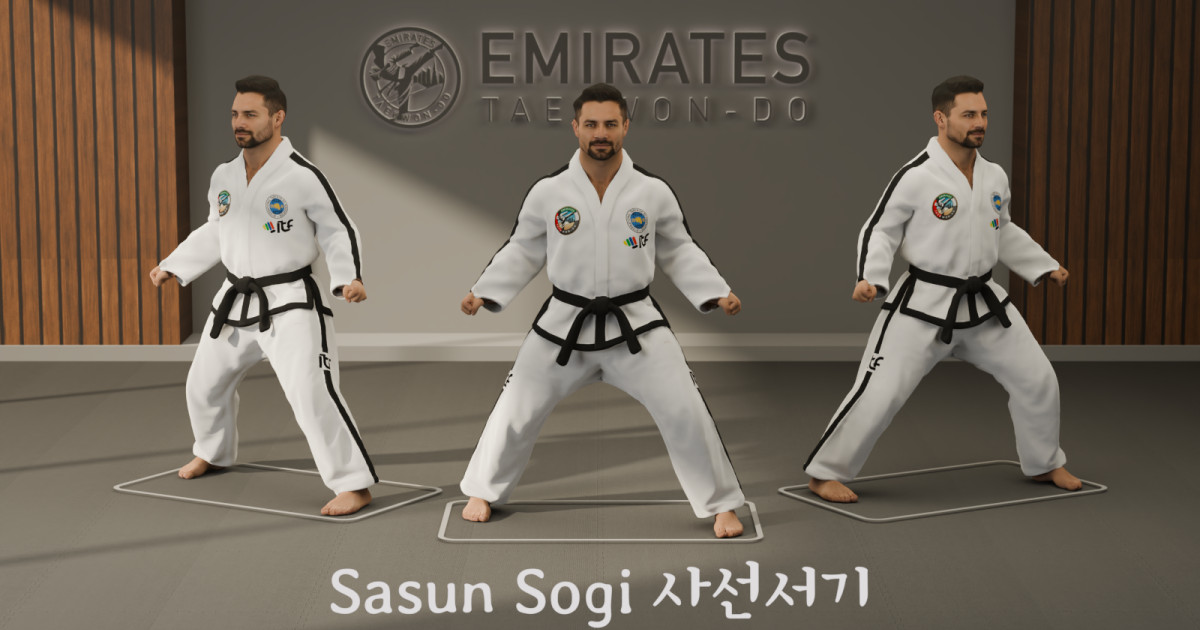

Technical purpose
Diagonal Stance, called Sasun Sogi in Korean terminology, is an ITF Taekwon-Do stance used for attacking and defending against the front or rear. It is especially useful for shifting into Walking Stance without relocating the foot. This makes it a practical transitional stance when the practitioner must change structure efficiently while keeping the foot placement controlled.
The principle of Sitting Stance is directly applied to Diagonal Stance, except for one important change: the heel of the front foot is placed on the same line with the toes of the rear foot. This creates the diagonal relationship between the feet while keeping the strong bent-knee base associated with Sitting Stance.
This article is a technical reference. It focuses on the stance measurement, foot alignment, weight distribution, knee position, facing options, right and left naming rule, and common technical errors.
Relationship with Sitting Stance
Diagonal Stance uses the same basic lower-body principle as Sitting Stance. The stance is wide, stable, and grounded, with both knees bent and the body weight distributed equally. The feet remain parallel and point straight forward.
The difference is the foot offset. In Sitting Stance, both feet are even on the same line. In Diagonal Stance, the heel of the front foot is placed on the same line with the toes of the rear foot. This offset gives the stance its diagonal structure and allows the practitioner to shift into Walking Stance without relocating the foot.
Students should therefore avoid treating Diagonal Stance as a completely unrelated stance. It is best understood as a Sitting Stance principle adapted into a diagonal foot relationship. The knees, weight, and general base remain similar, but the foot placement changes the stance application.
Foot alignment
| Foot position | Correct standard |
|---|---|
| Front foot | Placed forward in the diagonal relationship |
| Rear foot | Placed behind in the diagonal relationship |
| Alignment rule | The heel of the front foot is on the same line with the toes of the rear foot |
| Foot angle | Both feet point straight forward at 0 degrees |
| Parallel feet | The feet remain parallel, following the Sitting Stance principle |
Right and left naming rule
Diagonal Stance is named according to the advanced foot. When the right foot is advanced, the stance is called a right diagonal stance. When the left foot is advanced, it is called a left diagonal stance.
This naming rule is important because the stance is not named by the hand position, the direction of the eyes, or the side of the technique. First identify which foot is advanced in the diagonal relationship, then name the stance as right or left.
For example, if the right foot is the front or advanced foot, the stance is right Sasun Sogi. If the left foot is the front or advanced foot, the stance is left Sasun Sogi. This rule should be checked when practicing patterns because an incorrect foot relationship can change the stance name and the technical meaning of the movement.
Full facing and side facing
Diagonal Stance can be either full facing or side facing. Both are used for attack and defense. In full facing, the shoulders and hips are squared toward the direction of the technique. In side facing, the body turns sideways while the lower-body structure remains unchanged.
The facing should not change the stance measurement or the foot relationship. The stance remains 1.5 shoulder widths wide, the feet remain parallel, and the heel of the front foot remains aligned with the toes of the rear foot.
A common mistake is to change the lower body when changing the facing. The student may turn the feet outward, narrow the stance, or remove the diagonal offset. This changes the technical character of Sasun Sogi. Only the body orientation changes; the stance itself must remain measured and stable.
Shifting into Walking Stance
One of the main practical values of Diagonal Stance is that it is useful for shifting into Walking Stance without relocating the foot. Because the front heel is already positioned on the same line with the rear toes, the practitioner can adjust the body and stance relationship efficiently when the next movement requires Walking Stance.
This does not mean the stance should be performed casually or halfway between two positions. Diagonal Stance is a complete stance with its own measurement, foot alignment, and use. Its usefulness for shifting does not reduce its technical precision.
When practicing this transition, students should check that they are not dragging, hopping, or resetting the foot unnecessarily. The purpose of Sasun Sogi is to allow efficient structural change while maintaining control of the base.
Reference checklist
| Check | Correct standard |
|---|---|
| Stance | Diagonal Stance (Sasun Sogi) |
| Width | 1.5 shoulder widths |
| Core principle | Sitting Stance principle applied with diagonal foot offset |
| Foot offset | Heel of the front foot on the same line with the toes of the rear foot |
| Weight | 50% front leg and 50% rear leg |
| Feet | Parallel and pointing straight forward |
| Knees | Bent outward over the balls of the feet |
| Naming rule | Named by the advanced foot |
| Facing options | Full facing or side facing |
| Main use | Attack and defense against the front or rear |
Common technical errors
A common error is placing the feet evenly as in Sitting Stance. Diagonal Stance uses the Sitting Stance principle, but the feet are not placed evenly. The heel of the front foot must be on the same line with the toes of the rear foot.
Another error is using the wrong width. The stance should be 1.5 shoulder widths. If the stance becomes too narrow, it loses the strong sitting-stance base. If it becomes too wide, the knees and hips may become difficult to control.
Students also commonly turn the toes outward. The feet should remain parallel and point straight forward. Turning the toes outward changes the lower-body structure and can disturb the knee line.
Another frequent error is naming the stance by the wrong foot. The stance is named by the advanced foot. When the right foot is advanced, it is a right diagonal stance. When the left foot is advanced, it is a left diagonal stance.
The final error is changing the stance when changing the facing. Sasun Sogi may be full facing or side facing, but the lower-body structure must remain the same. The stance should remain measured, parallel, offset, equally weighted, and ready for attack, defense, or shifting into Walking Stance.
Key principle
Diagonal Stance applies the Sitting Stance principle, but offsets the feet so the front heel is on the same line as the rear toes.
Technique identity
| Item | Technical reference |
|---|---|
| Stance name | Diagonal Stance |
| Korean terminology | Sasun Sogi |
| Stance family | Taekwon-Do stance, or Sogi |
| Main use | Attacking and defending against the front or rear |
| Transitional value | Useful for shifting into Walking Stance without relocating the foot |
| Core principle | Sitting Stance principle with diagonal foot offset |
| Facing options | Full facing or side facing |
Main stance dimensions
| Reference point | Technical requirement |
|---|---|
| Width | 1.5 shoulder widths |
| Length | No long front-to-back stance length, but the feet are offset diagonally |
| Foot offset | The heel of the front foot is placed on the same line with the toes of the rear foot |
| Weight distribution | 50% on the front leg and 50% on the rear leg |
| Foot direction | Both feet point straight forward and remain parallel |
| Knee position | Both knees are bent outward over the balls of the feet |