
Technical purpose
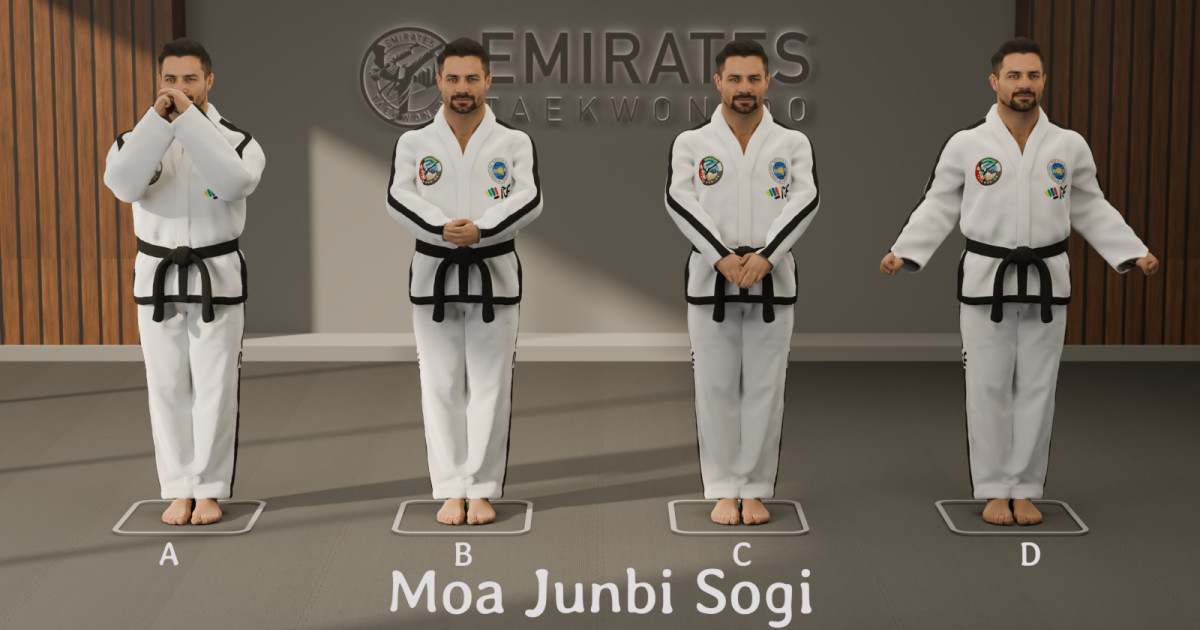
Close Ready Stance, called Moa Junbi Sogi in Korean terminology, is a formal ITF Taekwon-Do ready stance used before specific movements in patterns and fundamental exercises. It is based on Close Stance, with the feet together and the body held upright, controlled, and ready.
Moa Junbi Sogi is generally classified into Type A, Type B, Type C, and Type D. The main difference between the types is the position of the hands or fists in relation to the face, navel, abdomen, or thigh.
Key principle
Close Ready Stance keeps the body still and centered while the hands or fists are positioned according to the required type: A, B, C, or D.
Base stance structure
| Reference point | Correct standard |
|---|---|
| Stance name | Close Ready Stance (Moa Junbi Sogi) |
| Base stance | Close Stance (Moa Sogi) |
| Width | No width |
| Length | No length |
| Foot position | Feet together |
| Weight distribution | 50% on the left leg and 50% on the right leg |
| Legs | Straight and controlled |
| Body posture | Upright, centered, and calm |
Types A, B, C, and D
| Type | Key measurement | Reference point |
|---|---|---|
| Type A | About 30 cm | Distance between the philtrum and the fists |
| Type B | About 15 cm | Distance between the fists and the navel |
| Type C | About 10 cm | Distance between the hands and the abdomen |
| Type D | About 30 cm | Distance between the fists and the thigh |
Type A
Moa Junbi Sogi Type A is performed from Close Stance with the fists positioned in front of the upper body. The important reference is the distance between the philtrum and the fists, which is about 30 centimeters.
The body should remain upright and still. The elbows and shoulders should not be lifted with unnecessary tension. The fists must be positioned deliberately, not held casually or too close to the face.
Type B
Moa Junbi Sogi Type B is performed from Close Stance with the fists positioned lower than Type A. The key measurement is the distance between the fists and the navel, which is about 15 centimeters.
The stance remains closed, balanced, and upright. The fists should not press into the body, and they should not drift too far away from the required navel reference.
Type C
Moa Junbi Sogi Type C uses a hand position closer to the abdomen. The distance between the hands and the abdomen is about 10 centimeters.
The student should keep the shoulders relaxed and the body centered. The hands should be placed with control, maintaining the required distance without collapsing the posture or pulling the elbows too far back.
Type D
Moa Junbi Sogi Type D is performed with the fists positioned near the lower body. The key measurement is the distance between the fists and the thigh, which is about 30 centimeters.
The position should still show readiness and control. The arms should not hang loosely, and the fists should not be placed without reference to the thigh distance. The stance remains a formal ready stance, not a relaxed standing posture.
Reference checklist
| Check | Correct standard |
|---|---|
| Stance | Close Ready Stance (Moa Junbi Sogi) |
| Classification | Types A, B, C, and D |
| Base | Close Stance, with feet together |
| Width | No width |
| Length | No length |
| Type A | Philtrum to fists: about 30 cm |
| Type B | Fists to navel: about 15 cm |
| Type C | Hands to abdomen: about 10 cm |
| Type D | Fists to thigh: about 30 cm |
| Posture | Upright, centered, and controlled |
Common technical errors
A common error is treating all Close Ready Stance types as the same. Types A, B, C, and D are distinguished by their hand or fist distance from specific body reference points.
Another error is losing the Close Stance base. Moa Junbi Sogi has no width and no length. The feet should remain together, the body weight should stay balanced equally, and the legs should remain straight.
Students also commonly place the hands by appearance instead of measurement. Type A uses the philtrum as the reference, Type B uses the navel, Type C uses the abdomen, and Type D uses the thigh.
The final error is unnecessary shoulder tension. A ready stance should show concentration and control, not stiffness. The body should be calm, centered, and prepared for the next movement.