How to use this guide
This learning is a practical reference for students who need to understand the basic Korean terminology used in ITF Taekwon-Do classes, gradings, and competitions. Students do not need to speak Korean fluently, but they should recognise the most common words used by instructors, examiners, and umpires.
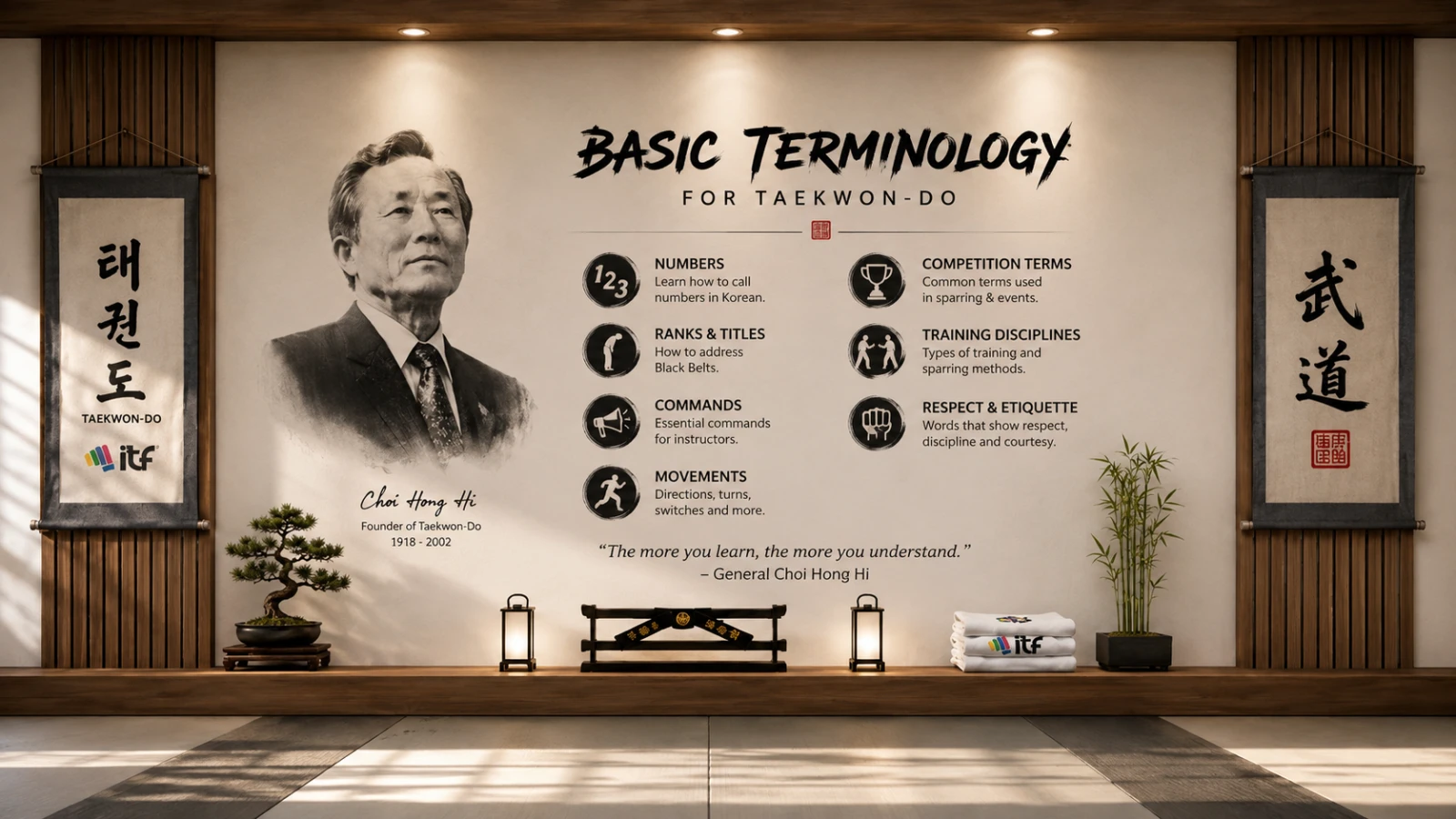
The terms are organised into clear categories: numbers, black belt titles, basic class commands, movement commands, competition terminology, and training disciplines. Students should review these words regularly and practise saying them clearly. Correct terminology helps students follow instructions faster, show respect for Taekwon-Do tradition, and prepare more confidently for exams.
Korean numbers
Numbers are used constantly in class for warm-ups, drills, stretching, exercises, and patterns. The cardinal numbers are the common counting words used during training. The original numbers are also included because students may see or hear them in other Taekwon-Do contexts.
- One — Hana
- Two — Dul
- Three — Set
- Four — Net
- Five — Daseot
- Six — Yeoseot
- Seven — Ilgob
- Eight — Yeodeol
- Nine — Ahop
- Ten — Yeol
For most beginner classes, students should first memorise Hana, Dul, Set, Net, Daseot, Yeoseot, Ilgob, Yeodeol, Ahop, Yeol.
Black belt titles
Students should know how to address senior grades with respect. These titles are part of correct Dojang etiquette and help students understand the difference between rank, responsibility, and role.
- Grand Master — Sa Seong — 사성
- Master — Sa Hyun — 사현
- Instructor — Sa Bum — 사범
- Assistant Instructor — Bo Sa Bum — 부사범
- Examiner — Sim Sa Guan — 심사관
In class, students should follow the etiquette used by their instructor and school. When unsure, it is better to speak respectfully and ask than to use a title casually. Respectful language is part of Taekwon-Do training.
Basic class commands
These commands are used frequently during class and grading. Students should recognise them immediately and respond without delay.
- Attention — Charyot
- Bow — Kyong-Ye
- Ready — Junbi
- Return — Baro
- At ease — Swiyo
- In your own time — Kooryong-Opshi
- By count — Kooryongy-Macho
These words help organise the class. For example, Charyot brings the student to attention, Kyong-Ye gives the command to bow, and Junbi tells the student to prepare. Students should practise responding calmly and accurately.
Instructor commands
These commands are commonly used when an instructor is leading exercises, patterns, or drills. Students should learn both the English meaning and Korean term.
- Start — Si Jak — 시작
- Once — Han Beon — 한 번
- Twice — Dubeon — 두 번
- To repeat — Dasi — 다시
- Stop — Guman — 그만
- Dismiss — Hae San — 해산
- Moving in steps — Omgyo — 옮겨
- Turns — Dolgi — 돌기
These words are especially useful during fundamental movements and patterns. For example, Si Jak begins the action, Guman stops it, and Dasi asks the student to repeat.
Movement commands
Movement commands help students understand direction, turning, and switching during class. These are useful in fundamental movements, line work, sparring drills, and pattern practice.
- To go forward — Jilleogagi — 찔러가기
- To go back — Dwilo Gagi — 뒤로가기
- To turn left — Jwalo Dola — 좌로 돌아
- To turn right — Ulo Dola — 우로 돌아
- To turn 180° — Dwilo Dola — 뒤로 돌아
- Switch sides — Bukkwo — 바꿔
- Switch hands — Son Bukkwo — 손 바꿔
- Switch feet — Bal Bukkwo — 발 바꿔
Students should listen carefully before moving. Correct direction is part of good discipline, especially when practising patterns or working with a partner.
Competition terms one
These competition terms are useful for students who attend tournaments, watch sparring, or prepare for umpire-related terminology. They help students understand referee commands and match decisions.
- Red — Hong — 홍
- Blue — Chong — 청
- Separate or break — Haechyo — 해쳐
- Continue — Gaesok — 계속
- One warning — Ju Ui Hana — 주의 하나
- One foul — Gam Jum Hana — 감점 하나
- Time — Sigan — 시간
- To stop the clock — Jung-Ji — 정지
Students do not need to be umpires to learn these words. Knowing them helps competitors respond correctly and understand what is happening during a match.
Competition terms two
These terms describe results and competition categories. They are commonly used in tournament organisation and match control.
- Winner — Sung — 승
- First round — Il He Jon — 일회전
- Second round — Yi He Jon — 이회전
- Third round — Sam He Jon — 삼회전
- Disqualify — Sil Kyuk — 실격
- Individual competition — Gein Jeon — 개인전
- Team competition — Danchejeon — 단체전
Competition terminology should be learned with the same discipline as technical terminology. It helps students become more confident competitors and more respectful participants at events.
Training disciplines one
Training disciplines describe the main areas practised in Taekwon-Do. Students should know these terms because they appear in grading requirements and class instructions.
- Pattern — Tul — 틀
- Sparring — Matsogi — 맞서기
- 3-Step Sparring — Sambo Matsogi — 삼보 맞서기
- 2-Step Sparring — Ibo Matsogi — 이보 맞서기
- 1-Step Sparring — Ilbo Matsogi — 일보 맞서기
A Tul is a pattern. Matsogi means sparring. Step sparring is structured partner training, used to develop distance, timing, accuracy, and control before more advanced free sparring.
Training disciplines two
These terms complete the main training discipline vocabulary. They are especially useful for students progressing through higher grades and preparing for competition or black belt training.
- Pre-arranged free sparring — Yaksok Matsogi — 약속 맞서기
- Semi free sparring — Ban Jayu Matsogi — 반자유 맞서기
- Free sparring — Jayu Matsogi — 자유 맞서기
- Self-defence — Hoo Sin Sool — 호신술
- Power breaking — Geeog Pa — 격파
- Special techniques — Tukki — 특기
Each discipline develops a different part of Taekwon-Do. Patterns build technical structure, sparring develops timing and distance, self-defence applies practical responses, power breaking tests focused power, and special techniques develop athletic skill and precision.
Study checklist
Students should use this article as a quick study checklist before class, grading, and competition. Begin with numbers one to ten, then memorise the basic class commands. After that, study instructor commands, movement commands, competition terminology, and training disciplines.
A good student does not only memorise words. A good student connects each word to action. When the instructor says Charyot, stand at attention. When the instructor says Kyong-Ye, bow. When practising Tul, understand that it means pattern. When practising Matsogi, understand that it means sparring. Correct terminology creates better understanding, faster response, and stronger respect for the ITF Taekwon-Do system.